Correcting Color Blindness With DLP Projectors

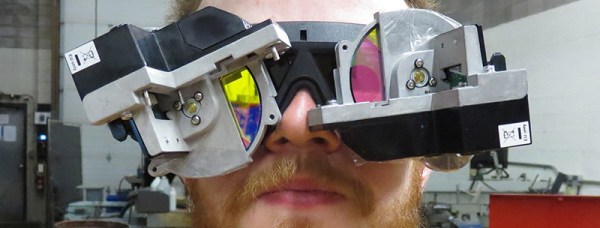
About five percent of the population is colorblind to one degree or another, and for them seeing the entire spectrum from Roy to Biv is simply impossible. Their eyes simply don’t have the cones to detect certain colors. The brain is the weirdest machine on the planet, though, and with the right tricks of light, even the colorblind can see more colors than they’re accustomed to. That’s the idea behind [PointyOintment]’s entry for the 2016 Hackaday Prize: color blindness correcting goggles.

Any device that claims to correct color blindness comes with a few caveats and a slightly loose interpretation of what ‘color blindness correcting’ actually is. For the same reason you can’t see deep infrared, someone with color blindness cannot distinguish between two colors; the eye simply doesn’t have the sensors to see a specific color of light. This doesn’t mean the ability to distinguish color in color blind individuals can’t be improved, though. The EnChroma glasses use an optical notch filter to block all colors between blue and green, and between green and red. This works, because the human brain is weird enough and can adapt to nearly anything.

[PointyOintmen] isn’t going with an optical notch filter. He’s using spinning color discs from a DLP projector and 3D ‘shutter’ glasses to present the world in different shades of color many times a second. It’s weird, untested, and will take a few hours to get used to, but it is a very interesting idea. Will it allow color blind people to see more colors? That’s a semantic issue, but if you define ‘seeing color’ as being able to differentiate between two different colors, yes, it will.


The Hacker’s Notebook: A Mission Log For Every Project

While “writing it down” might seem like common sense, it wasn’t always the case. From the times of Ancient Greece, Plato tells a story of a worried Egyptian King, who, upon witnessing the invention of writing, remarks,

“If men learn this, it will implant forgetfulness in their souls; they will cease to exercise memory because they rely on that which is written, calling things to remembrance no longer from within themselves, but by means of external marks. [1]”

To some, the notebook was a dangerous device, a thief that would rob us of our memories [2]. Fortunately, these days, there’s plenty of evidence from our Psych texts that say we humans are pretty shabby at keeping the facts straight. In fact, each time we recall a memory, we change it! Here lies the beauty of the notebook. Have an idea for a new project? Why not log it somewhere for future reference? With diligence, the notebook can become our own personal hub for spurring on new project ideas.

Continue reading “The Hacker’s Notebook: A Mission Log For Every Project” →

Just When You Thought Magnets Weren’t Magic; Magnets Are Mechanisms

This is magic, big news, both, or neither. It’s so exciting to see magnets behave in this bizarre and wonderful way that we think it’s hard to forecast where this will go. Shown above is a pair of magnets that have several modes of operation. They attract each other, but repel when less than a centimeter apart. However, give one a twist and the two will strongly attract.

The behavior is thanks to a new process of 3D printing magnets to manipulate where the fields occur. With the behavior just described, they would function well as a cabinet latch which has soft close and positive lock, all built into two magnets.

This comes from one of our favorite YouTube channels, [SmarterEveryDay], who just toured Polymagnet — a company that has figured out how to actually print magnetic fields.

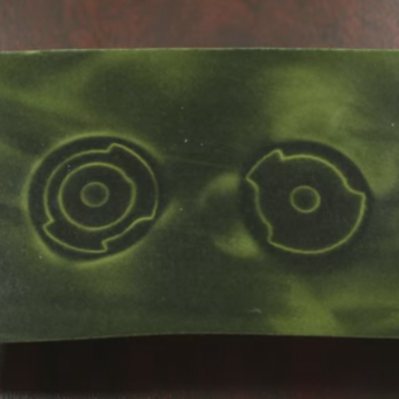
3dprinted-magnets-thumbSo how the heck does it work? Well, your standard magnet has a north face on one side, and a south face on the other — creating a magnetic loop between the two. But what if you could put north and south on the same side of the magnet, and vary their position and size? It means you can control the magnetic field down to the magnetic pixel, or as Polymagnet calls them — a Maxel.


Here you can see some magnetic film (which reacts visually to magnetic fields) put on top of the two parts of the demo magnet. The printed design is very similar to a mechanical mechanism. We’d explain more, but [Destin] does a great job teaching about the tech in the video found below.

Is this the dawn of magnetic mechanisms? We certainly have never seen anything like it.

Continue reading “Just When You Thought Magnets Weren’t Magic; Magnets Are Mechanisms” →

Ask Hackaday MRRF Edition: 3D Printers Can Catch Fire

[Jay] out of the River City Labs Hackerspace in Peoria, IL cleared out a jam in his printer. It’s an operation most of us who own a 3D printer have performed. He reassembled the nozzle, and in a moment forgot to tighten down the grub nut that holds the heater cartridge in place. He started a print, saw the first layer go down right, and left the house at 8:30 for work. When he came back from work at 10:30 he didn’t see the print he expected, but was instead greeted by acrid smoke and a burnt out printer.

The approximate start time of the fire can be guessed by the height of the print before failure.

As far as he can figure, some time at around the thirty minute mark the heater cartridge vibrated out of the block. The printer saw a drop in temperature and increased the power to the cartridge. Since the cartridge was now hanging in air and the thermistor that reads the temperature was still attached to the block, the printer kept sending power. Eventually the cartridge, without a place to dump the energy being fed to it, burst into flame. This resulted in the carnage pictured. Luckily the Zortrax is a solidly built full metal printer, so there wasn’t much fuel for the fire, but the damage is total and the fire could easily have spread.

Which brings us to the topics of discussion.

How much can we trust our own work? We all have our home-builds and once you’ve put a lot of work into a printer you want to see it print a lot of things. I regularly leave the house with a print running and have a few other home projects going 24/7. Am I being arrogant? Should I treat my home work with a lesser degree of trust than something built by a larger organization? Or is the chance about the same? Continue reading “Ask Hackaday MRRF Edition: 3D Printers Can Catch Fire” →

Exercise Wheel Tracks Kitty’s Fitness Goals

A few weeks ago [Jasper Ruben] built his cats a jumbo size hamster exercise wheel. They seemed to like it, so he decided to up the ante and upgrade it. The wheel now features a Raspberry Pi which can track speed, calculate distance traveled, and determine the equivalent running speed of [Jasper’s] feline companions.

To calculate the speed of the wheel, [Jasper] is using a small coil sensor (similar to how bicycle speedometers work). Six nails in the wheel trigger the sensor. Once the data is on-board the Pi, some simple calculations allow [Jasper] to provide a few different metrics on how effective the cat exercise is. A webcam sends a live stream of the wheel online with a data overlay for your viewing pleasure.

The really cool part is that this setup lets [Jasper] track when (and if) the cats actually use the exercise wheel. So far it seems like they use it about six times a day, with an average of a minute per walk — typically early in the morning between 5 and 8AM. That’s better than some of our own exercise habits!

Continue reading “Exercise Wheel Tracks Kitty’s Fitness Goals” →

Anti-Hack: Free Automated SSL Certificates

You want to put your credit card number into a web site. You know to look for a secure web site. But what does that really prove? And now that so many electronic projects have Web servers (ok, I’ll say it… the Internet of Things), do you need to secure your web server?

There was a time when getting a secure certificate (at least one that was meaningful) cost a pretty penny. However, a new initiative backed by some major players (like Cisco, Google, Mozilla, and many others) wants to give you a free SSL certificate. One reason they can afford to do this is they have automated the verification process so the cost to provide a certificate is very low.

Continue reading “Anti-Hack: Free Automated SSL Certificates” →

Standard Resistor Teardowns

What do you do, when you want an ohm? What is an ohm, for that matter? Take a wander over to the textbook definitions, and you’re soon deep in a world of coulombs and parallel infinite planes one meter apart in a vacuum that you probably only half remember from your high school physics class. It’s hard work, this metrology lark.

Of course, you can just order a resistor. A few cents each when you’re buying small quantities or much less when you’re buying a reel of five thousand, and there you have it. An ohm. Only it’s not really an ohm, more like nearly an ohm. Within 1% of an ohm is pretty good, but Vishay or Bourns or whoever don’t have the margins to get philosophical about those infinite planes when you’re only giving them a few cents.

When you REALLY want an ohm, you buy a standard resistor, and you pay a more significant sum. You’re never going to wire one of these up to bias a transistor or drive an LED, instead it’s about as close as it’s possible to get on your bench to the value it says on the box and you can use it for calibration purposes. PPM figures well in excess of the resolution of even superior DMMs sound pretty good to us!

[Zlymex] was curious about standard resistors, so performed a teardown of a few to see what they contain. And after a pithy explanation of the terms involved he’s managed to look inside quite a few of them.

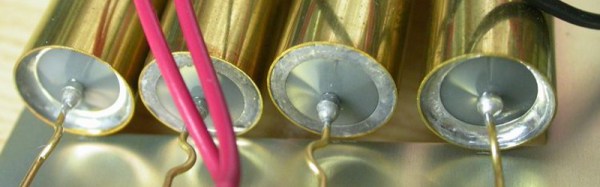
Inside he finds hermetically sealed wire-wound resistors, some oil-filled wire-wound resistors, and the occasional hefty piece of manganin. He also tears down some of the hermetically sealed resistors themselves, finding both wire-wound and foil resistance elements within.

It is a curious obsession that permeates hacker culture, that of standard measurements, and it’s one we’ve covered quite a few times here. Time enthusiasts with atomic clocks like this rather beautiful discrete logic build, or voltage enthusiasts with their temperature compensated references or programmable standards. Surprisingly though, this appears to be the first time we’ve looked at standard resistors.

Thanks [David Gustafik] for the tip.