Why Super Mario 64 Wastes So Much Memory

The Nintendo 64 was an amazing video game console, and alongside consoles like the Sony PlayStation, helped herald in the era of 3D games. That said, it was new hardware, with new development tools, and thus creating those early N64 games was a daunting task. In an in-depth review of Super Mario 64’s code, [Kaze Emanuar] goes over the curious and wasteful memory usage, mostly due to unused memory map sections, unoptimized math look-up tables, and greedy asset loading.

The game as delivered in the Japanese and North-American markets also seems to have been a debug build, with unneeded code everywhere. That said, within the context of the three-year development cycle, it’s not bad at all — with twenty months spent by seven programmers on actual development for a system whose hardware and tooling were still being finalized, with few examples available of how to do aspects like level management, a virtual camera, etc. Over the years [Kaze] has probably spent more time combing over SM64‘s code than the original developers, as evidenced by his other videos.

As noted in the video, later N64 games like Legend of Zelda: Ocarina of Time are massively more optimized and streamlined, as lessons were learned and tooling improved. For the SM64 developers, however, they had a gargantuan 4 MB of fast RDRAM to work with, so optimization and memory management likely got kicked down to the bottom on the priority list. Considering the absolute smash hit that SM64 became, it seems that these priorities were indeed correct.

Continue reading “Why Super Mario 64 Wastes So Much Memory”

Pong Cloned By Neural Network

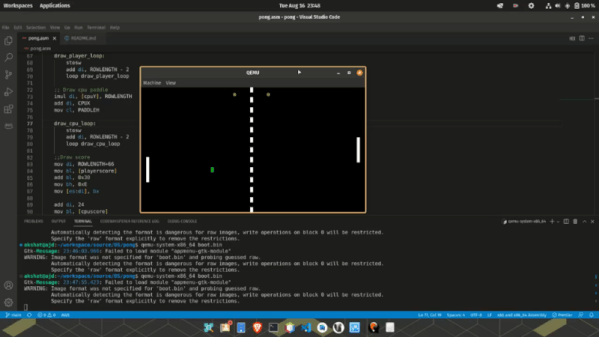
Although not the first video game ever produced, Pong was the first to achieve commercial success and has had a tremendous influence on our culture as a whole. In Pong’s time, its popularity ushered in the arcade era that would last for more than two decades. Today, it retains a similar popularity partially for approachability: gameplay is relatively simple, has hardwired logic, and provides insights about the state of computer science at the time. For these reasons, [Nick Bild] has decided to recreate this arcade classic, but not in a traditional way. He’s trained a neural network to become the game instead.

Continue reading “Pong Cloned By Neural Network”

Cracking Abandonware DRM Like It’s 1999

As long as there have been games, there have been crackers breaking their copy protections. “Digital Rights Management” or DRM, is a phrase for copy protection coined near the end of the 1990s, and subverted shortly thereafter. But how? [Nathan Baggs] show us what it took to be a cracker in the year 2000, as the first step to get an old game going again turned out to be cracking it. 

The game in question is “Michelin Rally Masters: Race of Champions” by DICE, a studio that was later subsumed by EA and is today best known as the developers of the Battlefield franchise. The game as acquired from an abandonware site does not run in a virtual machine, and after a little de-obfuscation of the code causing the crash, [Nathan] discovers LaserLock is to blame. LaserLock was a DRM tool to lock down a game to its original CD-ROM that dates all the way back to 1995. Counters to LaserLock were probably well-known in the community back in the day, but in 2025, [Nathan] walks us through attempting to crack it it from first principles.

We won’t spoil the whole assembly-poking adventure, but the journey does involve unboxing an original CD to be able to compare what’s happening when the disc is physically present compared to running from the ISO. Its tedious work and can only be partially automated. Because it did prove so involved, [Nathan]’s original aim — getting the game to work in Windows 11 — remains unfulfilled so far.

Perhaps he’d have had better luck if he’d been listening to the appropriate music. Frustrating DRM isn’t always this hard; sometimes all you needed was a paperclip. Continue reading “Cracking Abandonware DRM Like It’s 1999”

Digital Etch-A-Sketch Also Plays Snake

The Etch-A-Sketch has been a popular toy for decades. It can be fun to draw on, but you have to get things right the first time, because there’s no undo button. [Tekavou] decided to recreate this popular toy in digital form instead to give it more capabilities. 

The build relies on an Inkplate e-paper screen as a display, which is probably as close you can get in appearance to the aluminium dust and glass screen used in an Etch-a-Sketch. The display is hooked up to an ESP32 microcontroller, which is charged with reading inputs from a pair of rotary encoders. In standard drawing mode, it emulates the behavior of an Etch-A-Sketch, with the ESP32 drawing to the e-paper display as the user turns the encoders to move the cursor. However, it has a magical “undo” feature, where pressing the encoder undoes the last movement, allowing you to craft complex creations without having to get every move perfect on your first attempt. As a fun aside, [Tekavou] also included a fun Snake game. More specifically, it’s inspired by NIBBLES.BAS, a demo program included with Microsoft QBasic back in the day.

We’ve seen all kinds of Etch-A-Sketch builds around these parts, including this impressive roboticized version. Video after the break.

Continue reading “Digital Etch-A-Sketch Also Plays Snake”

PCB Business Card Plays Pong, Attracts Employer

Facing the horrifying realization that he’s going to graduate soon, EE student [Colin Jackson] AKA [Electronics Guy] needed a business card. Not just any business card: a PCB business card. Not just any PCB business card: a PCB business card that can play pong.

[Colin] was heavily inspired by the card [Ben Eater] was handing out at OpenSauce last year, and openly admits to copying the button holder from it. We can’t blame him: the routed-out fingers to hold a lithium button cell were a great idea. The original idea, a 3D persistence-of-vision display, was a little too ambitious to fit on a business card, so [Colin] repurposed the 64 LED matrix and STM32 processor to play Pong. Aside from the LEDs and the microprocessor, it looks like the board has a shift register to handle all those outputs and a pair of surface-mount buttons.

Of course you can’t get two players on a business card, so the microprocessor is serving as the opponent. With only 64 LEDs, there’s no room for score-keeping — but apparently even the first, nonworking prototype was good enough to get [Colin] a job, so not only can we not complain, we offer our congratulations.

The video is a bit short on detail, but [Colin] promises a PCB-business card tutorial at a later date. If you can’t wait for that, or just want to see other hackers take on the same idea, take a gander at some of the entries to last year’s Business Card Challenge. Continue reading “PCB Business Card Plays Pong, Attracts Employer”

Physical Aimbot Shoots For Success In Valorant

Modern competitive games have a great deal of anti-cheat software working to make sure you can’t hack the games to get a competitive advantage. [Kamal Carter] decided to work around this by building a physical aimbot for popular FPS Valorant.

The concept is straightforward enough. [Kamal] decided to hardmount an optical mouse to a frame, while moving a mousepad around beneath it with an off-the-shelf Cartesian CNC platform, but modified to be driven by DC motors for quick response. This gave him direct control over the cursor position which is largely undistinguishable from a human being moving the mouse. Clicking the mouse is achieved with a relay. As for detecting enemies and aiming at them, [Kamal] used an object detection system called YOLO. He manually trained the classifier to detect typical Valorant enemies and determine their position on the screen. The motors are then driven to guide the aim point towards the enemy, and the fire command is then given.

The system has some limitations—it’s really only capable of completing the shooting range challenges in Valorant. The vision model isn’t trained on the full range of player characters in Valorant, and it would prove difficult to use such a system in a competitive match. Still, it’s a neat way to demonstrate how games can be roboticized and beaten outside of just the software realm. Continue reading “Physical Aimbot Shoots For Success In Valorant

Keyboard Hero: A Barebones Alternative To The Guitar Version

Guitar Hero was all the rage for a few years, before the entire world apparently got sick of it overnight. Some diehards still remember the charms of rhythm games, though. Among them you might count [Joseph Valenti] and [Daniel Rodriguez], who built a Keyboard Hero game for their ECE 4760 class at Cornell.

Keyboard Hero differs quite fundamentally from Guitar Hero in one major way. Rather than having the player tackle a preset series of “notes,” the buttons to press are instead procedurally generated by the game based on incoming audio input. It only works with simple single-instrument piano music, but it does indeed work. A Raspberry Pi Pico is charged with analyzing incoming audio and assigning the proper notes. Another Pi Pico generates the VGA video output with the game graphics, which is kept in sync with the audio pumped out from the first Pico so the user can play the notes in time with the music. Rather than a guitar controller, Keyboard Hero instead relies on five plastic buttons assembled on a piece of wood. It works.

It’s obviously not as refined as the game that inspired it, but the procedural generation of “notes” reminds us of old-school rhythm game Audiosurf. Video after the break.

Continue reading “Keyboard Hero: A Barebones Alternative To The Guitar Version”