Failed Scooter Proves The Worth Of Modular Design

Like many mechanically inclined parents, [Tony Goacher] prefers building over buying. So when his son wanted an electric scooter, his first stop wasn’t to the toy store, but to AliExpress for a 48V hub motor kit. Little did he know that the journey to getting that scooter road-ready would be a bit more involved than he originally bargained for.

She cannae take anymore, Captain

Of course, to build a motorized scooter you need a scooter to begin with. So in addition to the imported motor, [Tony] picked up a cheap kick scooter on eBay. Rather than worrying about the intricacies of cleanly integrating the two halves of the equation, he decided to build a stand-alone module that contained all of the electronics. To attach it to the scooter, he’d cut off the rear wheel and literally bolt his module to the deck.

[Tony] goes into considerable detail on how he designed and manufactured his power unit, from prototyping with laser cut MDF to the final assembly of the aluminum parts that he produced on a CNC of his own design. It’s really a fantastic look at how to go from idea to functional device, with all the highs and lows in between. When the first attempt at mounting the battery ended up cutting into the 8 Ah LiPo pack for example, and treated his son to a bit of a light show.

With all the bugs worked out and his son happily motoring around the neighborhood, [Tony] thought his job was done. Unfortunately, it was not to be. It turned out that his bolt-on power unit had so much kick that it sheared the front wheel right off. Realizing the little fellow didn’t have the fortitude for such electrified exploits, he went to a local shop and got a much better (and naturally much more expensive) donor for the project.

It’s here that his modular approach to the problem really paid off. Rather than having to redesign a whole new motor mount for the different scooter, he just lopped the back wheel off and bolted it on just as he did with the cheapo model. What could easily have been a ground-up redesign turned out to be a few minutes worth of work. Ultimately he did end up machining a new front axle for the scooter so he could fit a better wheel, but that’s another story.

Scooters would seem to be the unofficial vehicle of hackers, as we’ve seen a long line of hacked up two-wheeled rides over the years. From relatively low-key modifications of thrift store finds, to street-legal engineering marvels. We’ve even seen scooters fitted with trailers, so even the tiniest of proto-hackers can come along for the ride.

Continue reading “Failed Scooter Proves The Worth Of Modular Design”

Monitor The Pollution On Your Commute

Commuting through the urban sprawl of a 21st century city brings exposure to significant quantities of pollution. For a Medway Makers member that meant the Isle of Dogs, London, and a drive through the Blackwall Tunnel under the Thames. When you can taste the pollution in the air it’s evident that this isn’t the best environment to be in, but just how bad is it? Time to put together an environmental monitoring and recording rig.

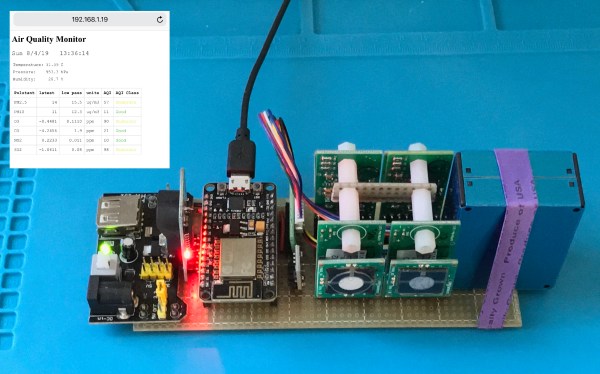
Into the build went an ESP32 module, an SPS30 particulate sensor, an MH-Z19 CO₂ sensor, an HTU21D temperature and humidity sensor, and a uBlox NEO 6M GPS module. The eventual plan is to add an SD card for data logging, but in the absence of that it connects to a Raspberry Pi running Grafana over InfluxDB for data analysis. The result provides a surprising insight into the environmental quality of not just a commute but of indoor life. We’re sorry to say that they don’t seem to have posted any of the code involved onto the Medway Makers writeup, though we hope that’s an oversight they’ll rectify by the time this has gone live.

This isn’t the first environmental monitor to grace these pages, indeed we’ve had quite a few as Hackaday Prize entries.

Postal-Themed Rat Rod Mower Really Delivers

There are birthday presents, and then there are birthday presents. You know, the amazing ones that are the polar opposite of phoning it in. This is one of those presents.

So, [peterbrazil]’s wife is a rural mail carrier on a small island. For her upcoming birthday, he wanted to build a lil’ something she could show off in the local Tractor Days Parade. He found an old Cub Cadet riding mower that was destined for the dump, and the rest is well-documented history.

This glorious conversion required a lot of frame work, but it’s obvious this wasn’t [peterbrazil]’s first rodeo. He got some tires and tie rods from a friend who used to race lawnmowers (yeah, really) and went from there. He wanted this rat rod to be totally slammed (lowered as far as possible), but that would prohibit [Mrs. peterbrazil] from riding it ’round the farm after her parade dust settles. Instead, he went for the raked look, which means the front is lower than the back.

We love all of the reuse here, which includes a wheelbarrow cleverly cut into a seat and a dashboard, an old mailbox for a bed/cargo box, and a pitchfork grill. There are some modern touches as well, like a 3D printed mailbox shift knob with a working door, printed ignition switch box for the dash, and an adapter that makes room for a huge cone air filter. The seat cushion is a nice touch, too—the sunflower fabric adds both femininity and farm flavor to the build.

Always wanted to build a hot rod, but don’t have the garage space? Get some traction with an R/C rod.

Low Power Weather Station Blows The Competition Away

Building a weather station isn’t too tall of an order for anyone getting into an electronics project. There are plenty of plans online, and you can even put your station on Weather Underground if it meets certain standards. These usually have access to a reliable source of power, though, and like any electronics project can get challenging quickly once it needs to work reliably in a remote location. The weather station from [Tegwyn☠Twmffat] has met this challenge though, and has been working reliably for three years now.

Getting that sort of reliability from any circuit that has to be powered by an unreliable source (solar, wind, etc.) and a battery is quite a challenge. Not only do you need to sort out the power management and make sure that you can get enough sun in the winter for your application, but you’ll need to do some extreme low power modifications to your circuitry as well. This weather station accomplishes all of that, helped by using LoRa for communication, and also comes complete with a separate hardware watchdog timer that can reboot the weather station if it loses power or hangs up for some reason.

If you’ve been looking for a weather station to build, this is a great place to start. [Tegwyn☠Twmffat] also goes through the assembly of the weather station, complete with a guy-wire-supported platform to mount it on. There are other weather stations out there too, if you need even more ideas about saving power in remote areas.

Innovative Bird Feeder Design Recycles Recycling’s Garbage

Recycling beverage cartons isn’t 100% efficient. The process yields some unusable garbage as a byproduct. Why? Because containers like juice boxes are mostly paper, but also contain plastic and aluminum. The recycling process recovers the paper fibers for re-use, but what’s left after that is a mixture of plastic rejects and other bits that aren’t good for anything other than an incinerator or a landfill. Until now, anyway!

It turns out it is in fact possible to turn such reject material into a product that can be injection-molded, as shown here with [Stefan Lugtigheid]’s SAM bird feeder design. The feeder is not just made from 100% recycled materials, it’s made from the garbage of the recycling process — material that would otherwise be considered worthless. Even better, the feeder design has only the one piece. The two halves are identical, which reduces part count and simplifies assembly.

[Stefan] makes it clear that the process isn’t without its quirks. Just because it can be injection-molded doesn’t mean it works or acts the same as regular plastic. Nevertheless, the SAM birdfeeder demonstrates that it can definitely be put to practical use. We’ve seen creative reprocessing of PET bottles and sheet stock made from 3D printed trash, but recycling the garbage that comes from recycling drink cartons is some next-level stuff, for sure.

Putting Some Smarts Into An Electric Car Charger

Many electric cars feature a timer capability that allows the owner to set which hours they want the vehicle to start pulling a charge. This lets the thrifty EV owner take advantage of the fact that the cost of electricity generally goes down late at night when the demand is lower. The Renault Zoe that [Ryan Walmsley] owns has this feature, but not only does it cost him extra to have it enabled, it’s kind of a hassle to use. So being an enterprising hacker, he decided to implement his own timer in the charger itself.

Now controlling high voltages with a lowly microcontroller might sound dangerous, but it’s actually not nearly as tricky as you might think. The charger and the vehicle actually communicate with low-voltage signals to determine things like the charge rate, so it turns out you don’t need to cut into the AC side of things at all. You just need to intercept the control signals between the two devices and modify them accordingly.

Or do you? As [Ryan] eventually realized, he didn’t need to bother learning how the control signals actually worked since he wasn’t trying to do anything tricky like set the charge rate. He just wanted to be able to stop and start the charging according to what time it was. So all he had to do was put the control signal from his car through a relay controlled by a Particle Photon, allowing him to selectively block communication.

The charger also had an optional key lock, which essentially turns the controller off when the contacts are shorted. [Ryan] put a relay on that as well so he could be absolutely sure the charger cuts the juice at the appropriate time. Then it was just a matter of getting the schedule configured with IFTTT. He mentions the system could even be tweaked to automatically control the charger based on the instantaneous cost of electricity provided by the utility company, rather than assuming overnight is always the most economical.

We’ve seen a fair amount of electric car hacking, but with only a few exceptions, the projects always steer clear of modifying the actual chargers themselves. In general hackers feel a lot safer playing around in the world of DC, but as [Ryan] has shown, safely hacking your EV charger is possible if you do your homework.

A Farmer’s Guide To Technology

One of the hardest aspects of choosing a career isn’t getting started, it’s keeping up. Whether you’re an engineer, doctor, or even landscaper, there are always new developments to keep up with if you want to stay competitive. This is especially true of farming, where farmers have to keep up with an incredible amount of “best practices” in order to continue being profitable. Keeping up with soil nutrient requirements, changing weather and climate patterns, pests and other diseases, and even equipment maintenance can be a huge hassle.

A new project at Hackerfarm led by [Akiba] is hoping to take at least one of those items off of farmers’ busy schedules, though. Their goal is to help farmers better understand the changing technological landscape and make use of technology without having to wade through all the details of every single microcontroller option that’s available, for example. Hackerfarm is actually a small farm themselves, so they have first-hand knowledge when it comes to tending a plot of land, and [Bunnie Huang] recently did a residency at the farm as well.

The project strives to be a community for helping farmers make the most out of their land, so if you run a small farm or even have a passing interest in gardening, there may be some useful tools available for you. If you have a big enough farm, you might even want to try out an advanced project like an autonomous tractor.