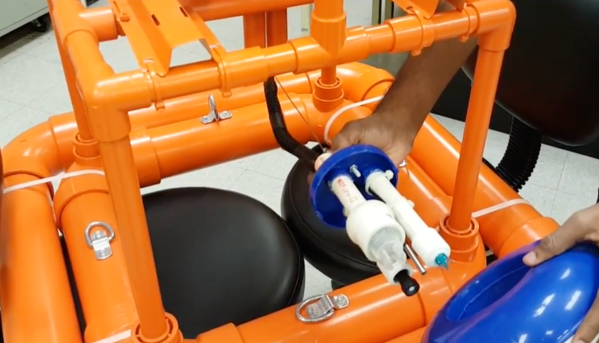
With world oceans ranging in cleanliness from pretty nasty to OMG, we need to get a handle on what exactly is going on. High School students from Hackensack, NJ built the Intellibuoy, a floating water quality sensor. The buoy has an anemometer and digital rain gauge up top, as well as a LED beacon to comply with maritime regulations.
Flotation is provided by a framework of sealed 3/4″ and 3″ PVC pipes that look strong enough to protect the electronics from a casual boat-bump. High above the water (under ideal conditions) there is the waterproof control box, packing two Arduino UNOs which listen to the sensors. A turbidity sensor measures how much silt is in the water; the other sensors measure Ph, dissolved oxygen, and temperature. The sensor pod is suspended inside a double ring of PVC for maximum protection. Each ‘Duino also has a SD card shield that stores the data of the respective sensors.