Jaromir Sukuba: The Supercon 2018 Badge Firmware

If you missed it, the Hackaday Supercon 2018 badge was a complete retro-minicomputer with a screen, keyboard, memory, speaker, and expansion ports that would make a TRS-80 blush. Only instead of taking up half of your desk, everyone at the conference had one around their neck, when they weren’t soldering to it, that is.

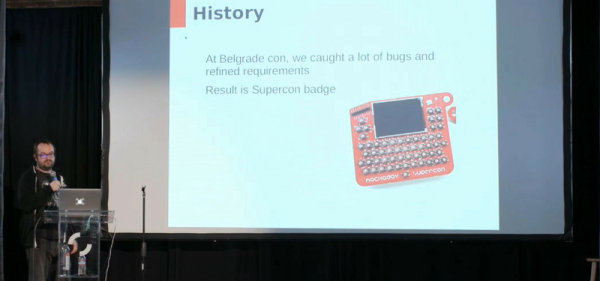
The killer feature of the badge was its accessibility and hackability — and a large part of that was due to the onboard BASIC interpreter. And that’s where Jaromir comes in. Once Voja Antonic had finalized the design of the badge hardware for our conference in Belgrade in the spring of 2018, as Jaromir puts it, “all we needed was a little bit of programming”. That would of course take three months. The badge was battle-tested in Belgrade, and various feature requests, speed ups, and bugfixes were implemented (during the con!) by Jaromir and others.

Firmware work proceeded over the summer. Ziggurat29 helped out greatly by finding ways to speed up the badge’s BASIC interpreter (that story is told on his UBASIC and the Need for Speed project page) and rolled into the code base by Jaromir. More bugs were fixed, keywords were added, and the three-month project grew to more like nine. The result: the badge was in great shape for the Supercon in the fall.

Jaromir’s talk about the badge is supremely short, so if you’re interested in hacking a retrocomputer into a PIC, or if you’ve got a badge and you still want to dig deeper into it, you should really give it a look. We don’t think that anyone fully exploited the CP/M machine emulator that lies inside — there’s tons of software written for that machine that is just begging to be run after all these years — but we’re pretty sure nearly everyone got at least into the basement in Zork. Dive in!

Continue reading “Jaromir Sukuba: The Supercon 2018 Badge Firmware”

Blacksmithing For The Uninitiated: What Is A Forge?

Blacksmiths were the high technologists of fabrication up until the industrial revolution gained momentum. At its core, this is the art and science of making any needed tool or mechanism out of metal. Are you using the correct metal? Is the tool strong where it needs to be? And how can you finish a project quickly, efficiently, and beautifully? These are lessons Blacksmiths feel in their bones and it’s well worth exploring the field yourself to appreciate the knowledge base that exists at any well-used forge.

I had an unexpected experience a few days ago at the Hacker Hotel weekend hacker camp in the Netherlands. At the side of the hotel our friends at RevSpace in The Hague had set up a portable forge. There was the evocative coal fire smell of burning coke from the hearth, an anvil, and the sound of hammering. This is intensely familiar to me, because I grew up around it. He may be retired now, but my dad is a blacksmith whose work lay mostly in high-end architectural ironwork.

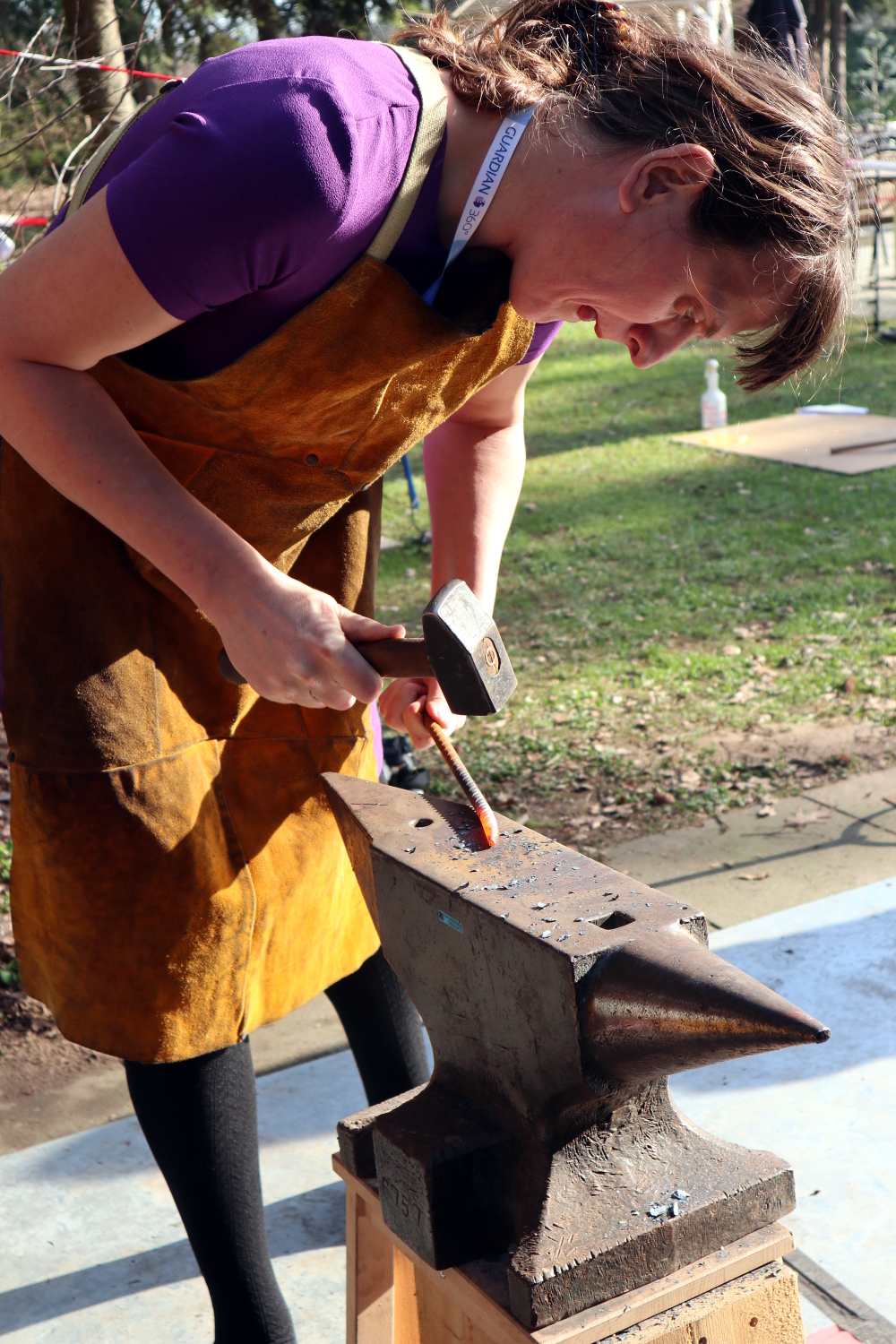
Working the RevSpace forge at Hacker Hotel, in not the most appropriate clothing for the job.

The trouble is, despite all that upbringing, I don’t consider myself to be a blacksmith. Sure, I am very familiar with forge work and can bash metal with the best of them, but I know blacksmiths. I can’t do everything my dad could, and there are people we’d encounter who are artists with metal. They can bend and shape it to their will in the way I can mould words or casually solder a tiny surface-mount component, and produce beautiful things in doing so. My enthusiastic metal-bashing may bear the mark of some experience at the anvil but I am not one of them.

It was a bit of a surprise then to see the RevSpace forge, and I found myself borrowing a blacksmith’s apron to protect my smart officewear and grabbing a bit of rebar. I set to and made a pretty simple standard of the dilletante blacksmith, a poker with a ring on one end. Hammer one end of the rebar down to a point, square off the other end for just over 3 times the diameter of the ring, then bend a right angle and form the ring on the pointy end of the anvil. Ten minutes or so of fun in the Dutch sunshine. Working a forge unexpectedly brought with it a bit of a revelation. I may not be a smith of a high standard, but I have a set of skills by virtue of my upbringing that I had to some extent ignored.

Where others might have put effort into learning them, they’re things I just know. It had perhaps never occurred to me that maybe all my friends in this community didn’t learn how to do this by hanging round the forge next to the house they grew up in. If I have this knowledge merely by virtue of my upbringing, perhaps I should share some of it in a series of articles for those in our community who’ve always fancied a go at a forge but have no idea where to start.

Continue reading “Blacksmithing For The Uninitiated: What Is A Forge?”

Ask Hackaday: Earth’s Magnetic Field Shifting Rapidly, But Who Will Notice?

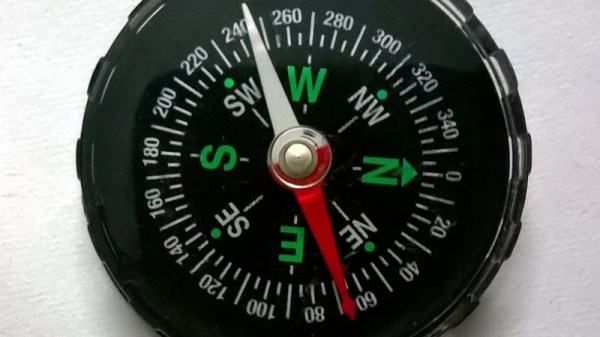
Just when you though it was safe to venture out, the National Oceanic and Atmospheric Administration released an unexpected update. Magnetic North is on the move — faster than expected. That’s right, we know magnetic north moves around, but now it’s happened at a surprising rate. Instead of waiting for the normal five year interval before an update on its position, NOAA have given us a fresh one a bit earlier.

There are some things that we can safely consider immutable, reliable, they’ll always be the same. You might think that direction would be one of them. North, south, east, and west, the points of the compass. But while the True North of the Earth’s rotation has remained unchanged, the same can not be said of our customary method of measuring direction.

Earth’s magnetic field is generated by a 2,000 km thick outer core of liquid iron and nickel that surrounds the planet’s solid inner core. The axis of the earth’s internal magnet shifts around the rotational axis at the whim of the currents within that liquid interior, and with it changes the readings returned by magnetic compasses worldwide.

The question that emerged at Hackaday as we digested news of the early update was this: as navigation moves inexorably towards the use of GPS and other systems that do not depend upon the Earth’s magnetic field, where is this still relevant beyond the realm of science?

Continue reading “Ask Hackaday: Earth’s Magnetic Field Shifting Rapidly, But Who Will Notice?”

New Contest: Flexible PCBs

The now-humble PCB was revolutionary when it came along, and the whole ecosystem that evolved around it has been a game changer in electronic design. But the PCB is just so… flat. Planar. Two-dimensional. As useful as it is, it gets a little dull sometimes.

Here’s your chance to break out of Flatland and explore the third dimension of circuit design with our brand new Flexible PCB Contest.

We’ve teamed up with Digi-Key for this contest. Digi-Key’s generous sponsorship means 60 contest winners will receive free fabrication of three copies of their flexible PCB design, manufactured through the expertise of OSH Park. So now you can get your flex on with wearables, sensors, or whatever else you can think of that needs a flexible PCB.

Continue reading “New Contest: Flexible PCBs”

Google Launches AI Platform That Looks Remarkably Like A Raspberry Pi

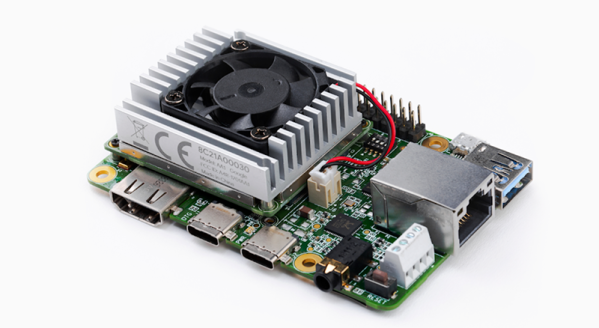
Google has promised us new hardware products for machine learning at the edge, and now it’s finally out. The thing you’re going to take away from this is that Google built a Raspberry Pi with machine learning. This is Google’s Coral, with an Edge TPU platform, a custom-made ASIC that is designed to run machine learning algorithms ‘at the edge’. Here is the link to the board that looks like a Raspberry Pi.

This new hardware was launched ahead of the TensorFlow Dev Summit, revolving around machine learning and ‘AI’ in embedded applications, specifically power- and computationally-limited environments. This is ‘the edge’ in marketing speak, and already we’ve seen a few products designed from the ground up to run ML algorithms and inference in embedded applications. There are RISC-V microcontrollers with machine learning accelerators available now, and Nvidia has been working on this for years. Now Google is throwing their hat into the ring with a custom-designed ASIC that accelerates TensorFlow. It just so happens that the board looks like a Raspberry Pi.

Continue reading “Google Launches AI Platform That Looks Remarkably Like A Raspberry Pi”

Better Living Through Science: Why Your Kids Probably Aren’t Getting Measles

Oddly, there’s been a few recent outbreaks of measles. It struck me how when I was a kid, a few hundred kids getting measles wouldn’t have been news at all. However, even a handful makes the news now, since in 2000 the Center for Disease Control declared measles eradicated in the United States.

So how can an eradicated disease come back? How did we eradicate it to start with? The answers tell a pretty interesting tale of science applying to everyday life.

Continue reading “Better Living Through Science: Why Your Kids Probably Aren’t Getting Measles”

“Good Code Documents Itself” And Other Hilarious Jokes You Shouldn’t Tell Yourself

Code documentation — is there anything more exciting than spending your time writing extensive comments? If I had to guess, your answer is probably somewhere along the lines of “uhm, yes, everything is more exciting than that”. Plus, requesting to document your code is almost like an insult to your well thought out design, this beautiful creation you implemented so carefully that it just has to be obvious what is happening. Writing about it is just redundant, the code is all you need.

As a result, no matter if it’s some open source side project or professional software development, code documentation usually comes in two flavors: absent and useless. The dislike for documenting ones code seems universal among programmers of any field or language, no matter where in the world they are. And it’s understandable, after all, you’re in it for the coding, implementing all the fun stuff. If you wanted to tell stories, you would have chosen a different path in life.

This reluctance has even formed whole new paradigms and philosophies claiming how comments are actually harmful, and anyone trying to weasel their way out of it can now happily rehash all those claims. But, to exaggerate a bit, we’re essentially villainizing information this way. While it is true that comments can be counterproductive, it’s more the fundamental attitude towards them that causes the harm here.

In the end, code documentation is a lot like error handling, we are told early on how it’s important and necessary, but we fail to understand why and instead grow to resent doing it again for that same old teacher, supervisor, or annoying teammate. But just like error handling, we are the ones who can actually benefit the most from it — if done right. But in order to do it right, we need to face some harsh truths and start admitting that there is no such thing as self-documenting code, and maybe we simply don’t understand what we’re actually doing if we can’t manage to write a few words about it.

So let’s burst some bubbles!

Continue reading ““Good Code Documents Itself” And Other Hilarious Jokes You Shouldn’t Tell Yourself”