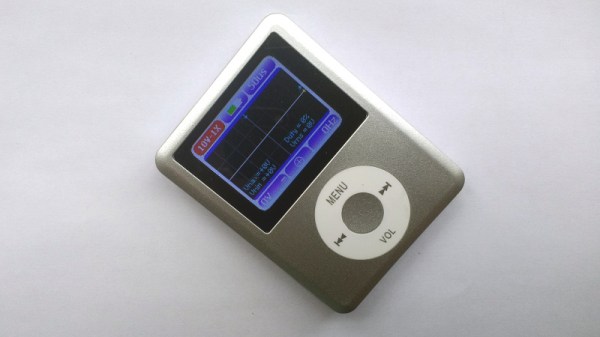
DSO Nano 3 Review: A 20 MHz Pocket ‘Scope For Not A Lot

The oscilloscope is an essential tool of any electronics bench, and it is also an instrument whose capabilities have expanded exponentially over the decades. Your entirely analogue CRT ‘scope of a few decades ago has now been supplanted by a digital device that takes on many of the functions of both an expensive multimeter a frequency counter, and more. At the top end of the market the sky is the limit when it comes to budget, and the lower end stretches down to low-bandwidth devices based upon commodity microcontrollers for near-pocket-money prices.

These super-cheap ‘scopes are usually sold as kits, and despite their very low bandwidth are surprisingly capable instruments with a useful feature set due to well-written software. I  reviewed a typical model last year, and came away lamenting its lack of an internal battery and a decent quality probe. If only someone would produce an inexpensive miniature ‘scope with a decent bandwidth, decent probe, and an internal battery!

As it happens, I didn’t have long to wait for my wish to be satisfied, with news of the release of the DSO Nano 3. Let’s see what you can do with a portable scope for less than $50.

Continue reading “DSO Nano 3 Review: A 20 MHz Pocket ‘Scope For Not A Lot”
Learn FPGA Fast With Hackaday’s FPGA Boot Camp

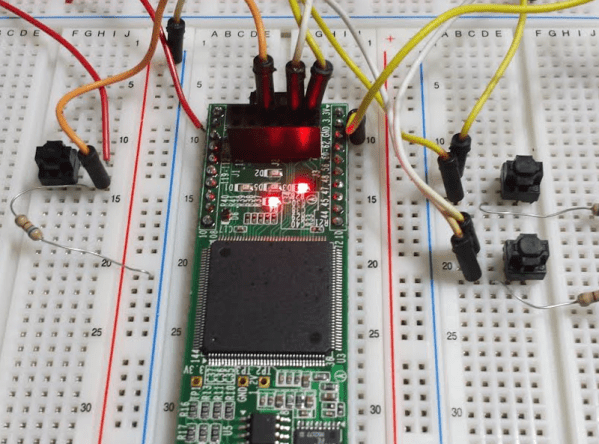
FPGAs have gone from being a niche product for people with big budgets to something that every electronics experimenter ought to have in their toolbox. I am always surprised at how many people I meet who tell me they are interested in using FPGAs but they haven’t started. If you’ve been looking for an easy way to get started with FPGAs, Hackaday’s FPGA boot camp is for you. There’s even a Hackaday.io chat in the group specifically for FPGA talk for questions and general discussion!

While it is true FPGAs aren’t for everything, when you need them you really need them. Using FPGAs you can build logic circuits — not software simulations, but real circuits — and reap major performance benefits compared to a CPU. For digital signal processing, neural networks, or computer vision applications, being able to do everything essentially in parallel is a great benefit. Sometimes you just need the raw speed of a few logic gates compared to a CPU plodding methodically through code. We expect to see a lot more FPGA activity now that Arduino is in the game.

These boot camps gather together some of the material you seen spread over many articles here before, plus new material to flesh it out. It’s designed for you to work through more like a training class than just some text to read. There’s plenty of screenshots and even animations to help you see what you are supposed to be doing. You’ll be able to work with simulations to see how the circuits we talk about work, make changes, and see the results. We’ll focus on Verilog — at least for now — as it is close to C and easier for people who know C to pick up. Still not convinced? Let’s run though the gist of the boot camp series.

Continue reading “Learn FPGA Fast With Hackaday’s FPGA Boot Camp”

Hackaday Links Column Banner

Hackaday Links: August 5, 2018

Here’s something of historical interest. The daughter of Terry Holdt, project manager for the 6502, cleaned out a garage and found shelves full of MOS Technology binders, test results, notes, instructions for processes, letters to customers, and datasheets full of errata. Some of these documents have been posted on Twitter, and efforts are underway to collect, scan, upload, and preserve them. In the distance, a man in a fabulous suit is screaming, ‘donate them to the Internet Archive’.

This is a link to Defcad, the repository of 3D printable files for weapons. Under an agreement with the US Department of State, Defcad was set to go online on August 1st. This caused much handwringing in the tech journalist thoughtspace, with reporters calling to end the first amendment because they don’t like the second. Alyssa Milano chimed in. Defcad was ordered shut down by a federal judge in the western district of Washington before going live.

As you may well be aware, Printrbot ceased operations last month. It’s sad to see them go, but they made some acceptable machines and were really pushing the boundaries of what was possible with their infinite build volume prototype printer. But what about all those existing printrbots in the wild, you might ask. Well, good news for anyone who hasn’t changed their hotend over to an E3D yet: Ubis is going to be selling hotends. Get ’em while they’re hot (or not, I don’t know how this pun works).

File this one into the ‘awesome government auctions’ category. The city of Longmont, Colorado decommissioned their tornado sirens last year because they ‘self-activated’ and malfunctioned. These sirens were put up for auction, with a winning bid of $526. Someone bought the most annoying thing imaginable for just over five bills. The world of government auctions is amazing.

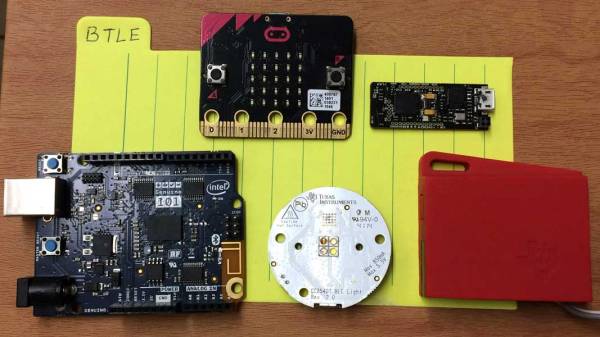
Beginning BLE Experiments And Making Everything Better

Successfully connecting things without physical wires has a profound effect on the maker brain. Machines talking to each other without any cables is as amazing today as it was a decade ago. When Bluetooth came out, it was a breakthrough since it offered a wireless way to connect cellphones to a PC. But Bluetooth is a complicated, high-bandwidth power hog, and it didn’t make sense for battery-powered devices with less demanding throughput requirements to pay the energy price. Enter Bluetooth LE (BLE), with power requirements modest enough to enable a multitude of applications including low power sensor nodes and beacons.

Over the years, a number of gadgets with BLE have popped up such as the LightBlue Bean, BLE Beacons as well as quadcopters like the FlexBot that rely on BLE for communication. Android or iOS apps are the predominant method of talking to these wonderful gadgets though there are alternatives.



This is the first in a two part series on building with BLE devices. First, I’ll survey some BLE devices and how to get started with BLE from the Linux command line. Later, we will go into describing the process of making a NodeJS cross-platform app that will leverage the BLE capabilities and connect it to the Internet.
Lets get started.
Continue reading “Beginning BLE Experiments And Making Everything Better”

Hackaday Belgrade: Sophi Kravitz’s Blimp Army

Building things that fly is hard. The constraints on small, battery powered, radio-operated gear already presents a challenge, but adding weight, balance, and aerodynamic constraints takes it to a whole new level. Sophi Kravitz rises to the occasion and discusses each challenge of building a blimp from start to finish in her presentation at the 2018 Hackaday Belgrade conference.

One of the pleasures of writing for Hackaday comes through the incredible array of talent and experience to be found among our colleagues. We all do our own work, but one is humbled by that which flows from the benches of those one works alongside. Just such a project is the Remote Control Mini Blimp from our colleague Sophi Kravitz. It’s a game involving an obstacle course and a set of remote-controlled blimps. The challenges in such an endeavour have been pushing the limits of what is possible with off-the-shelf components. Continue reading “Hackaday Belgrade: Sophi Kravitz’s Blimp Army”

Friday Hack Chat: Training Robots By Touch

When it comes to training robots, you could grab a joystick or carefully program movements in code. The better way, though, is to move the robot yourself, and have the robot play back all those movements ad infinitum. This is training robots by touch, and it’s the subject of this week’s Hack Chat over on hackaday.io.

Our guest for this week’s Hack Chat will be [Kent Gilson], inventor, serial entrepreneur, and pioneer in reconfigurable computing. [Kent] is the creator of Viva, an object-oriented programming language and operating environment that harnesses the power of FPGAs into general-purpose computing He’s launched eight entrepreneurial ventures, won multiple awards, and created products used in numerous industries across the globe.

[Kent]’s claim to fame on hackaday.io is Dexter, a low-cost robotic arm with 50-micron repeatability and modular end effectors. It does this with three harmonic drives and optical encoders that give it extreme precision. The arm is also trainable, meaning that you can manually control it and play back the exact path it took. It’s training robots by touch, exactly what this Hack Chat is all about.

For this Hack Chat, we’re going to be discussing:

  • Building trainable robots
  • Developing robotics haptics
  • Training robots to manufacture
  • Heterogenous direct digital manufacturing

You are, of course, encouraged to add your own questions to the discussion. You can do that by leaving a comment on the Hack Chat Event Page and we’ll put that in the queue for the Hack Chat discussion.join-hack-chat

Our Hack Chats are live community events on the Hackaday.io Hack Chat group messaging. This week is just like any other, and we’ll be gathering ’round our video terminals at noon, Pacific, on Friday, July 27th.  Need a countdown timer? Well, here you go, mango.

Click that speech bubble to the right, and you’ll be taken directly to the Hack Chat group on Hackaday.io.

You don’t have to wait until Friday; join whenever you want and you can see what the community is talking about.

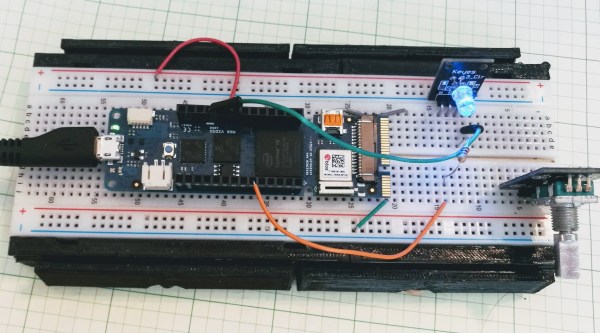
Hands-On With New Arduino FPGA Board: MKR Vidor 4000

Hackaday brought you a first look the Arduino MKR Vidor 4000 when it announced. Arduino sent over one of the first boards so now we finally have our hands on one! It’s early and the documentation is still a bit sparse, but we did get it up and running to take the board through some hello world exercises. This article will go over what we’ve been able to figure out about the FPGA system so far to help get you up and running with the new hardware.

Continue reading “Hands-On With New Arduino FPGA Board: MKR Vidor 4000”