VCF East 2018: Cactus, Retro Because It Wants To Be

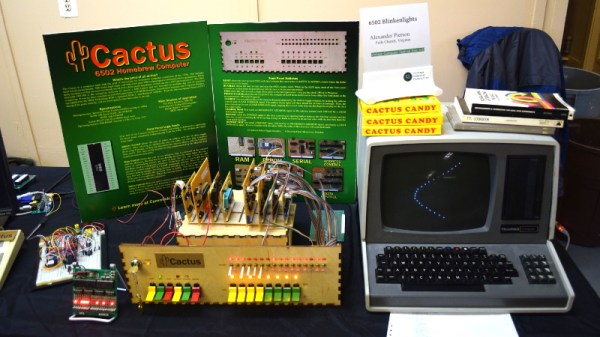
Among the rows of digital dinosaurs, one blinking front panel stood out. It certainly looked the part of a retro computer; with banks of blinking LEDs and multicolored paddle switches. But upon closer inspection, the laser cut wooden front panel betrays the fact that this machine is an impostor. It may have the appearance of a machine from the heady days where home computers looked like they could have doubled as a prop on the bridge of Kirk’s Enterprise, but it’s actually a product of much more modern provenance.

It’s called the Cactus, a love letter to the homebrew microcomputers of the 1970’s, designed and built by somebody at least 20 years too young to have experienced them the first time around. Alexander Pierson created the Cactus not because he had fond memories of putting together an Altair 8800 in 1975, but because he’s fascinated with the retro computer experience: the look of the front panel, the satisfying clunk of era-appropriate switches, and the idea that the computer’s inner workings aren’t an abstract black box but rather something you can interact with and study. Judging by all the attention the Cactus got at VCF East XIII, he’s not the only one.

Let’s take a look at everything Alexander poured into this retrocomputer build.

Continue reading “VCF East 2018: Cactus, Retro Because It Wants To Be”

Friday Hack Chat: All About The Hackaday Prize

Right now we’re neck deep in the Hackaday Prize. What’s the Hackaday Prize? It’s the Academy Awards of hardware creation, or at least that’s what we’re calling it until we get a cease and desist from the Academy of Motion Picture Arts and Sciences.

Already we’ve seen over eight hundred entries in the Hackaday Prize, and there are still months to go. We’re already through the Open Hardware Design Challenge, and twenty fantastic projects from that are moving onto the final round. Yesterday, we announced the winners of the Robotics Module challenge, and again we were blown away. These are the greatest bits of hardware anywhere, and we couldn’t have imagined anything more awesome.

For this week’s Hack Chat, we’re going to be talking all about The Hackaday Prize. This is your chance to be a hardware hero and finally get some recognition for what you’ve been working on. Right now, we’re in the Power Harvesting Challenge in this year’s Hackaday Prize, and we want to see what you can come up with that will get energy from solar, thermal, wind, or random electromagnetic energy. This is your time to shine, and we can’t wait to see what you come up with.

Of course, you might have a few questions on what it takes to make a successful Hackaday Prize entry. For this week’s Hack Chat, we’re going to sit down with [Stephen Tranovich], the person coordinating this year’s Prize, to see what makes a successful entry. This is your chance to find out what it takes to become the next great hardware hacker, and it’s all going down this Friday in the Hack Chat.

Some of the things we’ll be talking about in this week’s Hack Chat:

  • What makes a winning entry?
  • How can you get publicity for your project?
  • Want to bounce your project ideas off the community?
  • What’s the story behind the seed funding confusion from this year?

You are, of course, encouraged to add your own questions to the discussion. You can do that by leaving a comment on the Hack Chat Event Page and we’ll put that in the queue for the Hack Chat discussion.join-hack-chat

Our Hack Chats are live community events on the Hackaday.io Hack Chat group messaging. This week is just like any other, and we’ll be gathering ’round our video terminals at noon, Pacific, on Friday, June 15th.  Here’s a clock counting down the time until the Hack Chat starts.

Click that speech bubble to the right, and you’ll be taken directly to the Hack Chat group on Hackaday.io.

You don’t have to wait until Friday; join whenever you want and you can see what the community is talking about.

These Twenty Amazing Projects Won The Robotics Module Challenge

Right now, we’re running the greatest hardware competition on the planet. The Hackaday Prize is the Academy Awards of Open Hardware, and we’re opening the gates to thousands of hardware hackers, makers, and artist to create the next big thing.

Last week, we wrapped up the second challenge in The Hackaday Prize, the Robotics Module challenge. Now we’re happy to announce twenty of those projects have been selected to move onto the final round and have been awarded a $1000 cash prize. Congratulations to the winners of the Robotics Module Challenge portion of the Hackaday Prize. Here are the winners, in no particular order:

Robotics Module Challenge Hackaday Prize Finalists:

These projects are fantastic

These are the best projects the Robotics Module Challenge in this year’s Hackaday Prize has to offer. These projects are simply fantastic. You answered the call with more than 200 entries for this challenge, and have created the best projects that can be turned into smarter, better robots. Need some proof? Just take a look at some of these projects. Continue reading “These Twenty Amazing Projects Won The Robotics Module Challenge”

Fail Of The Week: Two Rotors Are Not Better Than Four

Fair warning: [Paweł Spychalski]’s video is mostly him talking about how bad his “dualcopter” ended up. There are a few sequences of the ill-fated UAV undergoing flight tests, most of which seem to end with it doing a reasonable impression of a post-hole auger. We have to admit that it’s a pretty poor drone. But one can only truly fail if one fails to have some fun doing it, [Paweł] enjoyed considerable success, at least judging by the glee with which he repeatedly cratered the craft.

The overall idea seems to make sense, with coaxial props mounted in the middle of a circular 3D-printed frame. Mounted below the props are crossed vanes controlled by two servos. The vanes sit in the rotor wash and provide pitch and roll control, while yaw and thrust are controlled by varying the speeds of the counter-rotating props. [Paweł] knew going in that this was a sketchy aerodynamic design, and was surprised it performed as well as it did. But with ground effects limiting roll and pitch control close to the ground, the less-than-adequate thrust due to turbulence between the rotors, and the tendency for the center of mass and the center of gravity to get out whack with each other, all made for a joyously unstable and difficult to control aircraft.

Despite the poor performance, [Paweł] has plans for a Mark II dualrotor, a smaller craft with some changes based on what he learned. He’s no slouch at pushing the limits with multirotors, with 3D-printed racing quad frames and using LoRa for control beyond visual range. Still, we’re sure he’d appreciate constructive criticism in the comments, and we wish him luck with the next one.

Continue reading “Fail Of The Week: Two Rotors Are Not Better Than Four”

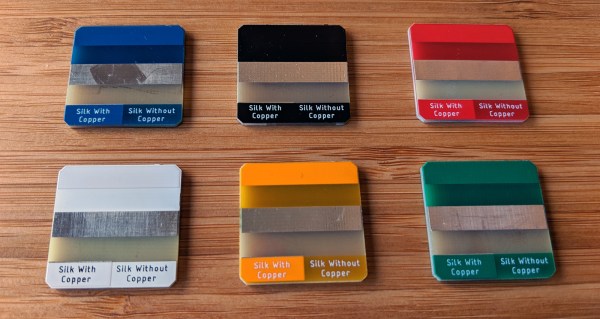
Ask Hackaday: What Color Are Your PCBs?

A decade ago, buying a custom-printed circuit board meant paying a fortune and possibly even using a board house’s proprietary software to design the PCB. Now, we all have powerful, independent tools to design circuit boards, and there are a hundred factories in China that will take your Gerbers and send you ten copies of your board for pennies per square inch. We are living in a golden age of printed circuit boards, and they come in a rainbow of colors. This raises the question: which color soldermask is most popular, which is most desirable, and why? Seeed Studio, a Chinese PCB house, recently ran a poll on the most popular colors of soldermask. This was compared to their actual sales data. Which PCB color is the most popular? It depends on who you ask, and how you ask it.
Continue reading “Ask Hackaday: What Color Are Your PCBs?”

Hackaday Links Column Banner

Hackaday Links: Benchoff Rants On Flying Cars

It’s time for Computex, and that means [Linus] has dropped something. I don’t know what, but he’s dropped something. It’s a meme or something at this point. What were the highlights? Asus announced Project Precog, a laptop with two screens. Yes, a touchscreen keyboard. It’s the 2018 version of the IBM Transnote or whatever that Microsoft thing was called. Why is it called Project Precog? Because AI or whatever. Unimaginative marketing is terrible. Intel is going to launch a 28-core CPU, and AMD is introducing a 32-core CPU. Awesome, core wars. And here’s RGB RAM because stuffing a case full of cold cathode lighting is sooo early-2000s.

Need a reverse engineering challenge? Here’s something from American Science and Surplus. It’s a 48 x 12 LED matrix, loaded up with driver ICs and power regulators. $20 a piece, so stock up and save.

Finally, the main event. The biggest story in aviation this week is that a media embargo has lifted on the Kitty Hawk Flyer. Kitty Hawk is a startup funded by Larry Page, CEO’d by Sebastian Thrun, and has received $6.5 M in funding. The Flyer, a one-man decacopter, was announced to the world through CNN Money and Casey Neistat. It should be noted that in the entire media landscape, these are the two outlets most ignorant of aviation: CNN needs no explanation, and Neistat flies quadcopters through the Hudson River Corridor at 1000 feet AGL. Additionally, Kitty Hawk is not exhibiting at AirVenture next month, which leads me to believe Kitty Hawk is trying to stay out of the aviation industry or simply doesn’t want knowledgeable people asking them questions. But I digress.

The Kitty Hawk Flyer is being promoted by the company as “a personal flying vehicle… to make flying part of everyday life” and a machine that will give you, “a world free from traffic”. It is being billed by CNN and Neistat as ‘a flying car’. Kitty Hawk is just fine with allowing the media to call it as such. Additionally, Sebastian Thrun is making claims about the Flyer that are disingenuous at best, outright illegal at worst, and should draw the ire of any investors.

In the CNN Money piece, Thrun claims the Flyer is capable of traveling at 100 miles per hour, which would be illegal. The Flier is certified as a Part 103 Ultralight, and under that regulation the Flyer “is not capable of more than 55 knots calibrated airspeed at full power in level flight.” The Flyer may also be overweight. The first version of the Flyer was basically a decacopter with a seat, and weighed in at 220 pounds. Part 103 regulations have a limit of 254 pounds, and it’s entirely possible there are more than 34 pounds of chassis and fiberglass on the latest version. I should also mention the safety training, while not required for a Part 103 ultralight, is insufficient: Casey Neistat’s underwater egress training was done in a Chuck E. Cheese-style ball pit. You can breathe in a ball pit, you can’t breathe underwater.

But legality aside, a Part 103 ‘flying car’ is just about the dumbest idea ever. You can’t use it to commute, and you’re welcome to call your local FSDO to confirm that. You’re not going to fly it in New York City or San Francisco because there are airports in the way. At best, this is a ‘flying ATV’ that you would take out on your farm; a toy for rich people. At worst, it’s the latest example of the Silicon Valley philosophy of ‘ignore laws and break things’.

Fail Of The Week: Never Trust A Regulator Module

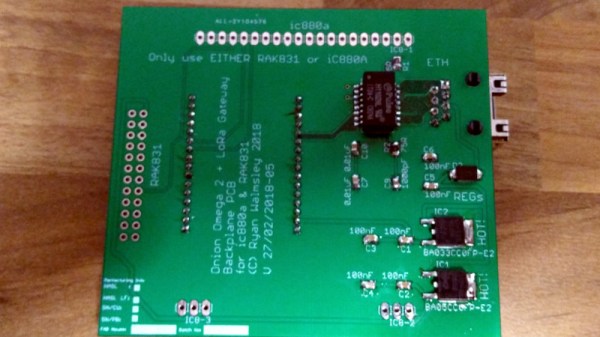
[Ryan Wamsley] has spent a lot of time over the past few months working on a new project, the Ultimate LoRa backplane. This is as its name suggests designed for LoRa wireless gateways, and packs in all the features he’d like to see in a LoRa expansion for the Nano Pi Duo.

His design features a three-terminal regulator, and in the quest for a bit more power efficiency he did what no doubt many of you will have done, and gave one of those little switching regulator modules in a three-terminal footprint a go. As part of his testing he inadvertently touched the regulator, and was instantly rewarded with a puff of smoke from his Nano Pi Duo. As it turned out, the regulator was susceptible to electrical noise, and had a fault condition in which its input voltage was routed directly to its output. As a result, a component in the single board computer received way more than its fair share, and burned out.

If there is a moral to be extracted from this story, it is to never fully trust a cheap drop-in module to behave exactly as its manufacturer claims. [Ryan]’s LoRa board lives to fight another day, but the smoke could so easily have come from more components.

So that’s the Fail of The Week part of this write-up complete, but it would be incomplete without the corresponding massive win that is [Ryan]’s LoRa board itself. Make sure to take a look at it, it’s a design into which a lot of attention to detail has been put.