Eclipse 2017: Where Will You Be When The Sun Goes Away?

In less than a month, on August 21, 2017, the Moon will cast its shadow upon the Earth, a relative pinprick at only 60 miles across. The shadow will begin in the Pacific Ocean off North America, make landfall south of Portland, Oregon, and rake diagonally across the United States. Charging southeastward at about 2000 miles an hour, the path of totality will touch 12 states before racing off into the Atlantic Ocean around Charleston, South Carolina.

Those are the dry facts of the eclipse, the wheres and the whens of an event that hasn’t been visible to a majority of the US population in 47 years. But beyond the science and the natural wonder of the celestial alignment lies a simple question: Where will you be when the sun goes away?

An Eclipse from a Volcano
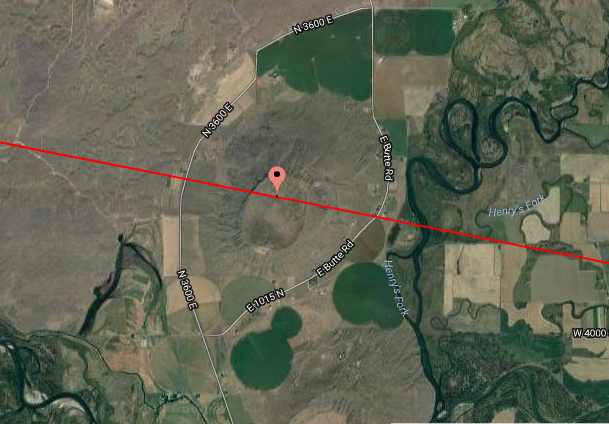
Bullseye! The center of totality passes right through North Menan Butte in Rexburg, ID.

For me, the answer is simple: I’ll be smack dab in the middle of totality on top of an extinct volcano in eastern Idaho. To see an eclipse is pretty cool; to watch the mechanics of the heavens work above you while standing in a unique geological feature will be far cooler.

It will take me eight hours to drive to Menan Buttes with my family from our home in the Panhandle; Idaho is an enormous state. We’ll be camping on private land outside the southern butte, probably in pretty rustic conditions and without a lot of rough camping experience. OK, none. But I don’t care because I want to see totality, and the 92% totality we’d see if we stayed home just won’t cut it.

While most people will likely have their eyes cast heavenward with their cheap cardboard and plastic eclipse glasses or shade 14 welding lens when the big moment arrives, my eyes will be locked on the ground to the west of our vantage point. Menan Butte stands about 500′ above the flat, featureless Snake River plain, and I intend to watch the moon’s shadow racing across the planet toward us. That’s the draw for me, and I hope I get to see it.

That’s not to say I won’t look skyward once the shadow is upon us, gazing in wide wonder at the incandescent dance of our sun’s atmosphere against the suddenly dark sky. I’ll bask in the unnatural twilight, listen to the gasps and cheers of my fellow watchers, and feel the sudden temperature drop, which should be quite marked in the east Idaho drylands. We’ll have about two minutes of totality before the shadow races east toward the vast majority of the US population, and I plan to enjoy every second of it.

Hackaday Eclipse Meetups

Aside from just watching the eclipse, there’s plenty else to do. Hackaday.io members across the country are hosting Hackaday Eclipse Meetups, where like minded folks can mix and mingle before the eclipse. If you know where you’ll be to watch the eclipse — like an extinct volcano, for instance — and you don’t mind sharing the experience with some of your fellow enthusiasts, be sure to post a meetup on the Eclipse Meetups page. Make your event page and we’ll send you some eclipse glasses with the Jolly Wrencher on the side of them for you and your guests.

Have you started thinking of what you’re going to bring with you to the viewing? There are a lot of eclipse projects, from pinhole cameras to watch the eclipse safely, to the Ham operators who will be taking advantage of localized ionospheric changes to make long-distance contacts. Those of us with telescopes might want to build a low-cost solar filter. Someone will likely be trying to prove General Relativity somewhere along the path of totality, and we’d love to see the rig for that. And there will no doubt be petabytes of photographs and videos taken with everything ranging from smartphones to professional cinematic cameras. We’d love to hear what you’re planning and see your setups. And even if you’ve got something cool that’s not eclipse related, bring it along. It’s always a good time to talk shop for hackers.

Continue reading “Eclipse 2017: Where Will You Be When The Sun Goes Away?” →

How To Do Beautiful Enclosures With Custom Fiberglass

There are times when I feel the need to really make a mess. When I think of making messes with a degree of permanency, I think of fiberglass. I also really like the smell, reminds me of a simpler time in 8th grade shop class. But the whole process, including the mess, is worth it for the amazing shapes you can produce for speaker pods and custom enclosures.

Utilizing fiberglass for something like a custom speaker pod for a car is not difficult, but it does tend to be tedious when it comes to the finishing stages. If you have ever done bodywork on a car you know what kind of mess and effort I am talking about. In the video below, I make a simple speaker pod meant for mounting a speaker to the surface of something like a car door.

You can also use a combination of wood and fiberglass to make subwoofer cabinets that are molded to the area around them. You can even replace your entire door panel with a slick custom shaped one with built in speakers  if you’re feeling adventuresome.

Continue reading “How To Do Beautiful Enclosures With Custom Fiberglass” →

These Twenty Wheels, Wings, And Walkers Won $1000 In The Hackaday Prize

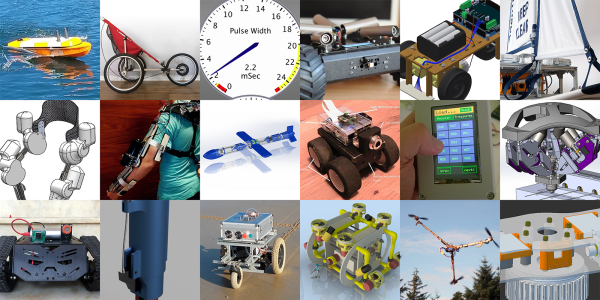
Today, we’re excited to announce the winners of the Wheels, Wings, and Walkers portion of The Hackaday Prize. We were looking for the next generation of robots, drones, machines that make machines move, and hackers who now know far too much about inverse kinematics. The results were spectacular.

Hackaday is currently hosting the greatest hardware competition on Earth. We’re giving away thousands of dollars to hardware creators to build the next great thing. Last week, we wrapped up the third of five challenges. It was all about showing a design to Build Something That Matters. Hundreds entered and began their quest to build a device to change the world.

There are still two more challenges in The Hackaday Prize. If you’re working on Assistive Technologies, the time is now, with this portion of the Prize ending September 4th. After that, Anything Goes. The Anything Goes challenge is the catch-all, and we’re looking for the best projects, full stop.

The winners of the Wheels, Wings, and Walkers challenge are, in no particular order:

Wheels, Wings, and Walkers Hackaday Prize Finalists:

Continue reading “These Twenty Wheels, Wings, And Walkers Won $1000 In The Hackaday Prize” →

Hackaday Links Column Banner

Hackaday Links: July 30, 2017

What are you doing next weekend? How about going to the Vintage Computer Festival West at the Computer History Museum in Mountain View. Hackaday is sponsoring, and there are always a ton of awesome builds. Last year, someone played Tron on a Commodore PET. Not a video game — the movie.

In case anyone forgot, I created the most desirable independent hardware badge this year at Def Con. It’s a hilarious joke, I got three from OSH Park, thirty more in different colors from Seeed, and something, somewhere, jumped a shark. [Drew Fustini] also shared these PCBs on OSH Park. There were four orders. This is hilarious.

‘Member Minecraft? Redstone was awesome, and people built computers out of red dust and torches. Now it’s not as cool with all the fancy redstone components, and simpler is always better. Here’s bitmap logic, or a complete computer made with pixels. There’s already an 8-bit computer for this thing.

Frag somebody and own their computer. [Justin] recently found an exploit in Valve’s Source engine (TF2, CSGO, Portal 2…) that allows for remote code execution on clients and servers by loading a custom ragdoll model.

High bandwith, low-power, and long range. If you’re doing RF, you may pick two. LoRa is the RF solution that picked low power and long range. There are quite a few companies behind it, but we really haven’t seen many products using LoRa here in the states yet (then again, products that would use LoRa shouldn’t be very visible…). Now there’s an Open Source LoRa backend server. This is somewhat significant; LoRa isn’t a completely Open protocol, and all licensing goes through Semtech and the LoRa Alliance.

Fail Of The Week: Good Prosthetic Hand Design Goes Bad

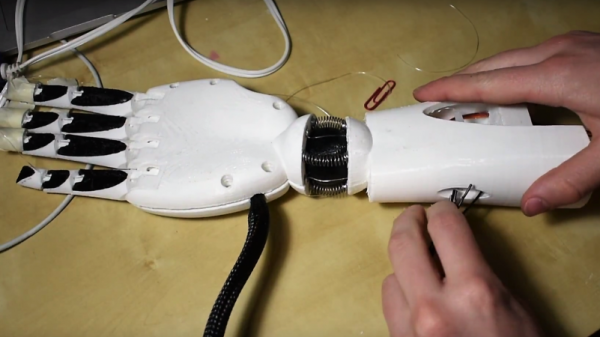
Is this a case of a good design gone wrong in the build phase? Or is this DIY prosthetic arm a poor design from the get-go? Either way, [Will Donaldson] needs some feedback, and Hackaday is just the right place for that.

Up front, we’ll say kudos to [Will] for having the guts to post a build that’s less than successful. And we’ll stipulate that when it comes to fully articulated prosthetic hands, it’s easy to fail. His design is ambitious, with an opposable thumb, fingers with three phalanges each, a ball and socket wrist, and internal servos driving everything. It’s also aesthetically pleasing, with a little bit of an I, Robot meets Stormtrooper look.

But [Will]’s build was plagued with print problems from the start, possibly due to the complex nature of the bosses and guides within the palm for all the finger servos. Bad prints led to creaky joints and broken servos. The servos themselves were a source of consternation, modified as they were for continuous rotation and broken apart for remotely mounting their pots in the hand’s knuckles. The video below relates the tale of woe.

There’s a lot to admire with [Will]’s build, but it certainly still has its issues. He’s almost to the point of other more successful DIY hand builds but just needs a little help. What say you in the comments line? Continue reading “Fail Of The Week: Good Prosthetic Hand Design Goes Bad” →

Where A Wood Shop Goes, A Hackerspace Follows

The 2×4 Contest at my local hackerspace captured my interest. The challenge was to build something cool out of a single eight-foot 2×4 with the winner getting free wood storage in the space. I had half an idea for a project, but I ran out of time and never even started it. My idea was to cut the board into half-thickness strips and glue them edge-to-edge with some biscuits holding them together — to basically make wider, thinner boards to do… something cool with it.

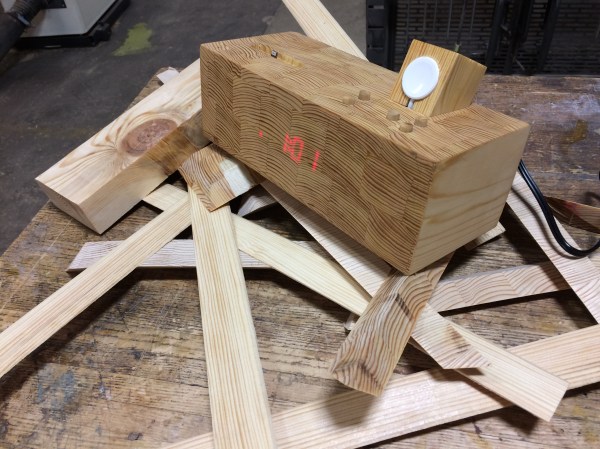
One of the entries is pictured above. [Jon Alt] designed this clock and phone charger that includes a capacitive charger for his smart watch. He makes use of the 2×4’s grain to make a gorgeous enclosure, carving away the rear of the front panel so only a credit-card’s thickness of wood remained, allowing the 7-segments to shine through. The other entries were great as well and I especially liked the 2×4 guitar.

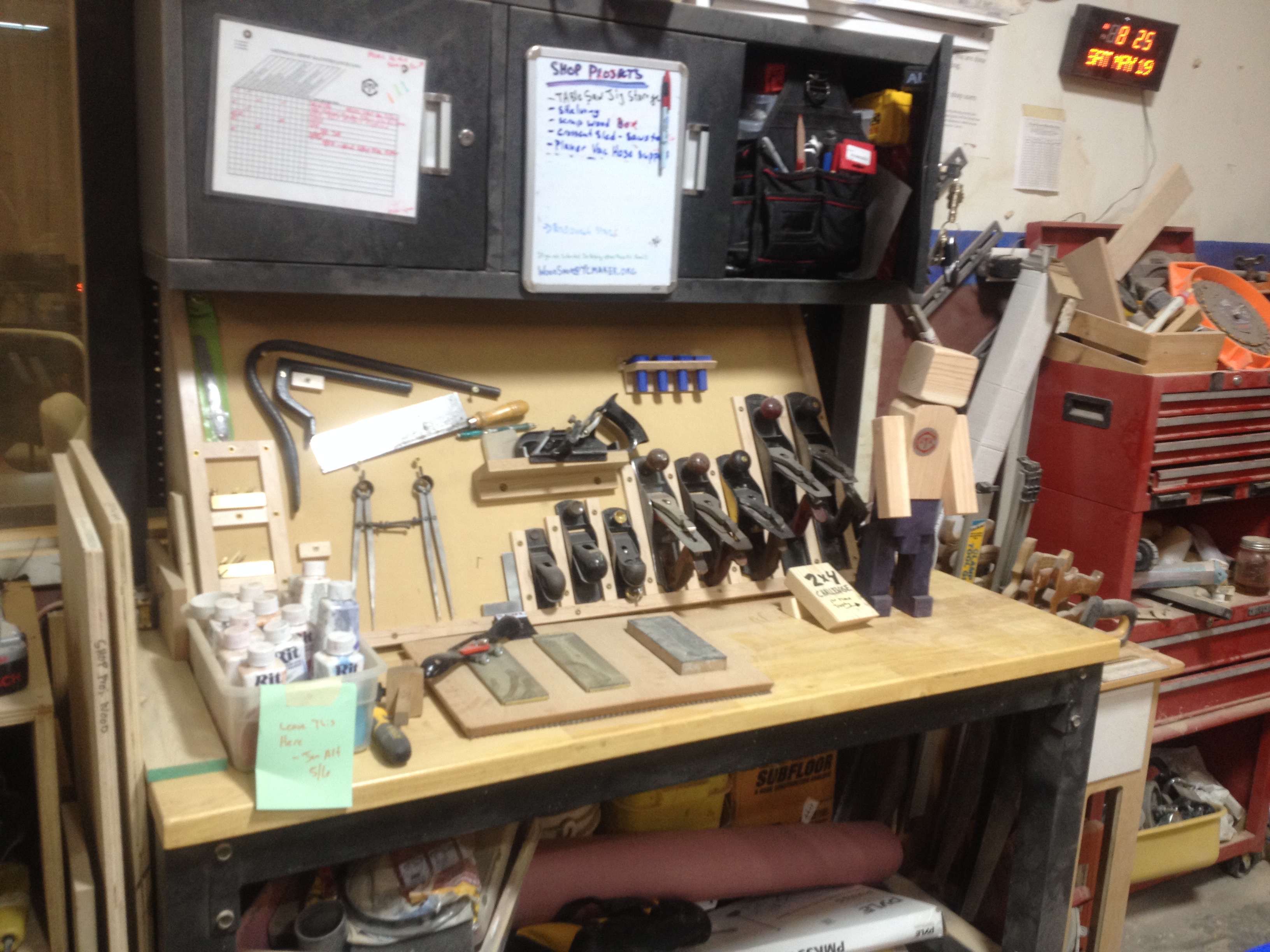
Mostly what interested me about the contest was what it showed about the wood shop: thanks to the volunteers and board, that is a wood shop doing well. Stuff is going on! A sad wood shop doesn’t hold contests. By extension, when the shop is doing well, that means the hackerspace is also doing well.

A wood shop is one of those areas of a hackerspace that is tool-driven. It’s not just a gathering place for like-minded folks; people go to use a specific tool or tools they can’t afford, and let’s face it, there’s always tools to buy that costs a bunch of money.

I’ve seen this particular shop begin as an empty concrete room with a cheap drill press and someone’s old bandsaw. Pretty soon worktables, shelving, and storage were built. More tools arrived, some donated, some loaned, some purchased with dues. So how can other spaces replicate this wood shop success story?

Continue reading “Where A Wood Shop Goes, A Hackerspace Follows” →

Rotary Phones And The Birth Of A Network

I can’t help but wonder how long it will be before the movie title  “Dial M for Murder” becomes mysterious to most of the population. After all, who has seen a dial phone lately? Sure, there are a few retro phones, but they aren’t in widespread use. It may not be murder, but it turns out that the dial telephone has its roots in death — or at least the business of death. But to understand why that’s true, you need to go back to the early days of the telephone.

Did you ever make a tin can phone with a string when you were a kid? That dates back to at least 1667. Prior to the invention of what we think of as the telephone, these acoustic phones were actually used for specialized purposes.



We all know that [Alexander Graham Bell] made a working telephone over a wire, drawing inspiration from the telegraph system. However, there’s a lot of dispute and many others about the same time were working on similar devices. It is probably more accurate to say that [Bell] was the first to successfully patent the telephone (in 1876, to be exact).

Continue reading “Rotary Phones And The Birth Of A Network” →