Hackaday Links: October 11, 2015

[Kratz] just turned into a rock hound and has a bunch of rocks from Montana that need tumbling. This requires a rock tumbler, and why build a rock tumbler when you can just rip apart an old inkjet printer? It’s one of those builds that document themselves, with the only other necessary parts being a Pizza Hut thermos from the 80s and a bunch of grit.

Boot a Raspberry Pi from a USB stick. You can’t actually do that. On every Raspberry Pi, there needs to be a boot partition on the SD card. However, there’s no limitation on where the OS resides,  and [Jonathan] has all the steps to replicate this build spelled out.

Some guys in Norway built a 3D printer controller based on the BeagleBone. The Replicape is now in its second hardware revision, and they’re doing some interesting things this time around. The stepper drivers are the ‘quiet’ Trinamic chips, and there’s support for inductive sensors, more fans, and servo control.

Looking for one of those ‘router chipsets on a single board’? Here you go. It’s the NixCoreX1, and it’s pretty much a small WiFi router on a single board.

[Mowry] designed a synthesizer. This synth has four-voice polyphony, 12 waveforms, ADSR envelopes, a rudimentary sequencer, and fits inside an Altoids tin. The software is based on The Synth, but [Mowry] did come up with a pretty cool project here.

Hacklet 79 – USB Projects

Universal Serial Bus was created to simplify interconnecting computers and peripherals. First released in 1996, hackers and makers were slow to accept this strange new protocol. Parallel and serial ports were simpler, worked great, and had decades of hacking with thousands of projects behind them. As the new standard caught on in the mainstream, RS-232 and parallel ports started disappearing. “Legacy free” PC’s became the norm. Hackers, Makers, and Engineers had no choice but to jump on the bandwagon, which they did with great gusto. Today everything has a USB port. From 8 bit microcontrollers to cell phones to children’s toys. This week’s Hacklet is about some of the best USB projects on Hackaday.io!

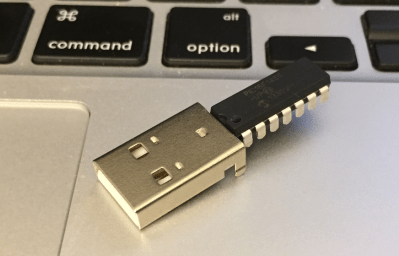
two partsWe start with [Michael Mogenson] and Two Component USB Temperature Data Logger, which may be the simplest USB device ever made. [Michael] isn’t kidding. This data logger consists of just a Microchip PIC16F1455 microcontroller and a USB connector. Microchip’s datasheet calls for a capacitor to smooth out power, but [Michael] made it work without the extra part. He used M-Stack by Signal 11 to implement the USB stack. Once connected to a PC, the PIC enumerates as a serial port device. It then sends its die temperature of the PIC once per second. It could do more, but that would probably require adding a few more components!

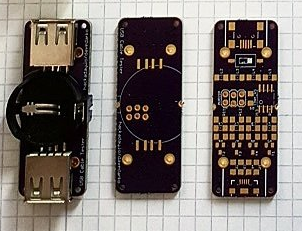
tester1Next up is [davedarko] with USB cable tester. Dave recently spent some time installing USB RFID readers. These devices were only a few meters away from the computer controlling them. Even so, the power and USB data cables had to run through pipes and in some cases under water. It wasn’t fun troubleshooting a device to find that it was a shorted USB cable causing the problem. [Dave’s] solution is a tiny coin cell powered board that tests each of the 4 wires in a standard USB 2.0 cable. The board runs on an ATtiny45 microcontroller. [Dave’s] current iteration has footprints for mini and micro USB connectors, along with the standard USB-A.


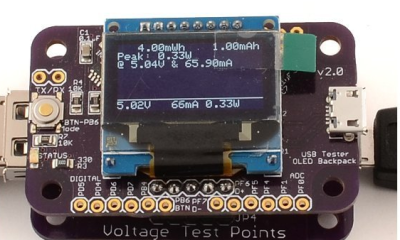
tester2[MobileWill] has a USB Tester of his own. This USB tester checks current consumption and rail voltage. It does this by connecting in-line with the device under test. It’s perfect for troubleshooting why your PC’s USB port goes into over-current protection every time you plug in your device. The tester is modular – you can use the base board with your own multimeter, or grab [Will’s] tester backpack and see the results right on the built-in OLED display. USB Tester is [Will’s] entry in the 2015 Hackaday Prize.


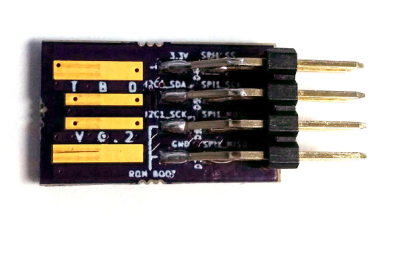
tbdFinally, we have [ajlitt] with Tiny Bit Dingus (TBD). TBD is a USB interface to 6 wires. Think of it as a tiny version of the bus pirate. This lilliputian board holds a Freescale KL27Z ARM processor, which has more than enough power to handle things like I2C, SPI, PWM, or just about any other way to send data or wiggle wires. [Ajlitt] started this project as an excuse to learn KiCAD and gain some experience with surface mount solder stencils. The result is an absolutely tiny board that is all but lost in a USB socket. Programming is handled with the mbed library, though you can always use Freescale’s native tools. Flashing code on the TBD is easy with kut, a chrome browser plugin.

If you want to see more USB projects, check out our new USB projects list. Did I miss your project? Don’t be shy, just drop me a message on Hackaday.io. That’s it for this week’s Hacklet, As always, see you next week. Same hack time, same hack channel, bringing you the best of Hackaday.io!

Makerbot Has Now Cut 36% Of Staff In Last 6 Months

The CEO of Makerbot, [Jonathan Jaglom] announced this week a massive reorganization. Twenty percent of the staff will be laid off, management will be changed, an office will be closed, and perhaps most interestingly, the production of 4th generation of Makerbots will be outsourced to contract manufacturers.

This news comes just months after Makerbot announced its first 20% reduction in staff, and follows on the heels of a class action suit from investors. These are troubling times for Makerbot.

So Goes Makerbot, So Goes The Industry

In the last six months, Makerbot has closed all three of its retail locations in Manhattan, Boston, and Greenwich, CT. It has moved out of one of its office buildings in Industry City, Brooklyn as the company faces a class action suit from investors for possible securities violations. These are by any measure troubling times for anyone at Makerbot.

The 3D printing industry has been forced through the rollercoaster of the hype cycle in the last few years, and where Makerbot goes, media coverage and public perception of 3D printing goes with it. According to pundits, we are now deep in the doldrums of the trough of disillusionment. No one wants to make their own parts for their washing machine, it is said, and 3D printers are finicky devices with limited utility.

Despite these pundits’ projections, the 3D printing industry doubled in 2015. Multiple manufacturers of sub $5000 machines are going gangbusters, and seeing the biggest revenues in the history of their respective companies. By any measure except the one provided by Makerbot, we are still in an era of a vast proliferation of 3D printing.

Makerbot, for better or worse, is a bellweather, and public perception and media attention is highly dependant on the success of Makerbot. The Verge writes – incorrectly – “…The consumer 3D-printing market’s rise has slowed”, and Business Insider writes ‘consumers are beginning to lose interest.’ These are not statements backed up by facts or statistics or even hearsay; they are merely a reflection of the consumer’s disinterest in Makerbot and not of the 3D printing industry of the whole.

Unfortunately, we will not know the extent of how bad it is at Makerbot until Stratasys releases its 2015 financial report sometime in early March next year. Wohlers Report 2016, the definitive guide to the 3D printing industry, will be released sometime around May of next year. Keep one thing in mind: Makerbot did not build the 3D printing industry, and the public perception of Makerbot does not necessarily translate to the public perception of 3D printing.

Code Craft: Subtle Interrupt Problems Stack Up

[Elliot Williams’] column, Embed with Elliot, just did a great series on interrupts. It came in three parts, illustrating the Good, the Bad, and the Ugly of using interrupts on embedded systems. More than a few memories floated by while reading it. Some pretty painful because debugging interrupt problems can be a nightmare.

One of the things I’ve learned to watch out for over the years is the subtlety of stack based languages, like C/C++, which can ensnare the unwary. This problem has to do with the corruption of arrays of values on a stack during interrupt handling. The fix for this problem points up another one often used by black hats to gain access to systems.

Continue reading “Code Craft: Subtle Interrupt Problems Stack Up”

Vintage Computer Fest: Berlin 2015

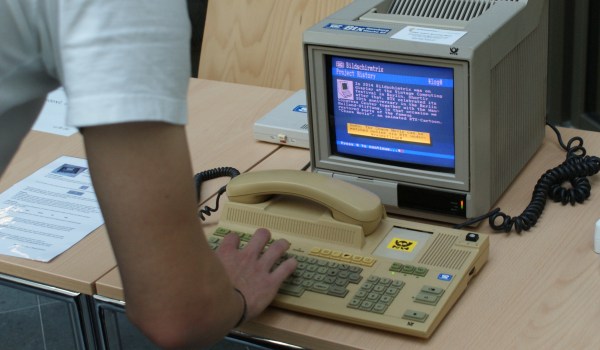
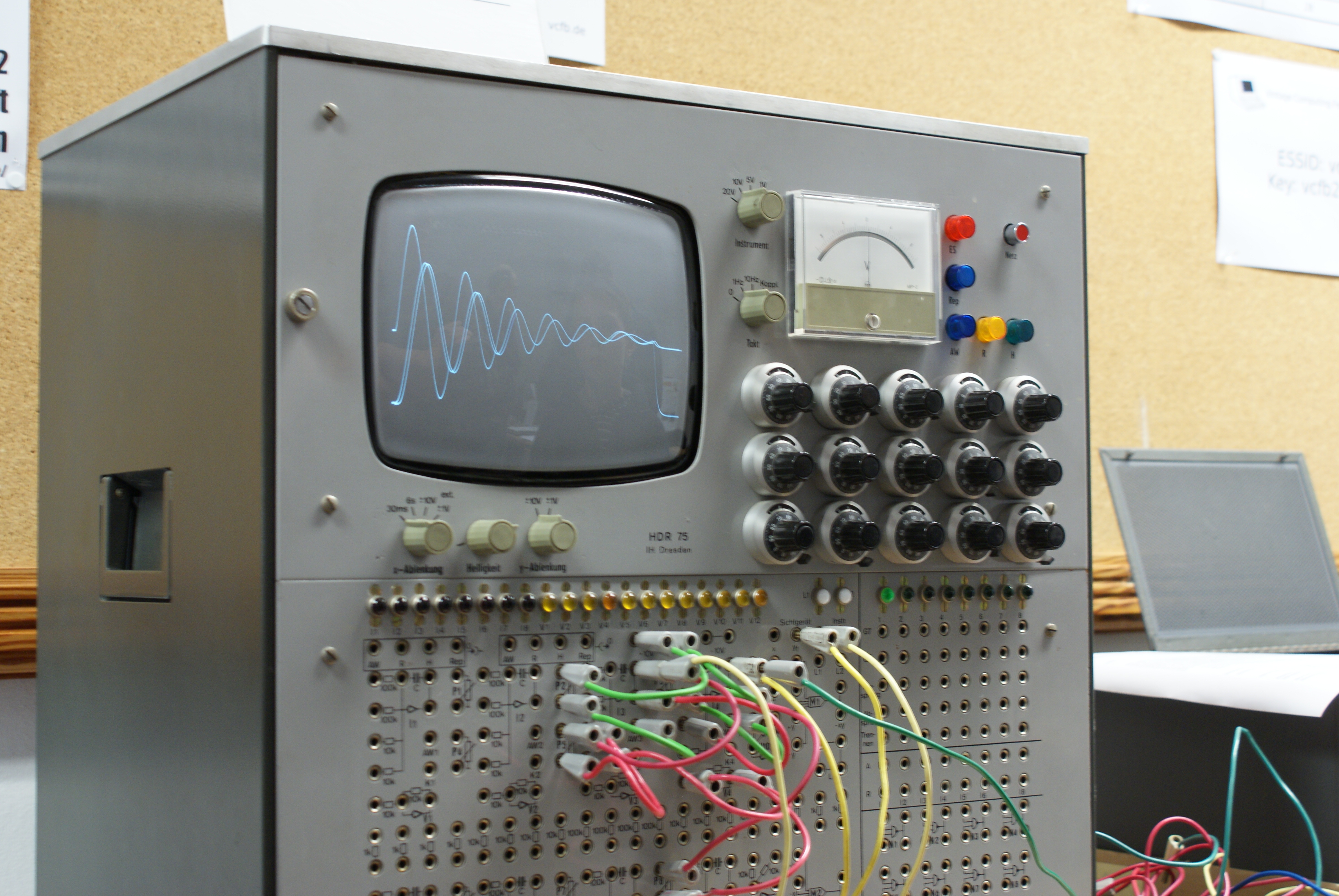
Berlin was a good city to be a geek in last weekend. Alongside the Berlin Maker Faire, there was the 2015 meeting of the Vintage Computing Festival: Berlin (VCFB). Each VCFB has a special theme, and this year it was analogue computers, but there was no lack of old computers large and small, teletext machines, vintage video game consoles, and general nerdy nostalgia.

Continue reading “Vintage Computer Fest: Berlin 2015”

Hackaday At Berlin Maker Faire

The first-ever Berlin Maker Faire was last weekend, and Hackaday was there. Berlin’s a city with an incredible creative vibe, so it’s no surprise that there was good stuff on display. What was surprising, though, was how far many of the presenters traveled to be there. I wandered around with a camera and a notebook, and here’s what we saw.

Continue reading “Hackaday At Berlin Maker Faire”

New Part Day: The BeagleBoard Gets Bigger

Officially, the latest hardware revision we’ve seen from BeagleBoard is the BeagleBone Black, a small board that’s perfect for when you want to interface hardware to a Linux software environment. This last summer, the BeagleBone Green was introduced, and while it’s a newer hardware release, it’s really just a cost-reduced version of the BB Black. Over the entire BeagleBoard family, it’s time for an upgrade.

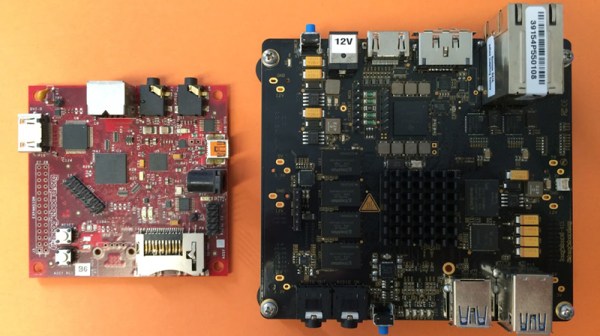
It’s been talked about for more than a year now, but the latest and greatest from the BeagleBoard crew is out. It’s called the BeagleBoard X15, and not only is it an extremely powerful Linux board, it also has more ports than you would ever need.

The new BeagleBoard features a dual-core ARM Cortex A15 running at 1.5GHz. There is 2GB of DDR3L RAM on board, and 4GB of EMMC Flash. Outputs include three USB 3.0 hosts, two Gigabit Ethernet controllers, one eSATA connector, LCD output, two PCIe connectors, and an HDMI connector capable of outputting 1920×1080 at 60 FPS. The entire board is open hardware, with documentation for nearly every device on the board available now. The one exception is the PowerVR SGX544 GPU which has a closed driver, but the FSF has proposed a project to create an open driver for this graphics engine so that could change in the future.

The expected price of the BeagleBoard X15 varies from source to source, but all the numbers fall somewhere in the range of $200 to $240 USD, with more recent estimates falling toward the high end. This board is not meant to be a replacement for the much more popular BeagleBone. While the development and relationship between the ~Board and ~Bone are very much related, the BeagleBone has always and will always be a barebone Linux board, albeit with a few interesting features. The BeagleBoard, on the other hand, includes the kitchen sink. While the BeagleBoard X15 hardware is complete, so far there are less than one hundred boards on the planet. These are going directly to the people responsible for making everything work, afterwards orders from Digikey and Mouser will be filled. General availability should be around November, and certainly by Christmas.

While it’s pricier than the BeagleBone, the Raspberry Pi, or dozens of other ARM Linux boards out there, The BeagleBone has a lot of horsepower and plenty of I/Os. It’s an impressive piece of hardware that out-competes just about everything else available. We can’t wait to see it in the wild, but more importantly we can’t wait to see what people can do with it.

Title image credit: Vladimir Pantelic