Hackaday Prize Entry: Open Source Electrospinning Machine

Electrospinning is a fascinating process where a high voltage potential is applied between a conductive emitter nozzle and a collector screen. A polymer solution is then slowly dispensed from the nozzle. The repulsion of negative charges in the solution forces fine fibers emanate from the liquid. Those fibers are then rapidly accelerated towards the collector screen by the electric field while being stretched and thinned down to a few hundred nanometers in diameter. The large surface area of the fine fibers lets them dry during their flight towards the collector screen, where they build up to a fine, fabric-like material. We’ve noticed that electrospinning is hoped to enable fully automated manufacturing of wearable textiles in the future.

[Douglas Miller] already has experience cooking up small batches of microscopic fibers. He’s already made carbon nanotubes in his microwave. The next step is turning those nanotubes into materials and fabrics in a low-cost, open source electrospinning machine, his entry for the Hackaday Prize.

Continue reading “Hackaday Prize Entry: Open Source Electrospinning Machine”

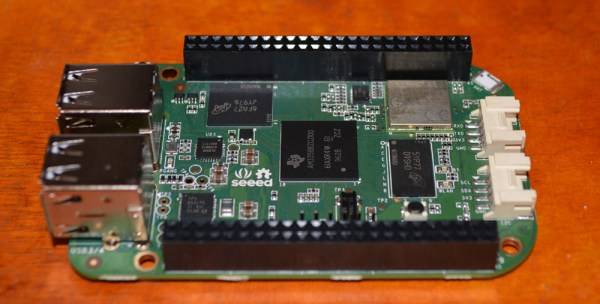
BeagleBone Green, Now Wireless

Over the past few years, the BeagleBone ecosystem has grown from the original BeagleBone White, followed two years later by the BeagleBone Black. The Black was the killer board of the BeagleBone family, and for a time wasn’t available anywhere at any price. TI has been kind to the SoC used in the BeagleBone, leading to last year’s release of the BeagleBone Green, The robotics-focused BeagleBone Blue, and the very recent announcement of a BeagleBone on a chip. All these boards have about the same capabilities, targeted towards different use cases; the BeagleBone on a Chip is a single module that can be dropped into an Eagle schematic. The BeagleBone Green is meant to be the low-cost that plays nicely with Seeed Studio’s Grove connectors. They’re all variations on a theme, and until now, wireless hasn’t been a built-in option.

This weekend at Maker Faire, Seeed Studio is showing off their latest edition of the BeagleBone Green. It’s the BeagleBone Green Wireless, and includes 802.11 b/g/n, and Bluetooth 4.1 LE.

Continue reading “BeagleBone Green, Now Wireless”

PTC Heaters For Reflow Soldering

Reflow soldering – setting components on a PCB in blobs of solder paste and heating the whole assembly at once to melt all joints simultaneously – has been the subject of many ingenious hacks. Once it was the sole preserve of industrial users with specialist microprocessor-controlled ovens, now there are a myriad Arduino-controlled toaster ovens, hot air blowers, and hotplates that allow hackers and makers to get in on the reflow act too.

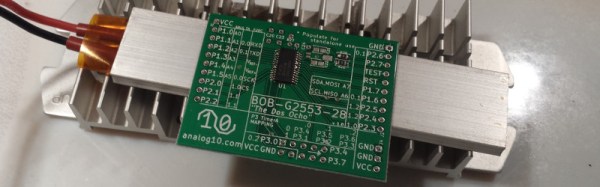
This morning a fresh idea in the reflow soldering arena has come our way. It’s not the most earth-shattering, but it does have some advantages so is worth a second look. [Analog Two] has successfully used a PTC heating element as a reflow soldering hotplate.

PTC heating elements are thermistors with a positive temperature coefficient. As their temperature rises, so does their electrical resistance. By careful selection of materials they can be manufactured with a sharp increase in resistance at a particular temperature. Thus when an electrical current is passed through them they heat up until they reach that temperature, then the current decreases as the resistance goes up, and they do not heat beyond that point. Thus as heaters they are intrinsically self-regulating. From our point of view they have another advantage, they are also cheap. Fitted as they are to thousands of domestic heating products they are readily available, indeed [Analog Two] found his on Amazon.

The heater chosen was a 200W 110V model with a temperature of 230 Celcius to match the solder he was using. They are also available for other mains voltages, and even at 12 and 24V for automotive applications. He reports that the time to reflow was about 90 seconds.

We’ve mentioned the advantages of this heater as its price and regulated temperature. Looking at the pictures though a disadvantage is its size. This is a reflow plate for small boards. There are larger PTC heater elements available though, it would be interesting to hear people’s experiences reflowing with them.

Hotplates for reflow soldering have featured before a few times here at Hackaday. We recently had this tiny plate, but we’ve also had a PID-controlled plate, and an Arduino-controlled domestic hotplate. We’re sure this is an avenue with further to go.

After The Prize: SatNOGS Builds Satellites

When Hackaday announced winners of the 2014 Hackaday Prize, a bunch of hackers from Greece picked up the grand prize of $196,418 for their SatNOGS project – a global network of satellite ground stations for amateur Cubesats.

upsat-integration-test-1The design demonstrated an affordable ground station which can be built at low-cost and linked into a public network to leverage the benefits of satellites, even amateur ones. The social implications of this project were far-reaching. Beyond the SatNOGS network itself, this initiative was a template for building other connected device networks that make shared (and open) data a benefit for all. To further the cause, the SatNOGS team set up the Libre Space Foundation, a not-for-profit foundation with a mission to promote, advance and develop Libre (free and open source) technologies and knowledge for space.

Now, the foundation, in collaboration with the University of Patras, is ready to launch UPSat – a 2U, Open Source Greek Cubesat format satellite as part of the QB50 international thermosphere research mission. The design aims to be maximally DIY, designing most subsystems from scratch. While expensive for the first prototype, they hope that documenting the open source hardware and software will help kickstart an ecosystem for space engineering and technologies. As of now, the satellite is fully built and undergoing testing and integration. In the middle of July, it will be delivered to Nanoracks to be carried on a SpaceX Dragon capsule and then launched from the International Space Station.

Continue reading “After The Prize: SatNOGS Builds Satellites”

Hackaday’s Fun With International Mains Plugs And Sockets

When we recently covered the topic of high voltage safety with respect to mains powered equipment, we attracted a huge number of your comments but left out a key piece of the puzzle. We take our mains plugs and sockets for granted as part of the everyday background of our lives, but have we ever considered them in detail? Their various features, and their astonishing and sometimes baffling diversity across the world.

When you announce that you are going to talk in detail about global mains connectors, it is difficult not to have an air of Sheldon Cooper’s Fun With Flags about you. But jokes and the lack of a co-starring Mayim Bialik aside, there is a tale to be told about their history and diversity, and there are also lessons to be taken on board about their safety. Continue reading “Hackaday’s Fun With International Mains Plugs And Sockets”

Working With Mains Voltage: The Electrifying Conclusion!

This is the second in a two-part series looking at safety when experimenting with mains-voltage electronic equipment, including the voltages you might find derived from a mains supply but not extending to multi-kilovolt EHT except in passing. In the first part we looked at the safety aspects of your bench, protecting yourself from the mains supply, ensuring your tools and instruments are adequate for the voltages in hand, and finally with your mental approach to a piece of high-voltage equipment.

The mental part is the hard part, because that involves knowing a lot about the inner life of the mains-voltage design. So in this second article on mains voltages, we’ll look into where the higher voltages live inside consumer electronics.

Continue reading “Working With Mains Voltage: The Electrifying Conclusion!”