Developed On Hackaday: Let’s Build An Electronic Hackaday Badge

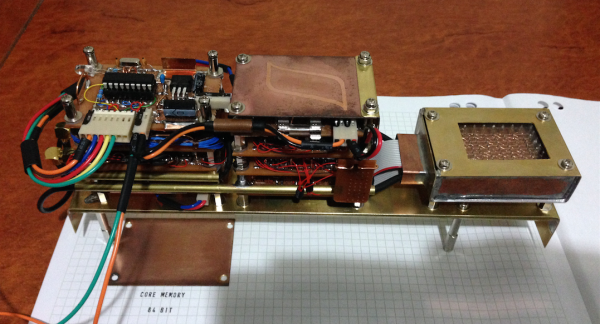
We’re going to build an electronic Hackaday Badge, and by “we”, I mean Hackaday community members who are passionate about the project.

I’ll be leading the charge. I had a great learning experience the last time I helped design the e-paper badge for the 2013 Open Hardware Summit, and hope to learn a lot along the way this time too. Since then, Badges have come a long way – at cons like DEFCON, LayerONE, Shmoocon, The Next Hope, Open Hardware Summit, The EMF, SAINTCON, SXSW Create, The Last Hope, TROOPERS11, ZaCon V and of course the rad1o from this year’s CCCamp. Word is that this year’s Open Hardware Summit badge is going to be pretty kickass too. So, we have some very big shoes to fill. But this doesn’t have to be about “my badge is better than yours”. And this badge isn’t meant to be specific to any single con or event. So what does the Badge do, then? “It’s a physical extension of the hackaday.io community, made specifically for hacker gatherings of all types and sizes.”

Continue reading “Developed On Hackaday: Let’s Build An Electronic Hackaday Badge”

DEF CON: HDMI CEC Fuzzing

HDMI is implemented on just about every piece of sufficiently advanced consumer electronics. You can find it in low-end cellphones, and a single board Linux computer without HDMI is considered crippled. There’s some interesting stuff lurking around in the HDMI spec, and at DEF CON, [Joshua Smith] laid the Consumer Electronics Control (CEC) part of HDMI out on the line, and exposed a few vulnerabilities in this protocol that’s in everything with an HDMI port.

CEC is designed to control multiple devices over an HDMI connection; it allows your TV to be controlled from your set top box, your DVD player from your TV, and passing text from one device to another for an On Screen Display. It’s a 1-wire bidirectional bus with 500bits/second of bandwidth. There are a few open source implementations like libCEC, Android HDMI-CEC, and even an Arduino implementation. The circuit to interface a microcontroller with the single CEC pin is very simple – just a handful of jellybean parts.

[Joshua]’s work is based off a talk by [Andy Davis] from Blackhat 2012 (PDF), but greatly expands on this work. After looking at a ton of devices, [Joshua] was able to find some very cool vulnerabilities in a specific Panasonic TV and a Samsung Blu-ray player.

A certain CEC command directed towards the Panasonic TV sent a command to upload new firmware from an SD card. This is somewhat odd, as you would think firmware would be automagically downloaded from an SD card, just like thousands of other consumer electronics devices. For the Samsung Blu-Ray player, a few memcpy() calls were found to be accessed by CEC commands, but they’re not easily exploitable yet.

As far as vulnerabilities go, [Joshua] has a few ideas. Game consoles and BluRay players are ubiquitous, and the holy grail – setting up a network connection over HDMI Ethernet Channel (HEC) – are the keys to the castle in a device no one  would ever think of taking a close look at.

Future work includes a refactor of the current code, and digging into more devices. There are millions of CEC-capable devices out on the market right now, and the CEC commands themselves are not standardized. The only way for HDMI CEC to be a reliable tool is to figure out commands for these devices. It’s a lot of work, but makes for a great call to action to get more people investigating this very interesting and versatile protocol.


BeagleBone Green Hands-On: Lower Price, Same Horsepower

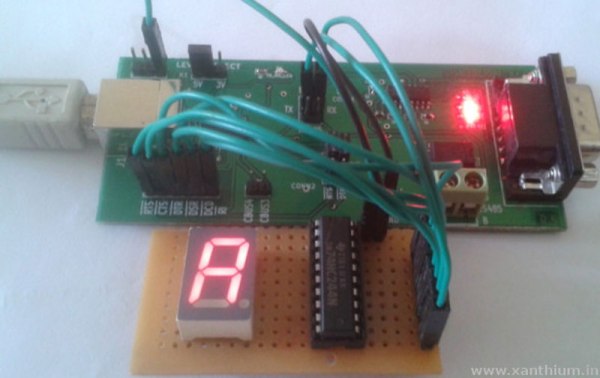
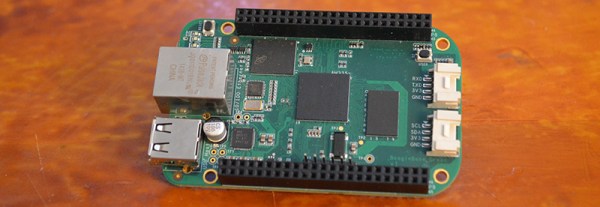
Although the BeagleBone Green was announced at the Bay Area Maker Faire last May, there hasn’t been much said about it on the usual forums and IRC channels. Now, it’s finally out and I got my hands on one of them. Through a cooperation between the BeagleBoard foundation and Seeed Studios, the best small Linux board for doing real work with small Linux boards is now cheaper, a little more modern, and green.

The BeagleBone Green is an update to the venerable BeagleBone Black, the dev board based on a TI ARM Cortex-A8. It’s an extremely capable machine with a few interesting features that make it the perfect device for embedded applications. With the BeagleBone Green, the BB Black gets a small hardware refresh and a drastic reduction in price. If you want to do real work on a Linux board, this is the one to get. Check out the review below for everything that’s been updated, everything that’s the same, and why this is one of the most interesting developments in small Linux boards in recent memory.

Continue reading “BeagleBone Green Hands-On: Lower Price, Same Horsepower”

Secrets Of The Lexus Hoverboard Revealed

Auto site [Jalopnik] got some hands-on (or rather feet-on) time with the Lexus hoverboard that was built for an advert for the luxury car brand, and their video reveals a few secrets about how this interesting device works. It is definitely real: the Jalopnik writer got to ride it himself, and described it as “Unbelievably difficult yet at the same time unbelievably cool, both because you’re levitating and because the board is filled with magnets more than 300 degrees below zero“. But a look behind the scenes reveals that it is another tease.

The device looks like it is a real hoverboard, floating several inches above the surface and even traveling over water, a feat that Marty McFly couldn’t do. But, as usual, there is a little more going on than meets the eye. The device is built around superconducting magnets cooled by liquid nitrogen, so it only works for about 10 minutes. After that, you have to refill the device with liquid nitrogen. The surface that the board is floating over also has what the Jalopnik writer describes as having “several hundred thousand dollars worth of magnets built in“. Try this on a non-magnetic surface and you’ll come to a grinding halt. If you watch the video of the hoverboard serenely gliding over the water from another angle, you can see a magnetic track just under the surface. If you run off this track, you’ll end up with wet feet.

Is it a neat hack? Yes. Is it cool? Yes. Is it the future of transportation? No: it is a cool hack put together for a car advert with a big budget. Kudos to Lexus for spending the cash to do it properly, but once again, our dreams of hoverboards are dashed in the cold, hard light of reality. Darn.


How CMOS Works: MOSFETs, JFETs, IGFETS And More

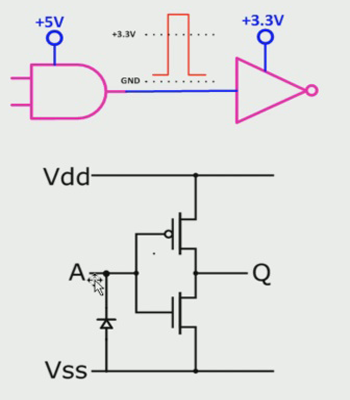
CMOS opened the door for many if not most of the properties needed for today’s highly integrated circuits and low power portable and mobile devices. This really couldn’t happen until the speeds and current drive capabilities of CMOS caught up to the other technologies, but catch up they did.

Nowadays CMOS Small Scale Integration (SSI) logic families, I.E. the gates used in external logic, offer very fast speeds and high current drive capability as well as supporting the low voltages found in modern designs. Likewise the Very Large Scale Integration (VLSI) designs, or Very Very Large Scale if you like counting the letter V when talking, are possible due to low power dissipation as well as other factors.

Continue reading “How CMOS Works: MOSFETs, JFETs, IGFETS And More”

Learning From Transparent Microchips

Microchips and integrated circuits are usually treated as black boxes; a signal goes in, and a signal goes out, and everything between those two events can be predicted and accurately modeled from a datasheet. Of course, the reality is much more complex, as any picture of a decapped IC will tell you.

[Jim Conner] got his hands on a set of four ‘teaching’ microchips made by Motorola in 1992 that elucidates the complexities of integrated circuitry perfectly: instead of being clad in opaque epoxy, these chips are encased in transparent plastic.

The four transparent chips are beautiful works of engineering art, with the chip carriers, the bond wires, and the tiny square of silicon all visible to the naked eye. The educational set covers everything from resistors, n-channel and p-channel MOSFETS, diodes, and a ring oscillator circuit.

[Jim] has the chips and the datasheets, but doesn’t have the teaching materials and lab books that also came as a kit. In lieu of proper pedagogical technique, [Jim] ended up doing what any of us would: looking at it with a microscope and poking it with a multimeter and oscilloscope.

While the video below only goes over the first chip packed full of resistors, there are some interesting tidbits. One of the last experiments for this chip includes a hall effect sensor, in this case just a large, square resistor with multiple contacts around the perimeter. When a magnetic field is applied, some of the electrons are deflected, and with a careful experimental setup this magnetic field can be detected on an oscilloscope.

[Jim]’s video is a wonderful introduction to the black box of integrated circuits, but the existence of clear ICs leaves us wondering why these aren’t being made now. It’s too much to ask for Motorola to do a new run of these extremely educational chips, but why these chips are relegated to a closet in an engineering lab or the rare eBay auction is anyone’s guess.

Review: Single Board 65C02 And 65C816 Computers

The 6502 is a classic piece of computing history. Versions of this CPU were found in everything from the Apple ][, to the Nintendo Entertainment System, and the Commodore 64. The history of the 6502 doesn’t end with video games; for the last forty years, this CPU has found its way into industrial equipment, medical devices, and everything else that doesn’t need to be redesigned every two years. Combine the longevity of the 6502 with the fact an entire generation of developers first cut their teeth on 6502 assembly, and you have the makings of a classic microprocessor that will, I’m sure, still be relevant in another forty years.

The cathedral of The 6502 is Western Design Center. For more than 35 years, WDC has been the home of 6502-related designs. Recently, WDC has been interested in the educational aspects of the 6502, with one of the VPs, [David Cramer], lending his time to an after-school club teaching opcodes.

The folks at WDC recently contacted me to see if I would give their hardware a close look, and after providing a few boards, this hardware proved to be both excellent. They’re great for educators adventurous enough to deviate from the Arduino, Processing, and Fritzing zeitgeist, and for anyone who wants to dip their toes into the world of 65xx development.

Continue reading “Review: Single Board 65C02 And 65C816 Computers”