Mousa rotary dial and circuit

Adapting An Old Rotary Dial For Digital Applications

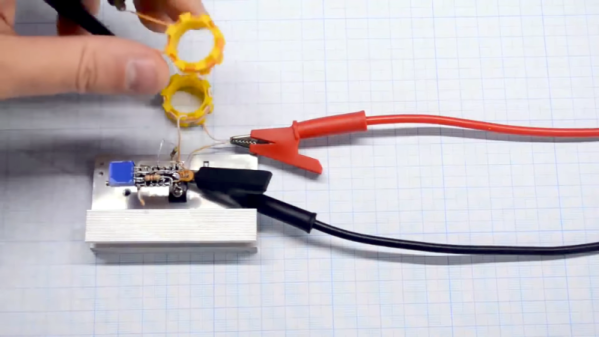
Today in old school nostalgia our tipster [Clint Jay] wrote in to let us know about this rotary dial.

If you’re a young whippersnapper you might never have seen a rotary dial. These things were commonly used on telephones back in the day, and they were notoriously slow to use. The way they work is that they generate a number of pulses corresponding to the number you want to dial in. One pulse for 1, two pulses for 2, and so on, up to nine pulses for 9, then ten pulses for 0.

We see circuits like this here at Hackaday from time to time. In fact, commonly we see them implemented as USB keyboards, such as in Rotary Dial Becomes USB Keyboard and Rotary Dialer Becomes Numeric Keypad.

Continue reading “Adapting An Old Rotary Dial For Digital Applications”

Back to the Future Lunchbox Cyberdeck

Back To The Future Lunchbox Cyberdeck

Our hacker [Valve Child] wrote in to let us know about his Back to the Future lunchbox cyberdeck.

Great Scott! This is so awesome. We’re not sure what we should say, or where we should begin. A lot of you wouldn’t have been there, on July 3rd, 1985, nearly forty years ago. But we were there. Oh yes, we were there. On that day the movie Back to the Future was released, along with the hit song from its soundtrack: Huey Lewis & The News – The Power Of Love.

Continue reading Back To The Future Lunchbox Cyberdeck”

A Steady Vacuum For The Fastest Cassette Tape Drive Ever

If you think of a 1960s mainframe computer, it’s likely that your mental image includes alongside the cabinets with the blinkenlights, a row of reel-to-reel tape drives. These refrigerator-sized units had a superficial resemblance to an audio tape deck, but with the tape hanging down in a loop either side of the head assembly. This loop was held by a vacuum to allow faster random access speeds at the head, and this fascinates [Thorbjörn Jemander]. He’s trying to create a cassette tape drive that can load 64 kilobytes in ten seconds, so he’s starting by replicating the vacuum columns of old.

The video below is the first of a series on this project, and aside from explaining the tape drive’s operation, it’s really an in-depth exploration of centrifugal fan design. He discovers that it’s speed rather than special impeller design that matters, and in particular a closed impeller delivers the required vacuum. We like his home-made manometer in particular.

What he comes up with is a 3D printed contraption with a big 12 volt motor on the back, and a slot for a cassette on the front. It achieves the right pressure, and pulls the tape neatly down into a pair of loops. We’d be curious to know whether a faster motor such as you might find in a drone would deliver more for less drama, but we can see the genesis of a fascinating project here. Definitely a series to watch.

Meanwhile, if your interest extends to those early machine rooms, have a wallow in the past.

Continue reading “A Steady Vacuum For The Fastest Cassette Tape Drive Ever”

The bill of materials and the assembled smartwatch.

Piko, Your ESP32 Powered Fitness Buddy

Over on Hackaday.io there’s a fun and playful write-up for a fun and playful project — the Piko, an ESP32 powered smartwatch.

Our hackers [Iloke Alusala], [Lulama Lingela], and [Rafael Cardoso] teamed up to design and manufacture this wrist-worn fitness wearable. Made from an ESP32 Beetle C6 and using an attached accelerometer with simple thresholds the Piko can detect if you’re idle, walking, jogging, or sprinting; and at the same time count your steps.

Design sketches

The team 3D printed the requisite parts in PLA using the printer in their university makerspace. In addition to the ESP32 and printed parts, the bill of materials includes a 240×240 IPS TFT LCD display, a LIS331HH triple-axis accelerometer, a 200 mAh battery, and of course, a watch strap.

Demonstrating splendid attention to detail, and inspired by the aesthetic of the Tamagotchi and pixel art, the Piko mimics your current activity with a delightful array of hand-drawn animations on its display. Should you want to bring a similar charm to your own projects, all the source is available under the MIT license.

If you’re interested in smartwatch technology be sure to check out our recent articles: Smartwatches Could Flatten The Curve Of The Next Pandemic and Custom Smartwatch Makes Diabetes Monitoring Easier For Kids.

Continue reading “Piko, Your ESP32 Powered Fitness Buddy”

A Lego vehicle crossing a gap between two benches.

Making A LEGO Vehicle Which Can Cross Large Gaps

Here is a hacker showing off their engineering chops. This video shows successive design iterations for a LEGO vehicle which can cross increasingly large gaps.

At the time of writing this video from [Brick Experiment Channel] has been seen more than 110,000,000 times, which is… rather a lot. We guess with a view count like that there is a fairly good chance that many of our readers have already seen this video, but this is the sort of video one could happily watch twice.

Continue reading “Making A LEGO Vehicle Which Can Cross Large Gaps”

ManiPylator focusing its laser pointer at a page.

Simulation And Motion Planning For 6DOF Robotic Arm

[Leo Goldstien] recently got in touch to let us know about a fascinating update he posted on the Hackaday.io page for ManiPylator — his 3D printed Six degrees of freedom, or 6DOF robotic arm.

This latest installment gives us a glimpse at what’s involved for command and control of such a device, as what goes into simulation and testing. Much of the requisite mathematics is introduced, along with a long list of links to further reading. The whole solution is based entirely on free and open source (FOSS) software, in fact a giant stack of such software including planning and simulation software on top of glue like MQTT message queues.

The practical exercise for this installment was to have the arm trace out the shape of a heart, given as a mathematical equation expressed in Python code, and it fared quite well. Measurements were taken! Science was done!

We last brought you word about this project in October of 2024. Since then, the project name has changed from “ManiPilator” to “ManiPylator”. Originally the name was a reference to the Raspberry Pi, but now the focus is on the Python programming language. But all the bot’s best friends just call him “Manny”.

If you want to get started with your own 6DOF robotic arm, [Leo] has traced out a path for you to follow. We’d love to hear about what you come up with!

Continue reading “Simulation And Motion Planning For 6DOF Robotic Arm”

Depositing Metal On Glass With Fiber Laser

Fiber lasers aren’t nearly as common as their diode and CO2 cousins, but if you’re lucky enough to have one in your garage or local makerspace, this technique for depositing thin films of metals in [Breaking Taps] video, embedded below, might be worth checking out. 

It’s a very simple hack: a metal shim or foil is sandwiched between two pieces of glass, and the laser is focused on the metal. Etching the foil blasts off enough metal to deposit a thin film of it onto the glass.  From electron microscopy, [Breaking Taps] reveals that what’s happening is that microscopic molten metal droplets are splashing up to the ̶m̶e̶t̶a̶l̶  glass, rather than this being any kind of plasma process like sputtering. He found this technique worked best with silver of all the materials tested, and there were a few. While copper worked, it was not terribly conductive — he suggests electroplating a thicker layer onto the (probably rather oxidized) copper before trying to solder, but demonstrates soldering to it regardless, which seems to work. 

This might be a neat way to make artistic glass-substrate PCBs. More testing will be needed to see if this would be worth the effort over just gluing copper foil to glass, as has been done before. [Breaking Taps] suspects, and we agree, that his process would work better under an inert atmosphere, and we’d like to see it tried.

One thing to note is that, regardless of atmosphere, alloys are a bit iffy with this technique, as the ‘blast little drops off’ process can cause them to demix on the glass surface. He also reasons that ‘printing’ a large area of metal onto the glass, and then etching it off would be a more reliable technique than trying to deposit complex patterns directly to the glass in one go. Either way, though, it’s worth a try if you have a fiber laser. 

Don’t have a fiber laser? Maybe you could build one. 

Continue reading “Depositing Metal On Glass With Fiber Laser”