 There’s a problem with products geared towards building the Internet of Things. Everyone building hardware needs investors, and thus some way to monetize their platform. This means all your data is pushed to ‘the cloud’, i.e. a server you don’t own. This is obviously not ideal for the Hackaday crowd. Yes, IoT can be done with a few cheap radios and a hacked router, but then you don’t get all the cool features of a real Things project – mesh networking and a well designed network. Pinoccio is the first Thing we’ve seen that puts a proper mesh network together with a server you can own. The Pinoccio team were kind enough to let us drop in while we were in Rock City last weekend, and we were able to get the scoop on these tiny boards from [Sally] and [Eric], along with a really cool demo of what they can do.
The hardware on the Pinoccio is basically an Arduino Mega with a LiPo battery and an 802.15.4 radio provided by an ATmega256RFR2. The base board – technically called a ‘field scout’ – can be equipped with a WiFi backpack that serves as a bridge for the WiFi network. It’s a pretty clever solution to putting a whole lot of Things on a network, without having all the Things directly connected to the Internet.
Programming these scouts can be done through Arduino, of course, but the folks at Pinoccio also came up with something called ScoutScript that allows you to send commands directly to any or all of the scouts on the mesh network. There’s a neat web-based GUI called HQ that allows you to command, control, and query all the little nodules remotely as well.
In the video below, [Sally] goes over the basic functions of the hardware and what it’s capable of. [Eric] was in Reno when we visited, but he was kind enough to get on a video chat and show off what a network of Pinoccios are capable of by emblazoning their web page with Hackaday logos whenever he presses a button.
Continue reading “Pinoccio: Mesh All The (Internet Of) Things”
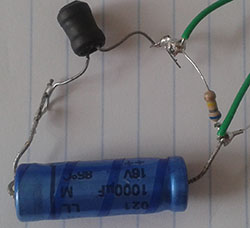 The Internet of Things is fast approaching, and although no one can tell us what that actually is, we do know it has something to do with being able to control appliances and lights or something. Being able to control something is nice, but being able to tell if a mains-connected appliance is on or not is just as valuable. [Shane]
 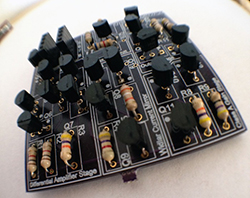 By now we’ve all seen the ‘Three Fives’ kit from Evil Mad Scientist, a very large clone of the 555 timer built from individual transistors and resistors. You can do a lot more in the analog world with discrete parts, and
 Texas Instruments’ CC3000 WiFi chip is the darling of everyone producing the latest and greatest Internet of Thing, and it’s not much of a surprise: In quantity, these chips are only $10 a piece. That’s a lot less expensive than the WiFi options a year ago. Now, TI is coming out with
 We
We