The BatBox: Portable Power, Polished And Professional. Plus Smoke!

batBox

About the size of a shoebox and stuffed with a compact battery/inverter combo, the BatBox packs a mean wallop at 480Wh. What else was [Bill Porter] supposed to do with his free time? He’s already mailed out electronic wedding invitations and built custom LED centerpieces for the reception. He and his wife [Mara] then made an appearance in a Sunday roundup tying the knot by soldering a circuit together. Surely the LED Tetris Tie would have been in the ceremony had it existed. This time, though, [Bill’s] scrounged up some leftover electronics to put a realistic spin on a Minecraft favorite: the BatBox.

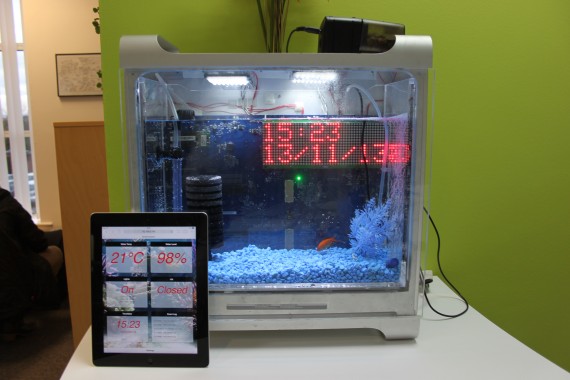
A pair of 18V high energy density batteries connect up to a 12V regulator, stepping them down to drive a 110VAC inverter. The BatBox also supplies 5V USB and 12VDC output for portable devices. Unfortunately, [Bill]’s first inverter turned out to be a low-quality, voltage-spiking traitor; it managed to let the smoke out of his fish tank’s LED bar by roasting the power supply. Undeterred, [Bill] pressed on with a new, higher-quality inverter that sits on an acrylic shelf above the batteries. OpenBeam aluminum extrusion seals up the remainder of the enclosure, completing the BatBox with a frame that looks both appealing and durable.

Voice Controlled Home Automation Uses Raspberry Pi And LightwaveRF

It’s not quite artificial intelligence, but saying “Jeeves, lights!” will switch on the bulbs in the room. [Chipos81] built the voice-activated home automation around a Rapsberry Pi board with LightwaveRF devices switching lights and outlets.

The LightwaveRF system offers a WiFi link which provides Internet connectivity for all of those devices in your house. This makes it a snap for [Chipos81] to control them from the RPi. To provide speech recognition he’s using CMU Sphinx. It’s an open source speech recognition library developed by researchers at Carnegie Mellon University and released under a BSD license. It seems to do a great job in the video of quickly parsing several sets of commands.

“Jeeves” will even talk back to you to confirm a command. This is generated by Festival, a package developed by the University of Edinburgh.  This provides some entertainment in the last seconds of the video as we detect a distinct Scottish accent when it says “See you tomorrow”.

The GPIO pins provide a bit of feedback, using three colored LEDs to let you know what is going on with the system. There’s even an IR LED used to add voice control to your Television.

Continue reading “Voice Controlled Home Automation Uses Raspberry Pi And LightwaveRF”

Controlling Real World Objects From Your Lucid Dream For $15

[Kyle Fredericks] tipped us about his first electronics project, a cheap and smart sleep mask that uses a vibration sensor to detect rapid eye movements.

As some of you may know, REM sleep is the part where you dream the most vividly and actively. If some external stimulation (sound, movement) is sent to you at this moment, it may help you take control of your dream by becoming aware of it. If not, your brain will create dream scenarios that incorporate this stimulus.

The interesting part of the concept is that the vibration sensor calibrates itself at the stage 2 sleep, when no eye movement occurs. This later allows a very accurate detection of the REM sleep stage, triggering a shelf stereo. Secondary buttons are even included in the mask sides.

[Kyle Fredericks] went to great lengths to document every step of the project, making it a perfect first step to learn electronics for beginners out there.

Pair Of Aquarium Builds Are Masterpieces Inside And Out

two-aquarium-builds

As you start to take in all that was involved with building these two aquariums it boggles the mind. At the time of writing the forum thread is 56 pages long and it’s not just filled up with the adoration of [Big Mr Tong’s] fans. He did so much work that every page is packed with progress pictures that cover the range of topics: plumbing, electrical, mechanical, artistic…. wow!

The curse project was sparked by a friend giving him a couple of huge acrylic cylinders which were a perfect size for custom aquariums. [Tong] even had a couple of ideas in mind for underwater artwork to fill them with. One is a replica of statue ruins that give you the feeling that the tank is a piece of Atlantis capture for your own entertainment. The other is a fascinating replica of a plumbing stack. You know, the large cast-iron pipes that carry away waste? But these are actually PVC parts with modeling clay accents. They were broken, cut, melted, sanded, and who knows what else, to arrive at this look. The different aquariums feature different lighting techniques. There’s custom-made filter baffles. We could go on and on but we won’t so check out the link at the top for all the details.

In the end he went beyond the original cylinders and built his own square tank for the pipe design. It’s a steam-punk piece so there’s even analog dials to display the vital signs of the habitat.

Just looking to maintain a tank you already own? How about building an automatic chemical dispenser.

Hacklet Adds Linux Control For The Modlet Smart Outlet

modlet-for-linux-hacklet

Linux users now have a simple option for controlling the Modlet smart outlet. Hacklet is a Ruby script that can switch and read status information from Modlet.

This is the first we remember hearing about Modlet. It’s another take on controlling your appliances remotely. Unlike WeMo, which puts control of one outlet on WiFi, the Modlet uses a USB dongle to control two outlets wirelessly. It has the additional benefit of reading how much current is being used by each plug. This does mean that you need a running computer with the USB dongle to control it. But cheap embedded systems like the Raspberry Pi make this less of an issue both in up-front cost, and the price to keep it running all the time.

[Matt Colyer’s] demo video includes an unboxing of the $60 starter kit. The screen seen above shows his script pairing with the outlet. It goes on to demonstrate commands to switch it, and to pull the data from the device. He even provides an example of how to use IFTTT with the script.

Continue reading “Hacklet Adds Linux Control For The Modlet Smart Outlet”

Monitoring A Sick Bird Using The Raspberry Pi

sick-bird-monitoring-with-rpi

[Jorge Rancé] was nursing a sick bird back to health. He found it on the street with a broken leg, which required a mini plaster cast for it to heal correctly. But felt bad when leaving the house for long periods. He grabbed some simple hardware and put his mind at easy by building an Internet connected bird monitoring system. It’s really just an excuse to play around with his Raspberry Pi, but who can blame him?

A webcam adds video monitoring using the Linux software called “motion” to stream the video. This is the same package we use with our cats when we travel; it provides a continuous live stream but can also save recordings whenever motion is detected. He added a USB temperature sensor and attached a water level sensor to the GPIO header. These are automatically harvested — along with a still image from the webcam — and tweeted once per hour using a bash script. He just needs to work out automatic food and water dispensing and he never needs to return home! Bird seed shouldn’t be any harder to dish out than fish food, right?

Home Audio And Lighting Taken Over By The Raspberry Pi

687474703a2f2f7777772e6265616b61626c652e636f6d2f696d672f707265766965772d312e706e67

We’re beginning to see a lot of momentum building for using Raspberry Pi boards as the basis of your home automation. This latest offering from [Iain Hamilton] combines lighting and audio control through a single web interface. His frontend is run as a web page from the RPi board. It even includes separate layouts for mobile devices and computers in order to maximize use of the screen real estate.

Three buttons at the top of the interface allow him to configure the settings and switch between lighting and audio controls. This audio control screen issues commands to the Spotify client running on the Pi. The Mopidy package takes care of almost everything (as we’ve seen with other single-board computer Spotify servers). Future iterations will offer other streaming services like SoundCloud. [Iain’s] home lighting system uses X10 modules for control. He’s using a USB dongle to facilitate control of that system.

Continue reading “Home Audio And Lighting Taken Over By The Raspberry Pi”