Buzzle: A Morse Code Puzzle Box

[lucasfragomeni] built the Buzzle after being inspired by the reverse geocache puzzle. The Buzzle was built as a gift to a friend. It’s a tricky gift too. His friend can’t open it until he decodes the words being displayed in morse code via an LED. A word is chosen at random, so you would have to decode it each time you want to open the box. That’s a pretty neat security feature. Sure it’s not the most secure, but it would keep casual peepers out. Unfortunately, the box was empty when his friend received it.

SheevaPlug PBX

[youtube=http://www.youtube.com/watch?v=RIcTWya7TQA&feature=player_embedded]

[Greg] has been working on a version of Debian/ FreePBX/ Asterisk for people to be able to drop onto a SheevaPlug. If you haven’t seen it, the SheevaPlug is a tiny computer housed in a wall plug. They made some waves when they were announced last year, and we’ve spoken of them several times. [Greg] is offering up the operating system in a pre configured format for SD cards so you can just download it and drop it in your SheevaPlug. Yeah, there’s a little bit of work to do before it will boot, which you can see in the video above.  Thanks for sending this in [Greg], keep up the good work.

The Most Complicated, And Simplest Binary Clocks.

We were going to take a break from posting clocks. Really we were. This one came in the tip line today though, and we just couldn’t pass it up. [Alex] has built, what might be the most complicated clock we’ve seen. At least, it would appear that way initially. This Binary clock shows Hours, Minutes, Seconds, Days, and Months. He started with a picaxe, but eventually settled on an Mbed. Yes, he knows it is overkill, but it worked out pretty well.

As for the simplest, that came into our tip line as well. [Toby] sent this in, and agrees with us that it is hardly worthy of being called a hack. However, in light of the complicated one above, we didn’t see any harm in posting its opposite. Check it out after the break.

Continue reading “The Most Complicated, And Simplest Binary Clocks.”

Wine Glass Time Keeper

We’ve seen a glut of time-keeping projects lately. We guess time was the original motivator for technology so we’re okay with it (but we’re not calling ourselves Clockaday quite yet). This clock, or more appropriately this timer, is a homemade hourglass that [Andrei] put together. The finished look is simple but he put some real time into its production.

The glass portion is a combination of two wine glasses. He removed the stems, ground the bottoms flat, then drilled holes to allow the sand to pass. He used plumbers putty around the top of the upturned reservoir to create a temporary bowl of water which cooled the glass during drilling. This prevented cracking by keeping the friction generated heat at bay. Working with the glass took a total of around five hours.

To assemble, he epoxied the two wine glasses together, routed out a ring in the wood bases for the lips, and used dowels to connect the two ends. [Andrei] concluded that the gentle slope at the bottom of the wine glasses is not the ideal shape as some sand can get stuck in them. Perhaps champagne flutes for his next build? At any rate, we think it’s a unique, non-automated hourglass build.

Volt Meter Clock

The Volt meter clock continues our recent slew of interesting clock projects. Though considerably easier to read than the resistor clock, it is in the same frame of mind. Set up to look like the face of an analog volt meter, it almost looks like something official or scientific. Since [Jon] couldn’t simply drop a clock mechanism in, he used a PIC microcontroller. The circuit is pretty simple, but he deserves some credit just for the unique layout.

Know Your Resistors… Tell The Time

[Darren] built a clock that uses a resistor to display the time. Well, it really uses a model of a resistor. This extremely tardy entry in the Hackaday design challenge houses all of the electronics on a PCB the size of a business card. Four RGB LEDs shine up through holes in the wooden base to light bands on an acrylic tube. The colors correspond to the values used in the Resistor Color Code. In the picture above the clock is displaying 5:26 (that’s supposed to be a red band but the camera didn’t pick it up too well). The band in the center fades up over 60 seconds to signify AM, and down to show PM.

It may be late, but it’s a clever design. It looks sleek and it uses no buttons for an interface. [Darren] sourced the LEDs themselves as light sensors to display the date, and enter time setting mode.

Google Bike Hack, Quick And Dirty

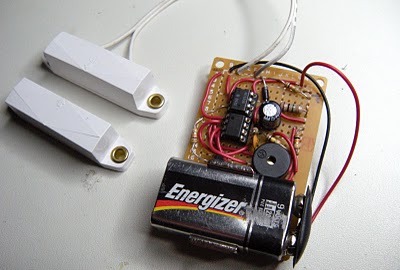
Many of the projects we post are so well thought out and engineered, they could hardly be called “hacks”.  This one, however, falls neatly into the hack category. [Dave] wanted his very own exercise bike hooked to Google maps. Instead of setting up a control system and writing software to control Google maps, he simply hacked a USB game controller. He wired a magnetic switch directly into the board, where the “up” button is. Then he mounted the switch so that it would be triggered each time he rotated the pedal.  Though he only has the forward movement done right now, it would be pretty easy to set up a couple more switches at the base of the handle bar for left and right.

While the experience may not be quite as nice as the more complicated one, aside from head tracking, it isn’t that far off.