DIY Router Base For Your Dremel

dremel-attachment-main

Dremel rotary tools are handy. Some of the attachments are convenient.  [vreinkymov] felt the convenience wasn’t worth the cost, so he decided to make a Router Base for his Dremel. These types of attachments are used to hold the Dremel perpendicular to the work surface.

Underneath the little nut/cover near the spindle of the Dremel, there is a 3/4″-12 threaded feature used to attach accessories. A quick trip down the hardware store’s plumbing aisle resulted in finding a PVC reducer with the correct female thread to fit the Dremel. Once on the rotary tool, the reducer threads into a PVC nipple that is glued to a piece of acrylic. The acrylic acts as the base of the router attachment.

Continue reading “DIY Router Base For Your Dremel”

Cheap, Resourceful DIY Mini CNC Router/Mill Contraption

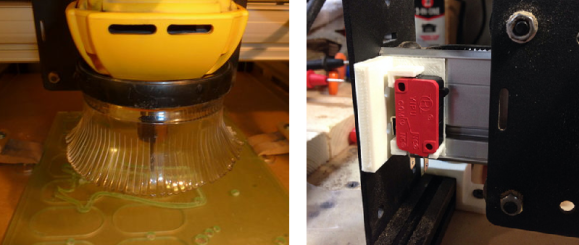
Few Hackaday Readers would disagree with the classic phrase: Necessity is the mother of invention. That statement is certainly no exaggeration when it comes to this mini 3-axis CNC Machine. The builder, [Jonathan], needed a way to prototype circuit boards that he designed. And although he admittedly doesn’t use it as much as he intended, the journey is one of invention and problem solving.

[Jonathan] started from the ground up with his own design. His first machine was a moving gantry style (work piece doesn’t move) and ended up not performing to his expectations. The main problem was alignment of the axis rails. Not becoming discouraged, [Jonathan] started on version 2. This time around the work piece would move in the X and Y directions like a conventional vertical milling machine. The Porter-Cable laminate trimmer would move up and down for the Z axis. It is clear that the frame is built specifically for this project. Although not the prettiest, the frame is completely functional and satisfactorily stiff for what it needs to do.

Continue reading “Cheap, Resourceful DIY Mini CNC Router/Mill Contraption”

7-Foot DIY Wind Turbine Proves Size Matters

7ft-wind-turbine

When [brokengun] decided to build a 7 ft diameter wind turbine, he had no idea how to even start, so he did as most of us would do and read some books on the topic. His design criteria was that it would be simple to construct and use as many recycled parts as possible. This wind turbine charges a 12 volt battery which can then be used to power a variety of gadgets.

Although made from recycled components, this isn’t a thrown together wind turbine. A lot of thought went into the design and build. [brokengun] discusses matching the blade size to that of the generator in order to maximize power and efficiency.  The design also incorporates a feature that will turn the turbine perpendicular to the wind if the wind-speed gets to high. Doing this prevents the turbine from being damaged by strong gusts.

For the main support/hub assembly, a Volvo 340 strut was used because they are widely available, cheap and known for being long-lasting. The tail boom is made from electrical conduit and it’s length is determined by the size of the main fan rotor. The tail vane is made from steel sheet metal and its surface area is also dependent on the fan rotor size to ensure that the turbine functions properly. The blades are made from wood but instead of making them himself, [brokengun] felt these were worth ponying up some cash. [brokengun] also scored a 30 ft high lattice tower an airport was getting rid of. This worked out great as it’s just the right height for a turbine of this size.

Continue reading “7-Foot DIY Wind Turbine Proves Size Matters”

Robot Dominates Air Hockey, Frightens John Connor, Wayne Gretzky

We’ve all been disappointed at some point in our lives after yearning to play air hockey and not finding anyone to play against. This is no longer a problem at [Jose]’s house. He has built a very amazing Air Hockey Playing Robot. This robot moves in 2 directions, can predict the movements of the puck and also decide to block, shoot or a do a combination of both.

Surprisingly, most of the ‘robotics’ parts are 3D printer left overs, which includes: NEMA17 stepper motors, an Arduino Mega, a RAMPS board, motor drivers, belts, bearings and rods. The bracketry, puck and paddle are all 3D printed. The air hockey table itself was built from scratch using off-the-shelf wood. Two standard 90mm PC fans are all that are responsible for creating the air pressure used to lift the puck. A PS3 camera monitors the action and is literally this robot’s eye in the sky.

Check out the video and learn more about this project after the break.

Continue reading “Robot Dominates Air Hockey, Frightens John Connor, Wayne Gretzky”

Laser-Based PCB Printer

Being able to create PCB’s at home is a milestone in the DIYer’s arsenal. Whether you physically mill or chemically etch boards, it’s a tricky task to perfect. [Charlie & Victor] are working towards a solution to this complicated chore. They call their machine the DiyouPCB. DiyouPCB is an open source PCB etching project consisting of both hardware and software components.

The project is based on using a Blue Ray optical pickup. The pickup was used in its entirety, without any modification, to simplify the build process. In order to use the stock pickup, [Charlie & Victor] had to reverse engineer the communication protocol which also allowed them to take advantage of the auto-focus feature used while reading Blue Ray discs. The frame of the machine is reminiscent of a RepRap, which they used to do preliminary testing and laser tuning. The X and Y axes run on brass bushings and are belt driven by stepper motors which are controlled by an Arduino through a specially designed DiyouPCB Controller Shield.

Continue reading “Laser-Based PCB Printer”

Collin’s Lab Is Coming Back

Collin

We would like to share a bit of good news; Collin’s Lab is back on the airwaves of the Internet. If you didn’t know, [Collin Cunningham] previously created excellent short videos, sometimes entertainingly tongue-in-cheek, for Make Magazines on the subjects of electronic components and fundamental electronics. In 2012 he was hired at Adafruit as a Creative Engineer to help with software development and video production.

Going forward Collin’s Lab videos will be a regular feature on Adafruit’s Blog and their YouTube channel. We’re sure there is going to be tons of entertaining learning from Collin with his unique video production skills and presentation delivery.

This first release of Collin’s Lab on Adafruit is a primer review covering fundamental multimeter functionality and measurements. Not much here for the medium to advanced electronics hacker but for the beginner this is an excellent and quick way to learn the basics on using your multimeter.

If you want to checkout Collin’s older video productions you can find them on his Narbotic Instruments site under – “Make Presents” and “Collin’s Lab” or watch them all with this convenient playlist. Just after the break you can also watch his latest edition of Collin’s Lab.

Continue reading “Collin’s Lab Is Coming Back”

This Space Saver Puts The Squeeze On Your Keys

MultiKey

Keys? Who needs them? Well, pretty much everyone. You can’t deny that there are some ridiculously crowded key chains out there. It’s clear that [Robb] wanted to hit the other side of that spectrum when he started working on his latest multi-key project.

The term “multi-key” may be a little misleading as there are more than just keys on this tool. In addition to the bike lock, locker, work and house keys, there is a USB drive, bottle opener, screw driver and a couple of Allen wrenches. The side frames started out as part of an Allen key combo set; one not of the highest quality.  The Allen keys started snapping off during use which left [Robb] with a set of otherwise useless side frames. These became the platform of which [Robb’s] project is based. Adding a couple new bolts, nuts and a few modified keys got him the rest of the way there. A lot of thought went into which items to put into this tool and [Robb] explains his thought process in his step-by-step instructions.

The simple nature and potential for customizing makes this a great utilitarian DIY project. Although this may not be Janitor worthy, it will certainly consolidate some of the bulk in our pockets.