Serial Telemetry To Wi-Fi With An ESP8266

Hackaday.io user [J. M. Hopkins] had a problem with his rocketry. Telemetry from the rockets came down to Earth via a 433MHz serial link, but picking just the bits he needed from a sea of data for later analysis on a laptop screen on bright sunny days was getting a little difficult.

His solution was to bring the serial data from his transceiver module to an ESP8266, and from that both share it over WiFi and display pertinent information via I2C to an LCD for easy reference. And he’s put the whole lot with a power supply in a rather splendid wooden case with an SMA socket on the back to attach his Yagi.

All information received from the telemetry is passed to a client connecting via Telnet over the WiFi, but pertinent information for the LCD is selected by sending it from the rocket enclosed in square brackets. We hope that the source code will be forthcoming in time.

This isn’t the first time we’ve featured rocket telemetry here at Hackaday. And we’d be missing a trick if we didn’t point out that this project is using our own Hackaday-branded Huzzah ESP8266 breakout board from the Hackaday Store.
Breaking Out The ATtiny10

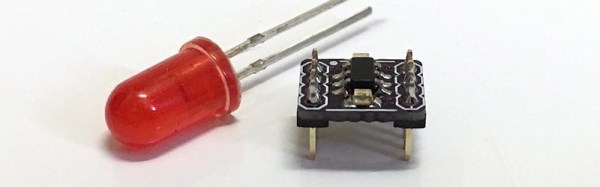
Atmel’s ATtiny10 is the one microcontroller in their portfolio that earns its name. It doesn’t have a lot of Flash – only 1 kilobyte. It doesn’t have a lot of RAM – only thirty two bytes. It is, however, very, very small. Atmel stuffed this tiny microcontroller into an SOT-23 package, more commonly used for surface mount transistors. It’s small, and unless your ideal application is losing this chip in your carpet, you’re going to need a breakout board. [Dan] has just the solution. He could have made this breakout board smaller, but OSHpark has a minimum size limit. Yes, this chip is very, very small.

Because this chip is so small, it doesn’t use the normal in-system programming port of its larger brethren. The ATtiny10 uses the Tiny Programming Interface, or TPI, which only requires power, ground, data, clock, and a reset pin. Connecting these pins to the proper programming header is easy enough, and with a careful layout, [Dan] fit everything into a breakout board that’s a hair smaller than a normal 8-pin DIP.

The board works perfectly, but simply soldering the ATtiny10 to a breakout board and using it as is probably isn’t the best idea. The reason you use such a small microcontroller is to put a microcontroller into something really, really small like ridiculous LED cufflinks. A breakout board is much too large for a project like this, but SOT23 test adapters exist, and they’re only $25 or so.

Either way, [Dan] now has a very, very small microcontroller board that can fit just about anywhere. There’s a lot you can do with one kilobyte of Flash, and with an easy way to program these chips, we can’t wait to see what [Dan] comes up with.

Microchip Unveils Online MPLAB IDE And $10 Board

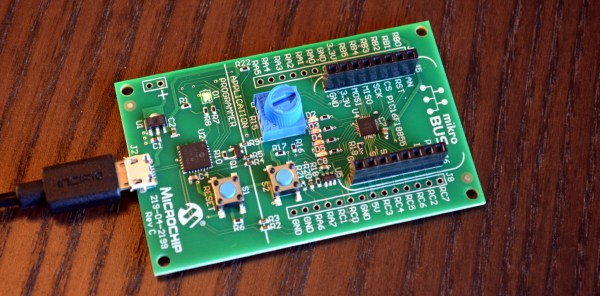
Today, Microchip released a few interesting tools for embedded development. The first is a free online IDE called MPLAB Xpress, the second is a $10 dev board with a built-in programmer. This pair is aimed at getting people up and running quickly with PIC development. They gave us an account before release, and sent over a sample board. Let’s take a look!

Continue reading “Microchip Unveils Online MPLAB IDE And $10 Board”

Particle Electron – The Solution To Cellular Things

Just over a year ago, Particle (formerly Spark), makers of the very popular Core and Particle Photon WiFi development kits, released the first juicy tidbits for a very interesting piece of hardware. It was the Electron, a cheap, all-in-one cellular development kit with an even more interesting data plan. Particle would offer their own cellular service, allowing their tiny board to send or receive 1 Megabyte for $3.00 a month, without any contracts.

Thousands of people found this an interesting proposition and the Electron crowdfunding campaign took off like a rocket. Now, after a year of development and manufacturing, these tiny cellular boards are finally shipping out to backers and today the Electron officially launches.

Particle was kind enough to provide Hackaday with an Electron kit for a review. The short version of this review is the Electron is a great development platform, but Particle pulled off a small revolution in cellular communications and the Internet of Things

Continue reading “Particle Electron – The Solution To Cellular Things”

Rube Goldberg PC/Console Game Hack

There’s no holy war holier than establishing whether PC games are superior to console games (they are). But even so, there’s no denying that there are some good console titles out there. What if you’d still like to play them using a mouse and keyboard? If you’re [Agent86], you’d build up the most ridiculous chain of fun electronics to get the job done.

Now there is an overpriced off-the-shelf solution for this problem, and a pre-existing open-source project that’ll get the same job done for only a few bucks in parts. But there’s nothing like the fun in solving a problem your own way, with your own tangle of wires, darn it all! The details of the build span four (4!) pages in [Agent86]’s blog, so settle down with a warm cup of coffee.

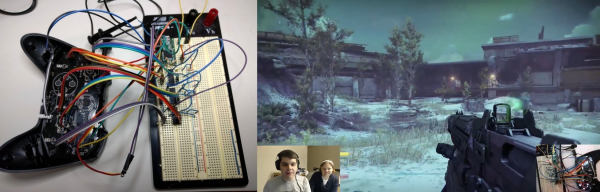
Here’s the summary: an Xbox 360 controller is taken apart and turned into an Xbox controller. The buttons and joysticks are put under computer control via a Teensy microcontroller. GPIOs press the controller’s buttons, and digipots replace the analog sticks. Software on the Teensy drives the digipots and presses the buttons, interpreting a custom protocol sent over USB from the computer, which also gets some custom software to send the signals.

So if you’re keeping score: a button press on a keyboard is converted to USB, sent to a PC, converted to a custom serial protocol, sent to a Teensy which emulates a human for a controller that then coverts the signals back into the Xbox’s USB protocol. Pshwew!

Along the way, there’s learning at every stage, which is really the point of an exercise like this. And [Agent86] says that it mostly works, with some glitches in the mouse-to-joystick mapping. But if you’re interested in any part of this crazy chain, you’ve now got a model for each of them.


Bye-bye ATmega328P, Hello 328PB!

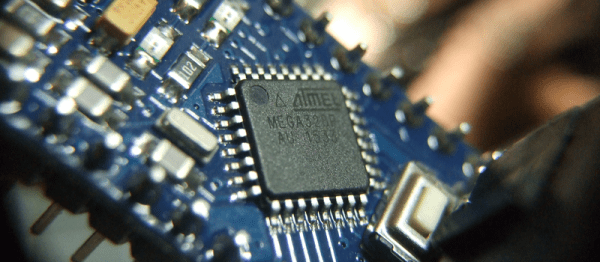
We never have enough peripherals on a microcontroller. Whether it’s hardware-driven PWM channels, ADCs, or serial communication peripherals, we always end up wanting just one more of these but don’t really need so many of those. Atmel’s new version of the popular ATmega328 series, the ATmega328PB, seems to have heard our pleas.

We don’t have a chip in hand, but the datasheet tantalizes. Here’s a quick rundown of the new features:

  • Two more 16-bit timer/counters. This is a big deal when you’re writing code that’s not backed up by an operating system and relies on the hardware for jitter-free timing.
  • Two of each USART, SPI, and I2C serial instead of one of each. Good when you use I2C devices that have limited address spaces, or when you need to push the bits out really fast over SPI.
  • Ten PWM channels instead of six. This (along with the extra 16-bit timers) is good news for anyone who uses PWM — from driving servos to making music.
  • Onboard capacitive sensing hardware: Peripheral Touch Controller. This is entirely new to the ATmega328PB chip, and looks like it’ll be interesting for running capacitive sense buttons without additional ICs. It relies on Atmel’s QTouch software library, though, so it looks like it’s not a free-standing peripheral as much as an internal multiplexer with maybe some hardware-level filtering. We’ll have to look into this in detail when we get our hands on one of the chips.

So what does this mean for you? A quick search of the usual suspects shows the chips in stock and shipping right now, and there’s an inexpensive dev kit available as well. If you write your own code in C, taking advantage of the new features should be a snap. Arduino folks will have to wait until the chips (and code support) work their way into the ecosystem.

Thanks [Peter van der Walt] for the tip!

Microchip To Acquire Atmel For $3.56 Billion

Just last week, there was considerable speculation that Microchip would buy Atmel. The deal wasn’t done, and there was precedent that this deal wouldn’t happen – earlier this year, Dialog made an approach at Atmel. Now, though, the deal is done: Microchip will acquire Atmel for $3.56 Billion.

There are three main companies out there making microcontrollers that are neither ancient 8051 clones or ARM devices: TI’s MSP430 series, Microchip and Atmel. Microchip has the very, very popular PIC series microcontrollers, which can be found in everything. Atmel’s portfolio includes the AVR line of microcontrollers, which are also found in everything. From phones to computers to toasters, there’s a very high probablitiy you’re going to find something produced by either Atmel or Microchip somewhere within 15 feet of your person right now.

For the hobbyist electronic enthusiast, this has led to the closest thing we have to a holy war. Atmel chips were a little easier (and cheaper) to program, but were a little more expensive. Microchip’s chips have a very long history and proportionally more proper engineers who are advocates. PIC isn’t Arduino, though, a community that has built a large and widely used code base around the AVR family.

Microchip’s acquisition of Atmel follows several mergers and acquisitions in recent months: NXP and Freescale, Intel and Altera, Avago and Broadcom, and On Semiconductor and Fairchild. The semiconductor industry has cash and wants to spend it. What this means for the Atmel product line is left to be seen. The most popular micros probably won’t be discontinued, but if you’re using unpopular Atmel micros such as the ATtiny10 you might want to grab a reel or two before they’re EOL’d.