Great Junk-yard Find Leads To A Reclaimed Control Panel Project

Having the “can you believe somebody threw this away?” mentality has gotten us into some trouble through the years, but look what [Joshua] found at the scrap yard! It’s a door from a power conversion station and it contains fourteen indicator lights and a lot of other doodads. But since this is just the door, he needed a way to monitor the controls and drive the indicators. At the heart of the hack he used to get this up and running is a PIC 18F2550. It has no trouble driving the indicators thanks to a pair of ULN2803 darlington arrays which switch the higher 24 volt levels.

His writeup doesn’t mention the method used, but the panel also has a couple of meters at the top. In the video after the break you can clearly see that he’s got them both working. We’d bet there’s a plan for each of the buttons as well, since this will be prominently featured in their alien-invasion themed Halloween display this year.

Continue reading “Great Junk-yard Find Leads To A Reclaimed Control Panel Project”

BAMF2011: ChipKIT Is Arduino To The Power Of 32

If you’ve been hungry for more power for your microcontroller projects, but reluctant to dump your investment in Arduino shields or the libraries and community knowledge that go with them all, Digilent has you covered. Their new chipKIT boards are built around the Microchip PIC32 MCU…a powerful 32-bit chip that until recently was left out of the cross-platform scene. A majority of code and quite a number of Arduino shields will work “out of the box” with the chipKIT, and the familiar development tools are available for all three major operating systems: Windows, Mac and Linux.

We first mentioned these a couple weeks ago, but the software was unavailable at the time. Seeing the development tools in action was quite unexpected…

Continue reading “BAMF2011: ChipKIT Is Arduino To The Power Of 32”

Using An AVR As An RFID Tag

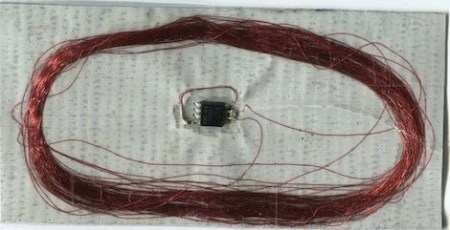
A few years ago, [Beth] came up with the idea of using an AVR as an RFID tag. She’s gotten sidetracked with a few other projects in the meantime but her idea has surfaced again, this time as a duct tape RFID tag. The build is just four components: 0.1 µF and 1 nF capacitors, an ATtiny85 microcontroller, and 100 turns of 40 AWG magnet wire, all soldered together and placed on a duct tape substrate.

Like most RFID tags, the power is drawn from the reader through the coil, but even in low power versions the ATtiny is only rated down to 1.8 Volts. Since the microcontroller is only getting about 1 Volt from the coil, the clock oscillator of the ATtiny won’t work. This isn’t a problem in this build, because the coil is connected to the the clock input – the 125 kHz coming off the reader provides the clock. Very clever.

Of course, the microcontroller is going to need some firmware to send some bits to the reader, so she used the AVRFID firmware (check out the comments in the source for a great walkthrough) to transmit under the HID protocol, itself a derivative of [Beth]’s earlier work with the EM4102 protocol.

Not only are we impressed with this hack, we’re amazed [Beth] is still perfecting her work more than two years after her first post on the subject. That’s dedication and unbridled cleverness.

Via adafruit

Reverse Engineering A Cheap LED Message Marquee

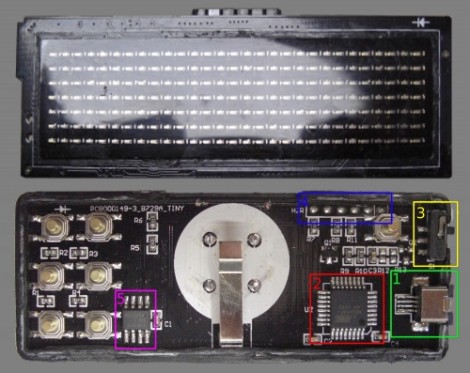
[Hugo] went all out when sharing his findings while reverse engineering this small LED marquee. He purchased the 29×7 LED matrix for under $12 but was surprised to find that the USB connector wasn’t a standard type and didn’t come with a cable. He first soldered a standard connector in place and then set out to make the device do his bidding (translated).

What he accomplished can be seen in the video after the break. He can now connect to the device via a USB cable, sending it new messages and adjusting the speed at which it scrolls. He can also adjust the spacing between letters, reverse the scrolling direction, read the on-board buttons, and write the settings to the device’s EEPROM. This is all thanks to some alternative firmware that [Hugo] wrote for the ATmega88. You can download a copy of that code from the wiki page he put together (translated). We really appreciate the time he spent putting that page together. The wealth of information he gathered during the hacking process serves as an example of the best way to share your projects with the world.

Continue reading “Reverse Engineering A Cheap LED Message Marquee”

Dimming Control For An Ikea Solar Desk Lamp

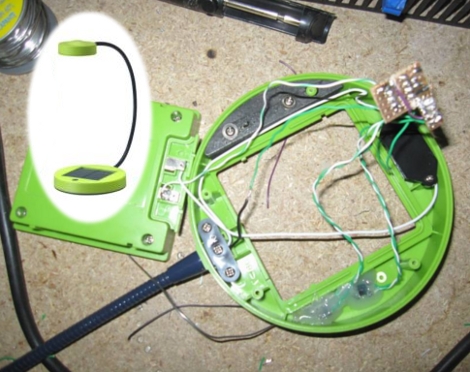
[Frank] decided to augment his desk lamp’s features by adding dimming controls (translated). Since the light source is a triad of LEDs the best method of dimming their intensity is to use Pulse Width Modulation. That’s the method that he went with, and luckily the SUNNAN lamp from Ikea which he’s using as the donor for the project has just enough room to squeeze in the parts necessary for this hack.

You need two main bits to use PWM with a lamp like this; a microcontroller (or possibly a timer chip like the 555) and a transistor to protect that chip from the current necessary to run the LEDs at full brightness. [Frank] went with an ATtiny13 and a 2N2222 transistor, both quite common and very inexpensive (you can even pull the microcontroller from a light bulb if you know where to look). Two buttons were added to the top of the lamp base which allow for up and down controls. There’s even an SOS function which is triggered by pressing both buttons at the same time. [Frank’s] happy to show off the completed project in the clip after the break.

Continue reading “Dimming Control For An Ikea Solar Desk Lamp”

Adding Ethernet Control For A 5.1 Speaker Set

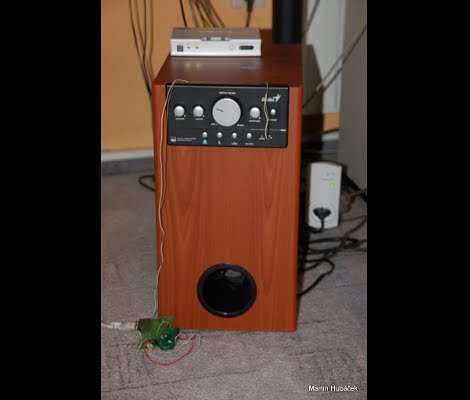
[HuB’s] set of 5.1 surround sound speakers was gobbling up a bunch of electricity when in standby as evidenced by the 50 Hz hum coming from the sub-woofer and the burning hot heat sink on the power supply. He wanted to add a way to automatically control the systems and offer the new feature of disconnecting the power from the mains.

The first part was not too hard, although he used a roundabout method of prototyping. He planned to use the IR receiver on the speakers to control them. At the time, [HuB] didn’t have an oscilloscope on hand that he could use to capture the IR protocol so he ended up using Audacity (the open source audio editing suite) to capture signals connected to the input of a sound card. He used this to establish the timing and encoding that he needed for all eight buttons on the original remote control.

Next, he grabbed a board that he built using an ATmega168 and an ENC28J60 Ethernet chip. This allows you to send commands via the Internet which are then translated into the appropriate IR signals to control the speakers and a few other devices in the room. The last piece of the puzzle was to wrap an RF controlled outlet into the project with lets him cut mains power to the speakers when not in use. You can see the video demonstration embedded after the break.

Continue reading “Adding Ethernet Control For A 5.1 Speaker Set”

Optimizing Code For PWM Efficiency

For some projects, it’s okay to have a microcontroller twiddling it’s thumbs most of the time. When a project requires the cpu to do just one thing over and over, there’s no loss with inefficient code – it either works or it doesn’t. However, if a project requires a microcontroller to do several things at once, like reading sensors, dimming LEDs, and writing serial data out, cpu utilization can become an issue. [Robert] wasn’t happy with the code he used to control a string of LEDs, so he rewrote his code. With the old implementation, [Robert]’s code used 60% of the cpu time. With the new and improved code, the cpu was only busy 8% of the time.

The code works by using a hardware timer to trigger an interrupt. After calculating the next time it should run again, and changing the state of the data line, the code just sits quietly until it’s needed again.

It’s not a pretty hack, or even one you can hold in your hands, but [Robert]’s determination in getting a μC to do what he wants is admirable.