Possibly-Smallest ESP32 Board Uses Smallest-Footprint Parts

Whenever there’s a superlative involved, you know that degree of optimization has to leave something else on the table. In the case of [PegorK]’s f32, the smallest ESP32 dev board we’ve seen, the cost of miniaturization is GPIO.

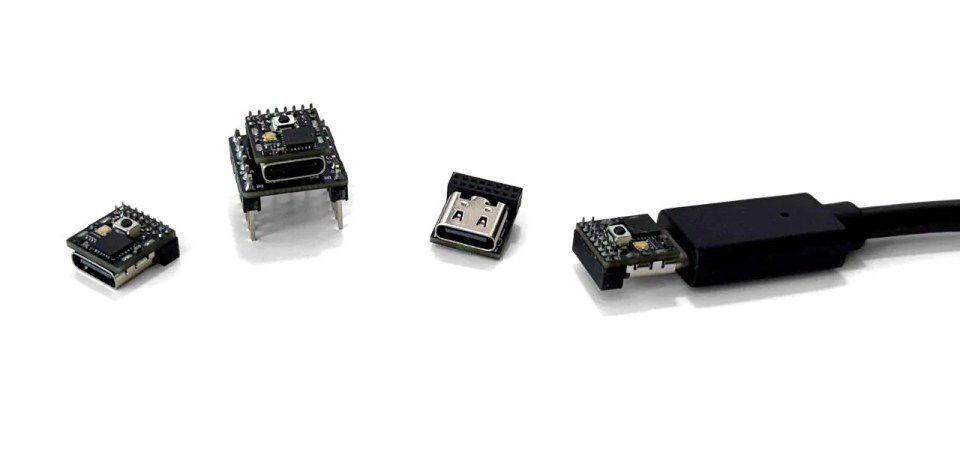
There’s only one GPIO pin broken out, and it’s pre-wired to an LED. That’s the bad news, and depending on what you want an ESP32 for, it might not phase you at all. What is impressive here, if not the number of I/O pins, is the size of the board: at 9.85 mm x 8.45 mm barely overhangs the USB-C socket that takes up one side of the board.

Pegor provides this helpful image in the readme so you know what you’re getting into with the 01005 resistors.

In order to get the ESP32-C3FH4 onto such a tiny board, all of the other support hardware had to be the smallest possible sizes– including resistors in 01005. If you don’t speak SMD, one could read that number code as “oh god too small” — at 0.4 mm x 0.2 mm it’s as minuscule as you’ll find– and [Pegor] hand soldered them.

OK, he did use a hot plate for the final step, but he did tin the pads manually with a soldering iron, which is still impressive. Most of us probably would have taken PCBWay up on their offer of assembly services, but not [Pegor]. Apparently part of the reason for this project was that he was looking for an excuse to use the really small footprint components.

Aside from leaving out GPIO and needing too-small SMD components, [Pegor] admits that pesky little details like antenna matching circuits and decoupling capacitors had to get cut to make the tiny footprint, so this board might be more of a stunt than anything practical. So what can you do with the smallest ESP32 board? Well, [Pegor] put up a basic web interface up to get you started blinking the built-in LED; after that, it’s up to you. Perhaps you might fancy a teeny-tiny minecraft server? If you can stand to increase the volume a little bit, we’ve seen how to hack a C3 for much better wifi performance.

Thanks to [Pegor] for the tip, and remember– submit your projects, big or small, we read ’em all!

Micro:Bit Gets Pseudo-Polyphonic Sound With Neat Hack

The Micro:bit is a fun microcontroller development platform, designed specifically for educational use. Out of the box, it’s got a pretty basic sound output feature that can play a single note at a time. However, if you’re willing to get a bit tricky, you can do some pseudo-polyphonic stuff as [microbit-noob] explains.

The trick to polyphony in a monophonic world? Rapidly alternating between the different notes you want to be playing at the same time. Do this fast enough and it feels like they’re playing together rather than seperately. [microbit-noob] demonstrates how to implement this with a simple function coded for the Micro:bit. Otherwise, it uses the completely stock sound hardware. However, the IR receiver is added to the device in order to allow a simple remote control to be used to command the notes desired, along with some extra tactile buttons to add further control.

Is it chiptune? Well, it’s a chip, playing a tune, so yes. Even if it is through a tiny speaker stuck to the PCB. In any case, if you’re trying to get some better bleeps and bloops out of the Micro:bit, this is a great place to start. If you’ve got other hacks for Britain’s educational little board, let us know on the tipsline!

Building A Smart Speaker Outside The Corporate Cloud

If you’re not worried about corporate surveillance bots scraping your shopping list and manipulating you through marketing, you can buy any number of off-the-shelf smart speakers for your home. Alternatively, you can roll your own like [arpy8] did, and keep your life a little more private.

The build is based around an ESP32 microcontroller. It connects to the ‘net via its inbuilt Wi-Fi connection, and listens out for your voice with an INMP441 omnidirectional microphone module. The audio data is trucked off to a backend server running a Whisper speech-to-text model. The text is then passed to Google’s Gemini 2.5 Flash large language model. The response generated is passed to the Piper Neural Voice text-to-speech engine, sent back to the ESP32, and spat out via the device’s DAC output and a speaker attached to an LM386 amplifier. Basically, anything you could ask Gemini, you can do with this device.

By virtue of using a commercial large language model, it’s not perfectly private by any means. Still, it’s at least a little farther removed than using a smart speaker that’s directly logged in to your Amazon/Google/Hulu/Beanstikk account. Files are on Github for those eager to dive into the code. We’ve seen some other fun builds along these lines before, too. Video after the break.

Continue reading “Building A Smart Speaker Outside The Corporate Cloud”

Tiny386 On An Espressif ESP32-S3

Some people may remember the joys of trying to boot Linux on an 8-bit AVR microcontroller, which was an absolute exercise in patience. In comparison [He Chunhui]’s Tiny386 emulator running on an ESP32-S3 MCU is positively zippy when it boots and runs Windows 95. The provided video (also embedded below) makes clear that while you can comfortably waddle off to prepare and pour a fresh cup of tea, it’s actually borderline usable.

The source code can be obtained via GitHub, which contains not just the basic emulated 80386 CPU written in C99, but also peripherals borrowed from TinyEMU and QEMU, along with a SeaBIOS ROM. In addition to the Windows 95 demo it’s claimed that Tiny386 should be able to run most 16/32-bit software.

Right now the ESP32-S3 version targets the JC3248W535 board, which is a roughly $30 development board featuring a built-in display with touch screen and an ESP32-S3 module. Although it has a USB-C port, it appears that this one is just for programming and not for the USB peripheral of the ESP32-S3. With the USB OTG peripheral used, one could conceivably make a small 386 system based around an ESP32-S3 that features a USB hub to plug a keyboard, mouse, etc. into.

Considering that the Tiny386 emulator is a very simple and straightforward approach to emulating an early-90s PC, some optimization might enable a pretty zippy general purpose PC for early 90s software. Quite a boost from watching Linux struggle into a command line on an AVR, indeed.

Continue reading “Tiny386 On An Espressif ESP32-S3”

Running A Minecraft Server On A WiFi Light Bulb

WiFi-enabled ‘smart’ light bulbs are everywhere these days, and each one of them has a microcontroller inside that’s capable enough to run all sorts of interesting software. For example, [vimpo] decided to get one running a minimal Minecraft server.

The Bl602-equipped board inside the LED lightbulb. (Credit: vimpo, YouTube)

Inside the target bulb is a BL602 MCU by Bouffalo Lab, that features not only a radio supporting 2.4 GHz WiFi and BLE 5, but also a single-core RISC-V CPU that runs at 192 MHz and is equipped with 276 kB of RAM and 128 kB flash.

This was plenty of space for the minimalist Minecraft server [vimpo] wrote several years ago. The project says it was designed for “machines with limited resources”, but you’ve still got to wonder if they ever thought it would end up running on a literal lightbulb at some point.

It should be noted, of course, that this is not the full Minecraft server, and it should only be used for smaller games like the demonstrated TNT run mini game.

Perhaps the next challenge will be to combine a large set of these light bulbs into a distributed computing cluster and run a full-fat Minecraft server? It seems like a waste to leave the BL602s and Espressif MCUs that are in these IoT devices condemned to a life of merely turning the lights on or off when we could have them do so much more.

Continue reading “Running A Minecraft Server On A WiFi Light Bulb”

Photo of breadboards and bench oscilloscope

Programming The 6581 Sound Interface Device (SID) With The 6502

Over on YouTube, [Ben Eater] pursues that classic 8-bit sound. In this video, [Ben] integrates the MOS Technology 6581 Sound Interface Device (SID) with his homegrown 6502. The 6581 SID was famously used in the Commodore line of computers, perhaps most notably in the Commodore 64.

The 6581 SID supports three independent voices, each consisting of a tone oscillator/waveform generator, an envelope generator, and an amplitude modulator. These voices are combined into an output filter along with a volume control. [Ben] goes into detail concerning how to configure each of these voices using the available facilities on the available pins, referencing the datasheet for the details.

[Ben]’s video finishes with an 8-bit hit from all the way back in October 1985: Monty on the Run by Rob Hubbard. We first heard about [Ben’s] musical explorations back in June. If you missed it, be sure to check it out. It seems hard to imagine that demand for these chips has been strong for decades and shows little sign of subsiding.

Continue reading “Programming The 6581 Sound Interface Device (SID) With The 6502”

Rocket Roll Control, The Old Fashioned Way

The vast majority of model rockets go vaguely up and float vaguely downwards without a lot of control. However, [newaysfactory] built a few rockets that were altogether more precise in their flight, thanks to his efforts to master active roll control.

[newaysfactory] started this work a long time ago, well before Arduinos, ESP32s, and other highly capable microcontroller platforms were on the market. In an era when you had to very much roll your own gear from the ground up, he whipped up a rocket control system based around a Microchip PIC18F2553. He paired it with a L3G4200D gyro, an MPXH6115A barometer, and an MMA2202KEG accelerometer, chosen for its ability to provide useful readings under high G acceleration. He then explains how these sensor outputs were knitted together to keep a rocket flying straight and true under active control.

[newaysfactory] didn’t just master roll control for small rockets; he ended up leveraging this work into a real career working on fully-fledged autopilot systems. Sometimes your personal projects can take your career in interesting directions.

Continue reading “Rocket Roll Control, The Old Fashioned Way”