Big Slew Bearings Can Be 3D Printed

Consider the humble ball bearing. Ubiquitous, useful, and presently annoying teachers the world over in the form of fidget spinners. One thing ball bearings aren’t is easily 3D printed. It’s hard to print a good sphere, but that doesn’t mean you can’t print your own slew bearings for fun and profit.

As [Christoph Laimer] explains, slew bearings consist of a series of cylindrical rollers alternately arranged at 90° angles around an inner and outer race, and are therefore more approachable to 3D printing. Slew bearings often find application in large, slowly rotating applications like crane platforms or the bearings between a wind turbine nacelle and tower. In the video below, [Christoph] walks us through his parametric design in Fusion 360; for those of us not well-versed in the app, it looks a little like magic. Thankfully he has provided both the CAD files and a selection of STLs for different size bearings.

[Christoph] is no stranger to complex 3D-printable designs, like his recent brushless DC motor or an older clock build. The clock is cool, but the bearings and motors really get us — we’ll need such designs to get to self-replicating machines.

Continue reading “Big Slew Bearings Can Be 3D Printed”

Scanning Electron Microscope Adds To Already Impressive Garage Lab

When you’re a high schooler who built a semiconductor fab in your garage, what’s next on your agenda? Why, adding a scanning electron microscope to your lab, naturally. How silly of you to ask.

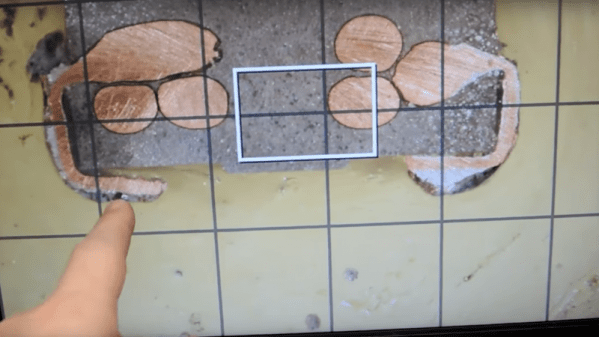
When last we stumbled across the goings on in the most interesting garage in New Jersey, [Sam Zeloof] was giving a tour of his DIY semiconductor fabrication lab and showing off some of the devices he’s made there, including diodes and MOSFETs. As impressive as those components are, it’s the equipment he’s accumulated that really takes our breath away. So adding an eBay SEM to the mix only seems a natural progression, and a good reason to use some of the high vacuum gear he has. The video below shows [Sam] giving a tour of the 1990s-vintage instrument and shows images of various copper-sputtered samples, including a tick, which is apparently the state bird of New Jersey.

SEM hacks are by no means common around here, but they’re not unheard of. [Ben Krasnow] has used his to image cutting tools and phonograph records in action, and there are a few homebrew SEMs kicking around too. But our hats are off to [Sam] for yet another acquisition and a great tutorial to boot.

Continue reading “Scanning Electron Microscope Adds To Already Impressive Garage Lab”

Being A Friend To Man’s Best Friend

When [Jason Dorie] tipped us off on this, he said, “This barely qualifies as a hack.” We disagree, as would any other dog lover who sees how it improved the life of his dog with a simple mood-altering doggie-bed carousel.

[Jason]’s hack lies not so much in the rotating dog bed – it’s just a plywood platform on a bearing powered by a couple of Arlo robot wheels. The hack is more in figuring out what the dog needs. You see, [Thurber] is an old dog, and like many best friends who live a long life, he started showing behavioral changes, including endlessly pacing out the same circular path to the point of exhaustion. Circling in old dogs is often a symptom of canine cognitive dysfunction, which is basically the dog version of Alzheimer’s. Reasoning that the spinning itself was soothing, [Jason] manually turned [Thurber]’s dog bed on the floor. [Thurber] calmed down immediately, so the bittersweetly named “Dementia-Go-Round” was built.

Sadly, [Thurber] was actually suffering from a brain tumor, but he still really enjoyed the spinning and it gave him some peace during his last few days. Looking for hacks to help with human dementia? We’ve had plenty of those before too.

Continue reading “Being A Friend To Man’s Best Friend”

DIY Ram Pump Obeys The Laws Of Physics

Despite the claims of “free energy” on the title of the video below, this is not yet another wacky perpetual motion story. We here at Hackaday fully support the laws of thermodynamics, and we think you should too. But you have to admit that a pump that works without any apparent energy inputs looks kind of shady at first glance.

The apparatus in question is a ram pump, a technology dating back all the way to the 18th century. The version that [Junkyard – Origin of Creativity] built uses commonly available materials like PVC pipes and fittings. About the only things on the BOM that might be hard to scratch up are the brass check valves, which should probably be flap valves rather than the easier to find spring valves. And the only custom part is an adapter to thread the plastic soda bottle that’s used as an air chamber to the PVC, which a 3D printer could take care of if you choose not to hack a bottle cap like [Junkyard] did. The video below shows the impressive lift achieved just by tapping the kinetic energy of the incoming flow.

There, the Second Law of Thermodynamics remains inviolate. But if you still think you can get something for nothing, check out our roundup of perpetual motion and Overunity quackery.

Continue reading “DIY Ram Pump Obeys The Laws Of Physics”

The Other Kind Of Phone Hacking

While it’s true that your parts bin might have a few parts harvested from outdated devices of recent vintage, there’s not much to glean anymore aside from wall warts. But the 3×48-character LCD from [Kerry Wong]’s old Uniden cordless landline phone was tempting enough for him to attempt a teardown and reverse engineering, and the results were instructive.

No data sheet? No problem. [Kerry] couldn’t find anything out about the nicely backlit display, so onto the logic analyzer it went. With only eight leads from the main board to the display module, it wasn’t likely to be a parallel protocol, and the video below shows that to be the case. A little fiddling with the parameters showed the protocol was Serial Peripheral Interface, but as with other standards that aren’t exactly standardized, [Kerry] was left with enough ambiguity to make the analysis interesting. Despite a mysterious header of 39 characters, he was able in the end to drive the LCD with an Arduino, and given that these phones were usually sold as a bundle with a base and several handsets, he ought to have a nice collection of displays for the parts bin.

With how prevalent this protocol has gotten, [Kerry]’s post makes us want to get up to speed on the basics of SPI. And to buy a logic analyzer too.

Continue reading “The Other Kind Of Phone Hacking”

FPGA Rescues Scope From The Dumpster

I’m always on the lookout for a quality addition to my lab that would respect my strict budget. Recently, I’ve found myself pushing the Hertz barrier with every other project I do and hence desperately wanted a high bandwidth scope. Unfortunately, only recently have 70 MHz to 100 MHz become really affordable, whilst a new quad channel oscilloscope in the 500 MHz to 1 GHz range still costs a fortune to acquire. My only option was to find an absolute miracle in the form of an old high bandwidth scope.

It seemed the Gods of Hand Me Down electronics were smiling upon me when I found this dumpster destined HP 54542C. It appeared to be in fairy good shape and was the Top Dog in its day. But something had to be broken right? Sure enough, the screen was clearly faulty and illegible. Want to know how I fixed it? Four letters: FPGA.

Continue reading “FPGA Rescues Scope From The Dumpster”

Inside A Microswitch

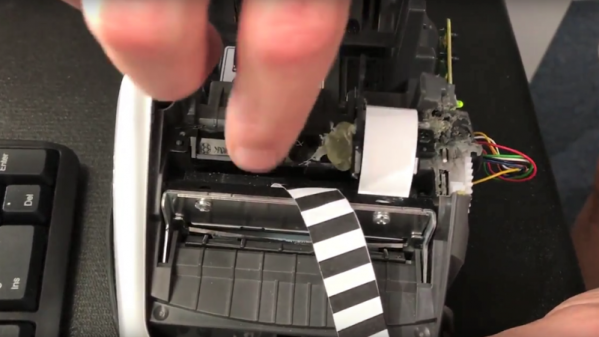
We’ve taken a few microswitches apart, mostly to fix those pesky Logitech mice that develop double-click syndrome, but we’ve never made a video. Luckily, [Julian] did, and it is worth watching if you want to understand the internal mechanism of these components.

[Julian] talks about the way the contacts make and break. He also discusses the mechanical hysteresis inherent in the system because of the metal moving contact having spring-like qualities

Continue reading “Inside A Microswitch”