Mobile Mini Green Recreates Coeur D’Alene’s Floating 14th Hole

Golf is an expensive obsession for some, with course fees on the most memorable and challenging courses running into the hundreds of dollars a game and beyond. If playing one of the most unusual holes in golf is simply beyond your means, there’s no need to fret – just do what [TVMiller] did and build a miniature mobile replica of the famous Coeur d’Alene Resort Floating 14th hole.

The Floating 14th is pretty spectacular as far as golf holes go. With a green located on an island about a hundred yards offshore of beautiful Lake Coeur d’Alene in northern Idaho, there’s little room for error – after all, it’s surrounded by a 49 square mile water trap. [TVMiller]’s replica green recreates the target quite accurately, although we doubt the Jolly Wrencher flag is regulation for championship play. But the best part is the motorized platform and smartphone app that can be used to send the mini green out as far as you feel like practicing. Sure, it could be a tad more realistic if the replica green actually floated, but asphalt fairways are a little easier to come by than Olympic-sized swimming pools.

A fun, tongue-in-cheek project, and we really enjoyed the faux TV coverage of the 2015 Hackaday Golf Championship in the video below. If real golf isn’t your thing, you might want to build a table-top golf course, or play a round of mini golf with a ball-incinerating Portal themed hole.

Continue reading “Mobile Mini Green Recreates Coeur D’Alene’s Floating 14th Hole”

Parts Bin Emergency Lights Deal With Tornado’s Aftermath

Sometimes having a deep inventory of parts in your shop is a pain – the clutter, the dust, the things you can’t rationally justify keeping but still can’t bear to part with. But sometimes the parts bin delivers and lets you cobble together some emergency lighting when a tornado knocks out your power.

It has been hard to avoid discussions of the weird weather in the US this winter. The eastern half of the country has had record warm temperatures, the west has been lashed by storms, and now December tornadoes have ripped through Texas and other parts of the south, with terrible loss of life and wide-ranging property damage. [TheTimmy] was close enough to one massive EF4 tornado to lose power on Saturday night, and after the charm of a candlelight Christmas evening wore off, he headed to the shop. He had a bunch of sealed lead acid batteries from old UPSs and a tangle of 12V LED modules, and with the help of some elastic bands and jumper clips he wired up a bunch of lights for around the house. Safer than candles by a long shot, and more omnidirectional than flashlights to boot.

The power came back before the batteries ran out of juice, so we don’t get to see any hacks for recharging batteries in a grid-down scenario. Still, it’s good to see how a deep parts bin and good mindset can make a positive impact on an uncomfortable situation. We’ve seen similar hacks before, like this hacked cordless tool battery pack or powering a TV with 18650 batteries. Be sure to share your story of epic power-outage hacks in the comments below.

A Better Expanding Table

About a year ago, [Scott] completed what is probably one of the finest builds ever shown on a YouTube channel. It was an expanding wooden table, a build inspired by a fantastically expensive expanding table that was itself inspired by a creation by a mad woodworker in the early 1800s. Although [Scott]’s table is a very well-engineered build, there were a few things he wasn’t happy with. Over the past few months he’s been refining the design and has come up with the final iteration – and plans – for a wooden mechanical expanding table.

Late last year, [Scott] had about 450 hours of design and build time in his table, and by the time he got to the proof of concept stage, he simply ran out of steam. Another year brings renewed enthusiasm, and over the past month or so he’s been working on much-needed improvements to his expanding table that included a skirt for the side of the table, and improvements to the mechanics.

The expanding table is rather thick with three layers of tabletop stacked on top of each other, and those exposed mechanical linkages should be hidden. This means a skirt, and that requires a huge wooden ring. [Scott] built a ring 5 1/2″ deep, about an inch and a half thick, and has the same diameter of the table itself. This means cutting up a lot of plywood, and stacking, gluing, sanding, and routing the entire thing into a perfectly round shape.

The other upgrades were really about the fit and finish of the internal mechanics of the table. Screws were changed out, additional brackets were crafted, and the mounts for the internal ‘star’ was upgraded.

After all that work, is the table done? No, not quite; the skirt could use a veneer, proper legs need to be built, and the entire thing could use a finish. Still, this is the most complete homebuilt expanding table ever conceived, and [Scott] has the plans for his table available for anyone who would want to replicate his work.

Continue reading “A Better Expanding Table”

Beer Kegs Make Excellent Resin Dispensers

[Josh Updyke] woke up one morning and found himself in a sticky situation. The demand for his modular robotic track system was outgrowing his ability to produce. One of the bottlenecks was weighing out resin. It’s a slow, monotonous process that must be done with accuracy. The free market did not have any affordable solutions to the problem. So like any hacker worth his weight in 2N2222 transistors, he made his own by re-purposing some used beer kegs.

The resin comes in two parts – the resin itself and a hardener. Each must be weighted out on a scale before mixing to ensure proper proportions. It was a trial-by-error learning process before [Josh] was able to settle on a final solution. First he tried some garden sprayers, which worked OK at first. But the resin was taking too long to exit the sprayers, and he had to pressurize them by manually pumping them with air. He ended up with a much better method that used some Cornelius Kegs.

Be sure to check out his io page for more details.

Comparing Movies Between Rottentomatoes And IMDB

Well, it’s the holiday season! Which means two things. Long, sometimes uncomfortable gatherings with family, and our favorite — free time. So if you’re looking to catch up on some movies, [Rajesh Verma] has you covered. He’s compiled a database that aggregated data from both Rotten Tomatoes and IMDB!

That means you can very easily sort through based on critic’s favorite, audience favorite, IMDB favorite, underrated, overrated, year, etc. He started by dabbling with aggregation scripts with just Rotten Tomatoes, and after he released one showing both Audience and Critic scores, Rotten Tomatoes updated their site to include that sorting method! Coincidence? Maybe.

Either way, it broke his original script when the site was updated — so he’s come back with something even better — a list for both IMDB and Rotten Tomatoes.

He started the project thanks to [Michael] at Meta Film List, who had the idea of making movie databases more accessible. Without further ado, you can check out the list on Google Docs.

Mostly Wood Motorized Camera Slider

Camera slides can make for interesting dolly shots in your videos, or can spice up an otherwise drab time-lapse sequence. When it came time for one of his own, [Bob] did what any hacker would do and rolled his own motorized camera slide in the wood shop.

We always like to see work based on a hacker’s own prior art, and [Bob] managed to leverage parts and techniques from his impromptu claw machine build for this slider. The rollers in this project use the same 3/4″ angle aluminum and skateboard bearings as the previous build. The bearings roll on a plywood strip capped with the same angle stock for durability and low friction. The stepper motor bracket and pillow blocks are 3D printed, as are the timing pulleys. [Bob] admits that the whole rig is a little noisy and blames it on the rough quality of the pulley prints. He has plans to replace them with commercially available pulleys, which should help; one further suggestion we have is to code a soft-start algorithm into the ATtiny85 to eliminate that jerkiness you see when he demos the slider in the video below.

There are plenty of ways to move a camera along a single axis, and a surprising number of them use parts from the roller sports. We’ve covered quite a few of them before, like this slide that uses skateboard trucks, or this non-motorized rig built from fence posts and inline skate wheels.

Continue reading “Mostly Wood Motorized Camera Slider”

The Ultimate Puzzle Desk — MYST Eat Your Heart Out

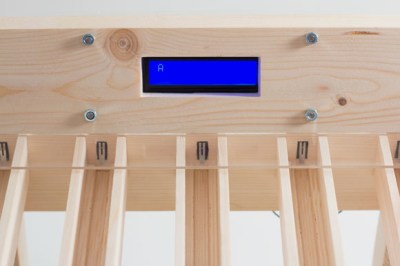
This project is absolutely mind boggling. Created by [Kagen Sound], this desk would fit right at home inside the MYST games. It has a pipe organ inside, and you can open a secret compartment by playing a specific tune.

Besides being an absolute marvel of woodworking, the hidden mechanics inside this desk make our heads hurt. The pipe organ aspect works by pushing in little drawers — this forces air into organ pipes at the front of the desk. But some of the air is redirected into a pneumatic memory board — which can actually keep track of the notes you play. When the correct tune is played, it triggers a pendulum which releases a secret compartment. All you need is a trap door over an abyss and you’ve recreated The Goonies.

Sure, it’d be easy to do that with an Arduino or something… but the pneumatic memory board is made of wood. Entirely made of solid wood. [Kagen] says it took countless hours to design, at least five different versions before he found one that worked.

Continue reading “The Ultimate Puzzle Desk — MYST Eat Your Heart Out”