DIY Punch Card System Despite Hanging Chads

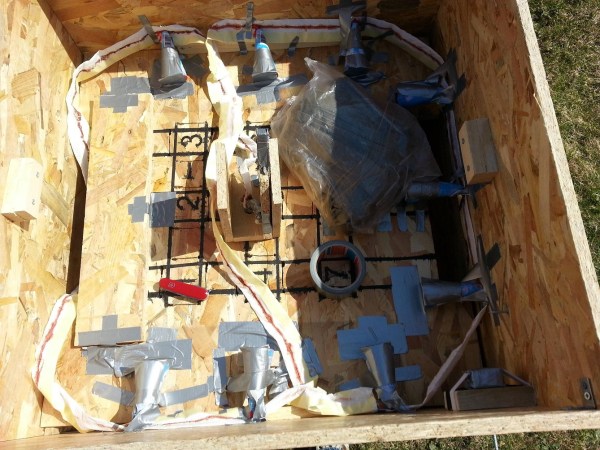
Sometimes you just have parts lying around and want to make something out of them. [Tymkrs] had a robot paper cutter, so naturally they made punch cards. But then, of course, they needed a punch card reader, so they made one of those too. All with stuff lying around the shop.

The Silhouette Portrait paper cutter is meant for scrapbooking, but what evokes memories of the past more than punchcards? To cut out their data, rather than cute kittens or flowers, they wrote some custom code to turn ASCII characters into rows of dots. And the cards are done — you just have to clean up the holes that didn’t completely cut. These are infamously known as hanging chads.

The reader is made up of a block of wood, with a gap for the cards and perpendicular holes drilled for LEDs and photoresistors. This is cabled to a Propeller dev board with some simple firmware. We would have used photodiodes or phototransistors, because that’s what’s in our junk box (and because they have faster reaction time), but when you’ve got lemons, make lemonade.

OK, now that you’ve got a punch card reader and writer, what do you do with it? Password storage comes to mind.

Continue reading “DIY Punch Card System Despite Hanging Chads”

The Simplest Steam Engine

[RimstarOrg] has posted an awesome writeup on his Hero’s steam engine . Hero’s engine is a Greek design from the first century and is the earliest known steam engine. It’s amazing to think he developed the engine seventeen centuries before the industrial revolution, and yet it was largely ignored. While you can find more faithful replicas, of this landmark machine [RimstarOrg]’s rig can’t be beaten for simplicity and he does a great job of explaining the principal of operation and construction.

Using a soda can filled with water and a propane torch [RimstarOrg] was able to get the can to rotate rapidly by ejecting steam from two holes in the side of the can. A fishing swivel is used to provide a pivoting joint and allow the can to rotate freely.

While we’ve covered steam engines before, we loved this simple design, and can’t wait to see what [RimStarOrg] comes up with next.

Continue reading “The Simplest Steam Engine”

Hackers Measure Cable Lengths With Time Domain Reflectometers

[android] has built up a fast edge pulse generator for time domain reflectometry (TDR). TDR is a neat technique which lets you measure cable lengths using electrical signals and can also be used to locate faults within the cable.

TDR works by sending a pulse down the cable. When the pulse reaches the end of the unterminated cable it is reflected back to the source. By monitoring the delay between the original pulse and its reflection you can determine the length of the cable. We’ve seen projects that use TDR before, and it’s often used in telecoms industry to locate faults in long cable runs.

You can try TDR in your lab using only a scope to observe the delay and a function generator to create the pulse. However, the technique works a lot better with pulses that have very fast rise times. So [android] built a fast edge pulse generator based on [w2aew]s design. Then added googly eyes for good measure. His build works great and is a nice demonstration of the technique.

Hacking Cheap Chinese PID Temperature Controllers

[Harvs] hacked a cheap PID controller he found on eBay to improve its performance. The controller originally used a K-type thermocouple but lacked cold junction compensation. As thermocouples only provide a differential measurement between the measurement junction and cold junction, this meant the controller was assuming the cold junction was at room temperature, and would in many cases be significantly inaccurate. The system also used a no-name brand Chinese microcontroller making firmware hacks impractical.

[Harvs] decided that even with cold junction compensation a K-type thermocouple wasn’t ideal for his application anyway, and designed a replacement PCB to interface to the display and power supply. The new PCB is based around a Cypress PsoC (a popular choice for its great analog functionality) with a DS18B20 temperature sensor. At the lower temperature ranges [Harvs] is interested in the DS18B20 is far more accurate and easy to use than the thermocouple.

Though the project hasn’t been updated recently, [Harvs] was planning on adding an ESP8266 for remote monitoring and control. Great work [Harvs]!

Thanks to Peter for the tip.

Get Biohacking With A DIY CO2 Incubator

The [Pelling Lab] have been iterating over their DIY CO2 incubator for a while now, and it looks like there’s a new version in the works.

incubator3

We’ve covered open source Biolab equipment before including incubators but not a CO2 incubator. Incubators allow you to control the temperature and atmosphere in a chamber. The incubator built by the [Pelling Lab] regulates the chambers temperature and CO2 levels allowing them to culture cells under optimal conditions.

While commercial incubators can cost thousands of dollars the [Pelling Lab] used a Styrofoam box, space blanket, and SodaStream tank among other low cost parts. The most expensive component was a CO2 sensor which cost $230. The rig uses an Arduino for feedback and control. With a total BOM cost of $350 their solution is cost effective, and provides an open platform for further development.

The original write up is full of useful information, but recent tweets suggest a new and improved version is on the way and we look forward to hearing more about this exciting DIYBio project!

Retro TO-3 Switching Voltage Regulator

Restoring old gear often means replacing unavailable parts with modern equivalents. [Alex Eisenhut] needed to replace some old TO-3 voltage regulators and decided to make an authentic-looking switching power supply replacement. These three pin metal cans were very common, especially the LM340 5V regulator which was, of course, a linear regulator. Today, you are more likely to see a 7805 in a TO-220 case or something surface mount for a comparable linear regulator.

As you might expect, the board uses surface mount components. [Alex] used Mill Max machine pins to match the original regulator footprint and calls the regulator Ton3y. He plans to cover it up with a 3D printed lid, but it seems a shame to hide the fine PCB work.

In the pictures, you can see that the machine pins are a tight fit. [Alex] used a hammer to lightly tap them into place. Of course, the original TO-3 regulators were linear and would generate a lot of heat. The Ton3y, as you’d expect from a switching power supply, runs cool (according to the scientific measurement made with [Alex]’s pinky finger) and surely has a wider input voltage range and more output current capacity.

We’ve seen replacement switching regulators before, but this one is really a work of art.

Self Built Interferometer Measures Nanometer Displacement

[jrcgarry] hacked together this awesome interferometer which is able to measure displacements in the nanometer range. Commercial interferometers are used in research labs to measure tiny displacements on the nanometer scale, and can cost tens of thousands of dollars. [jrcgarry] used beam splitters from BluRay drives, mirrors from ebay and a 5mw laser diode.

We’ve covered the use of interferometers before. But never an instrument built from scratch like this. Interferometers exploit the wave-like nature of a beam of light. The beam is split and sent down two separate paths, where the beams bounce off mirrors to return to the beam splitter to be recombined. Because of its wave light nature the beams will interfere with each other. And as the beams have traveled different distances they may be in or out of phase. Resulting in either constructive (brighter) or destructive (darker) interference.

Because the wavelength of light is on the order of 100s of nanometers, by observing the interference patterns you can monitor the displacement of the mirrors with respect to each other at nanometer resolution. [jrcgarry] doesn’t use the interferometer for any particular application in this tutorial but it’s a great demonstration of the technique!