Powder Your Prints For Baby-Smoothness

Layer lines are a dead giveaway to non-normies that a thing was 3D printed. There are things you can do to smooth them — sanding, chemical smoothing, and fillers come to mind. Although this technique technically uses all three, it starts with something very simple.

In the video after the break, [DaveRig] gets right to the point: baby powder and resin mixed together make a fine smoothing agent when cured. Having read about it online, he decided to give it a try.

Starting with a half sphere that had admittedly pretty big layer lines, [DaveRig] mixed up enough resin and baby powder to make the consistency of milk or cream. Then he put five coats on, curing and sanding with 120 in between each one.

Then it’s on to standard post-processing stuff. You know, wipe it down with alcohol, sand it a little more, wet sand, and then it’s on to the airbrush and clear-coat. The end result looks to be as smooth as your average bowling ball, as you can see in the main photo.

What’s your favorite post-processing method? Have you tried annealing them in salt?

Continue reading “Powder Your Prints For Baby-Smoothness”

Input Device Gets New Input Device

One of the nicest things about a trackpoint is that you don’t have to take your hands off the keyboard. One of the worst things about a trackpoint is its usual placement, which can force a weird hand position that can cause repetitive stress injury.

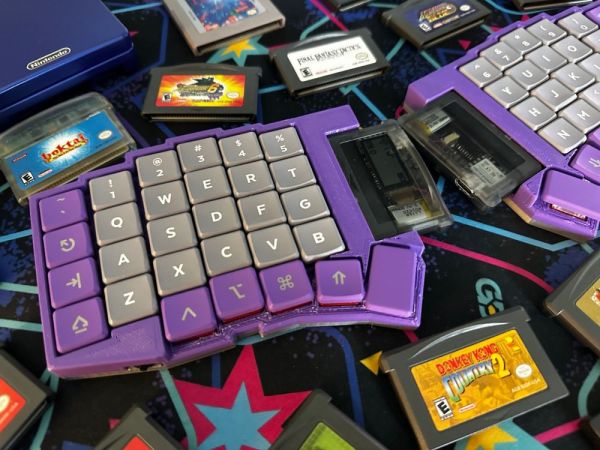
[notshitashi] has done an incredible job of adding a trackpoint to the Glove80 wireless split keyboard. It must have been really scary to drill holes in the palm rests of such a nice and not-cheap keyboard, but [notshitashi] soldiered on nonetheless, and the end result looks great.

Starting with a trackpoint module from Ali, [notshitashi] found that it didn’t fit the palm rest without being trimmed down, so they desoldered the business part from the main PCB and reattached it with wires. They had to go through a few of them to get it just right, but that’s the way it goes sometimes.

[notshitashi] calls this “a bit of a cheat and dirty hack” because the trackpoint module is wired and, therefore, a separate USB HID. Yes, the Glove80 has GPIO connectors in both halves, but the problem is that stock ZMK has yet to support pointing devices. We don’t care; this is quite the elegant hack anyway.

Want to jazz up your mechanical keyboard with a trackpoint? Here’s a handy guide. Or, you can perform a transplant.

You Can Use An Old Tape Deck As A Distortion Pedal

Distorted guitars were a big part of the rock revolution last century; we try to forget about the roll. As a youth, [David Hilowitz] couldn’t afford a loud aggressive amp, a distortion pedal, or even a proper electric guitar. This experience ended up teaching him that you can use random old audio hardware as a distortion effect.

[David’s] guitar journey started when he found a classical guitar on a dumpster. He learned to play, but longed for the sound of a proper electric guitar. Family friends gifted him a solitary pickup, intending he build a guitar, but he simply duct-taped it to his steel-strung classical instead. The only thing he lacked was an amp. He made do with an old stereo system and a record pre-amp. With his his faux-electric guitar plugged into the microphone input, he was blessed with a rudimentary but pleasant distortion that filled his heart with joy.

[David] goes on to explain the concepts behind distorted guitar sounds, and how his home hi-fi was able to serve as a passable starter amp when he was young and couldn’t afford better. He then goes on the hunt for more old gear at a local Goodwill store, finding a neat old tape deck that similarly produced some nice warm distorted tones. In [David’s] experience, old hi-fi gear with microphone inputs can generally do a decent job in this role, with electric guitar pickups typically overloading the preamps which expect a lower-level signal. It’s different to what you’d get from a Big Muff or Boss DS-1, but it’s a neat sound nonetheless.

We’ve looked at distortion effects before, including rolling your own and putting it into production. Video after the break.

Continue reading “You Can Use An Old Tape Deck As A Distortion Pedal”

Spinning CRT Makes A 360 Degree Audio Oscilloscope

A question for you: if the cathode ray tube had never been invented, what would an oscilloscope look like? We’re not sure ourselves, but it seems like something similar to this mechanical tachyscope display might worked, at least up to a point.

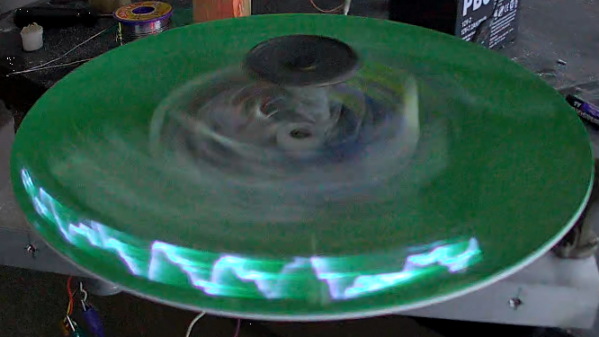
What’s ironic about this scenario is that the tachyscope [Daniel Ross] built actually uses a CRT from a defunct camcorder viewfinder as the light-up bit of what amounts to a large POV display. The CRT’s horizontal coil is disconnected while the vertical coil is attached to the output of a TEA205B audio amplifier. The CRT, its drive electronics, and the amp are mounted to a motorized plastic platter along with a wireless baby monitor, to send audio to the CRT without the need for slip rings — although a Bluetooth module appears to be used for that job in the video below.

Speaking of slip rings, you’d expect one to make an appearance here to transfer power to the platter. [Daniel] used a slip ring for his previous steampunk tachyscope, but this time out he chose a hand-wound air core transformer, with a stationary primary coil and secondary coil mounted on the platter. With a MOSFET exciter on the primary and a bridge rectifier on the secondary, he’s able to get the 12 volts needed to power everything on the platform.

Like most POV displays, this one probably looks better in person than it does in video. But it’s still pretty cool, with the audio waveforms sort of floating in midair as the CRT whizzes around. [Daniel] obviously put a lot of work into this, not least with the balancing necessary to get this running smoothly, so hats off for the effort.

Continue reading “Spinning CRT Makes A 360 Degree Audio Oscilloscope”
Building A Rotating Display Plate From A Lazy Susan

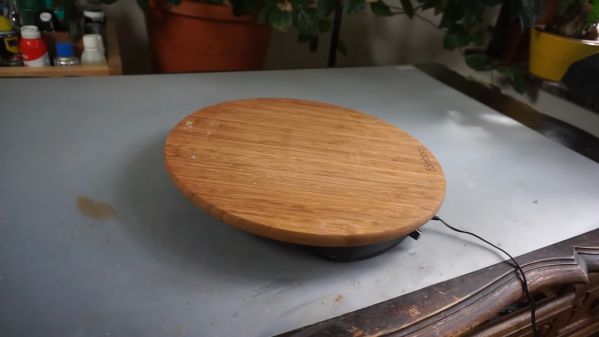
A rotating table is a super nifty tool for all kinds of photography and videography purposes. [Handy Bear] built a super simple example using some parts from IKEA.

The build starts with a Snudda, which is IKEA’s version of a Lazy Susan. It’s fitted with a 3D-printed gear to allow it to be easily driven. The platter is then fitted to a 3D printed base, which also contains the drive electronics, and driven by a small brushed DC gear motor. An off-the-shelf speed controller was employed to allow the speed of the platter to be varied as required.

[Handy Bear] does a good job of explaining how to build the project properly while avoiding the usual pitfalls. In particular, he demonstrates how to fit the gear to the platter without getting it off-axis. We also appreciate a design that can be built virtually anywhere thanks to using commonly-available parts.

We’ve featured other rotating tables before, like this open-ended design that was built on a much larger scale. Video after the break.

Continue reading “Building A Rotating Display Plate From A Lazy Susan”

Rocker Bogie Suspension: The Beloved Solution To Extra-Planetary Rovers

When navigating the vast and unpredictable expanses of outer space, particularly on the alien terrains of distant planets, smart engineering often underlies every major achievement. A paramount example of this is the rocker bogie suspension system. It’s an integral component of NASA’s Mars rovers and has become an iconic feature in its own right. Its success has seen the design adopted by the Indian space program and thousands of hobbyists in turn.

So, what exactly is it that makes rocker bogie suspension such a compelling design solution? Let’s dive into the engineering that makes these six-wheeled wonders so special.

Continue reading “Rocker Bogie Suspension: The Beloved Solution To Extra-Planetary Rovers”

It’s Time You Built A Smart Pocket Watch

There’s just something about a pocket watch that screams class compared to the barbaric act of bending your arm, or the no-fun way of looking at your phone.

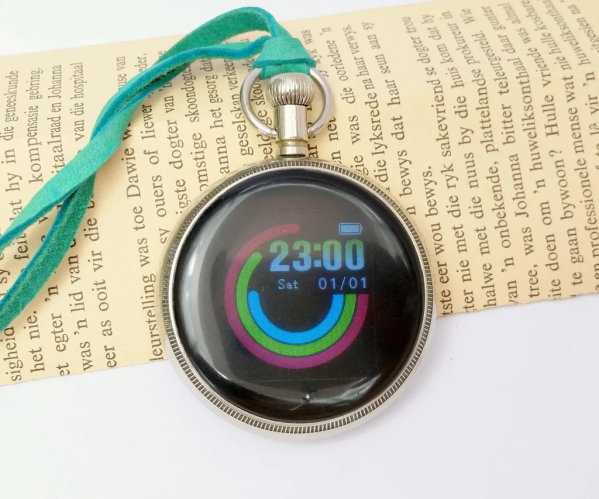
But smartwatches are dumb, analog things that mostly look pretty. Or are they? [JGJMatt] proves otherwise with their stunning DIY smart pocket watch. It is essentially a cheap smart watch from Amazon stuffed into the shell of an old pocket watch, but you know it’s not quite that simple.

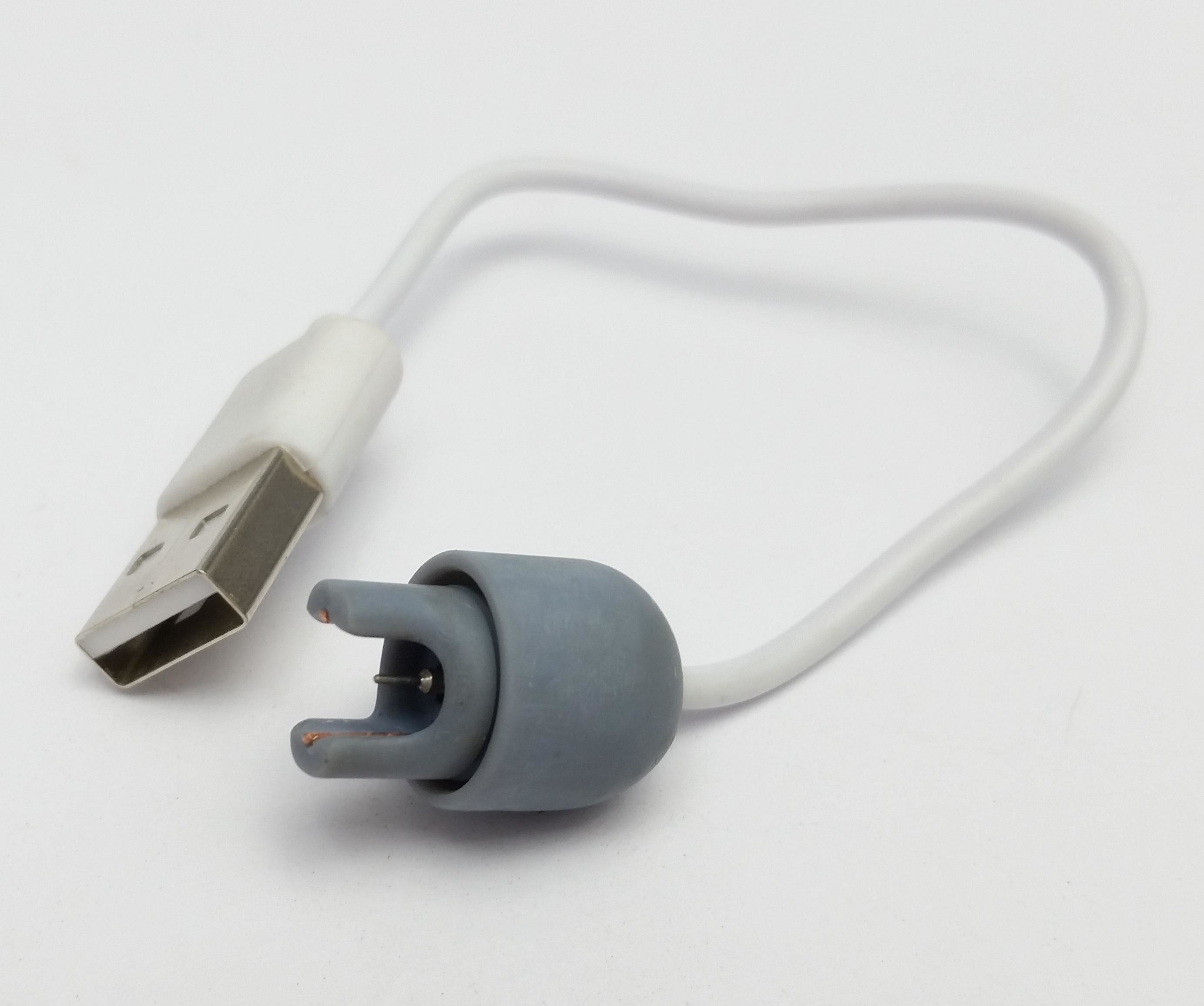
On the easier side of things, [JGJMatt] had to come up with a 3D-printed bracket to hold the smart watch’s guts. On the harder end of the spectrum, he ended up building the charging port into the crown, where the latch used to be.

This is a beautiful build for sure, and a great way to reuse something that might otherwise end up thrown away or melted down.

Looking for a cool alternative pocket watch that’s a little easier to build? Check out [JGJMatt]’s pocket sundial.