Pinewood Derby Cars Have Come A Long Way

Get your graphite and hike a wheel, [Aron Hoekstra] writes in to completely embarrass us with some excellent pinewood derby cars.    In the pursuit of that extra something [Aron] consulted with his sons who came up with some cool ideas for cars, one Tron themed and the other basically a Wiimote with wheels! The official Pinewood derby rules say nothing about electronics, so as long as nothing helps the block-o-wood travel down the track faster, anything goes. This means you are free to load up whatever cool lights you want, but will have to earn your robotics merit badge some other way.

[Aron] Starts the builds by carving out the shape of the cars, each feature a hollowed out cavity underneath to accommodate the batteries and electronics. For the Tron Light Runner car, one continuous EL strip weaves in and out of the derby car’s body, and a single AAA battery runs the driver. [Aron] notes that it took around five feet of EL wire to cover the little car, which is two more than the driver is rated for. Fortunately the extra little bit of additional wire had little effect on its brightness.

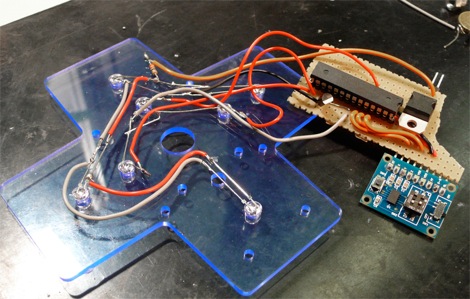
The Wiimote car has detailed 3d buttons, a breadboard with a linear regulator,  and PIC 16F628 driving  blue LEDs.  For the majority of the time the PIC simply runs a chase routine for the four LEDs, but [Aron] went through the trouble to program in the Wiimote’s start-up sequence!

Shown above the [Hokestra]’s work is my older brother’s pinewood derby car (top left) and my… potato rocket… thing… (top right)  from many many years ago. I now seriously regret not considering LEDs! Although I think all that existed then was red,  green and IR.

Check out videos of the [Hoekstra] bros’ cars after the jump!

Continue reading “Pinewood Derby Cars Have Come A Long Way”

aquarium_pump_shutoff

Aquarium Overflow Sensor Saves Your Fish And Your Floors

If you’ve ever had a water leak in your home, you know the sinking feeling that comes over you as you walk through the door to the sound of running water. [Greg] knows this feeling quite well, having returned home to a sopping wet floor and an overflowing reef aquarium on more than one occasion.

Both of the overflows he experienced were due to a clogged drain in his display, but there was little he could do as far as walling off the drain from potential blockages. With all of the delicate creatures living in the tank, the only possible solution that came to mind was monitoring the aquarium’s water level.

Unfortunately he had no idea how to get this done aside from using probes (which would rust in the salt water) or expensive off the shelf systems. [erich_7719] from the All About Circuits forums helped [Greg] out and designed a circuit for him which would monitor the water level using an IR sensor. The circuit simply shuts off the pump if the water level gets precariously high. As you can see in the video below it works quite well, and as a safety measure, requires a manual restart of the pump once the high water sensor has been tripped.

If you have a need for the same sort of setup, swing by his site for a detailed schematic as well as a bill of materials.

Continue reading “Aquarium Overflow Sensor Saves Your Fish And Your Floors”

Squishy Circuits For Tiny Tinkerers

squishy_circuits

Getting kids interested in electronics at a young age is a great idea. Feeding their developing minds via creative projects and problem solving is not only rewarding for the child, it helps prepare the next generation of engineers and scientists. University of St. Thomas professor [AnnMarie Thomas] along with one of her student [Samuel Johnson] have put together a winning recipe for getting kids started in electronics tinkering at a very young age.

While some 5-year-olds can wrangle a soldering iron just fine, some cannot – and younger kids should probably stay away from such tools. This is where the the team from St. Thomas comes in.

They scoured the Internet looking for Play Dough recipe clones, testing the resistance and useability of each before settling on two formulas. The first formula incorporates salt, and has a very low resistance. The second contains sugar and has about 150 times the resistance of the first formula. If you use them together, you have very simple conductor and insulator substrates that can be manipulated safely by tiny hands.

As seen in the demo video below, a small battery pack can be wired to the conductive putty easily lighting LEDs, turning small motors, and more. We can only imagine the delightful smile that would emerge from a child’s face when they power on their putty circuit for the first time.

While only two different types of putty have been made so far, we would be interested to see what other materials could be integrated – how about homemade peizo crystals?

[Thanks, Spence]

Continue reading “Squishy Circuits For Tiny Tinkerers”

Variable Super Capacitor Battery Provides Power On The Go

super_cap_battery

Instructable user [EngineeringShock] got sick of buying batteries for his devices all the time and has instead opted to build himself a super capacitor bank that can be used to power common household items.

His “forever” rechargeable capacitor bank is made of two large super capacitors rated at 400 farads apiece. It is charged through a LM317-based charging circuit that is adjustable to allow for slow or fast charging, the latter of which he admits, is slightly dangerous.

Since the super caps are only rated at 2.7 volts, they are wired through a DC-DC booster circuit that allows him to adjust the output voltage from 4.3 v to 34 v. The adjusted voltage is then passed through a digital display that allows him to see what the output voltage is at any time.

He says that the super cap bank can power his computer’s speakers for about two hours before requiring a recharge, which takes just a few short minutes, depending on how he is charging them.

While it’s not exactly cheap, the capacitor bank could be useful for those requiring quick portable power for relatively short periods of time. If we were to build one ourselves, we would likely fit all of the components into a small project box to protect the caps from accidental discharging, and top it off with a couple of solar cells to charge it for free during the day.

Keep reading to see a quick video demonstration of his super cap “battery” in action.

Continue reading “Variable Super Capacitor Battery Provides Power On The Go”

3-phase Jacob’s Ladder

Two sparks are better than one, a sentiment that was never more blindingly illustrated than with this three-conductor Jacob’s Ladder. The build centers around three-phase power, which uses a trio of alternating current sources sharing the same frequency, but offset by 1/3 from one another. If we’re reading the schematic correctly, [Jimmy Proton] is using normal mains as a power source, then connecting three transformers and a capacitor to set up the different phases. Two of the transformers, which were pulled from microwave ovens, are wired in antiparallel, with their cores connected to each other. The third transform is connected in series on one leg of the circuit.

The video after the break starts with the satisfying hum of power, only to be outdone by the wild sparks that traverse the air gap between conductors of the ladder. After seeing the first demonstration we kind of expected something to start on fire but it looks like all is well. We’ll probably stick to a less complicated version of Jacob’s Ladder.

Continue reading “3-phase Jacob’s Ladder”

Quick & Dirty USB Phone Charger

usb_phone_charger

Hackaday forum member [Dan Fruzzetti] wrote in to share a simple, yet useful hack he built just the other day. He and his wife both have Evo 4G smartphones and they were pretty disappointed in the lack of portable charging solutions available.

Instead of buying something and modifying it to his needs, [Dan] decided to build a quick and dirty charger instead. His ghetto-mintyboost was built into a cheap project box he found at Radio Shack, which is stocked with a set of four D-cell batteries. The batteries were wired in series and connected to a pair of salvaged USB ports mounted on a small piece of protoboard.

Knowing that most portable devices get 5.7v from their chargers already, he was not worried about hooking his phones straight into the 6v battery pack he built. He says that the phones actually charge pretty quickly, and that he estimates he should be able to get about 50 charges out of the box before he needs to swap the batteries.

This is not a complex hack by any means. It is quick & dirty, solves an annoying problem, and it’s dead simple to build. That’s exactly why we like it.

Reversible Relay-based Motor Controller

[Nothinglabs] built this motor controller as an alternative to using an H-bridge. They call it the RAT controller which stands for “Relay and Transistors”. You can see above that two Darlington transistors along with their base transistors allow logic signals to switch the relay on and off, driving the motor in one direction or the other based on the open or closed state of the relay. See it working in the video after the break.

It’s a nice little workaround with few parts, but because the relay is mechanical there will be a short lifespan when compared to solid-state motor controllers. That’s okay, because the motivation here was lack of parts on hand, rather than an increase in performance. It’s also worth mentioning that all of these parts can be purchased at your local Radio Shack when you don’t want to wait for component orders by mail. We certainly appreciate that it takes far few components than [David Cook’s] H-bridges. His designs are our favorite – we’ve used them in our own projects – but for quick and dirty you can’t beat five components and the short assembly time needed when using this type of dead-bug style soldering.

Continue reading “Reversible Relay-based Motor Controller”