3D Printing A Synthesizer

Before there were samplers, romplers, Skrillex, FM synths, and all the other sounds that don’t fit into the trailer for the new Blade Runner movie, electronic music was simple. Voltage controlled oscillators, voltage controlled filters, and CV keyboards ruled the roost. We’ve gone over a lot of voltage controlled synths, but [Tommy] took it to the next level. He designed a small, minimum viable synth based around the VCO in an old 4046 PLL chip

For anyone who remembers [Elliot]’s Logic Noise series here on Hackaday, this type of circuit should be very familiar. The only thing in this synth is a few buttons, a variable resistor for each button, and the very popular VCO for an analog square wave synth.

The circuit for this synth is built in two halves. The biggest, and what probably took the most time designing, is the key bed. This is a one-octave keyboard that’s completely 3D printed. We’ve seen something like this before in one of the projects from the SupplyFrame Design Lab residents, though while that keyboard worked it was necessary for [Tim], the creator of that project, to find a company that could make custom key beds for him.

The rest of the circuit is just a piece of perf board and the 4046. This project is all wrapped up in a beautiful all-wood enclosure with 3D printed hinges, knobs, and a speaker grille. The sound is phenomenal, and exactly what you want from a tiny monophonic square wave synth. You can check out a video of that below.

Continue reading “3D Printing A Synthesizer”

DIY Tiny Single-PCB Synthesizer

[Jan Ostman] has been pushing the limits of sound synthesis on the lowly AVR ATMega microcontrollers, and his latest two project is so cute that we just had to write it up. The miniTS shares the same basic sound-generation firmware with his previous TinyTS, which we’ve covered here before, but adds a lot more keys, an OLED, and MIDI, while taking away some of the knobs.

Both feature keyboards that are just copper pads placed over a ground plane, and the code does simple capacitive-sensing to figure out if they’re being touched or not. The point here is that you could pick up a PCB from [Jan] on the cheap, and experiment around with the code. Or you could just take the code and make a less refined version for yourself with a cheapo Arduino and some copper plates.

Either way, we like the combination of minimal materials and maximum tweakability, and think it’s cool that [Jan] shares the code, if not also the PCB designs. Anyone with PCB layout practice could get a clone worked up in an afternoon, although it’s going to be cheaper to get these made in bulk, and you’re probably better off just buying one from [Jan].

A Queen Mystery: The Legend Of The Deacy Amp

It sounds like a scene from a movie. A dark night in London, 1972. A young man walks alone, heading home after a long night of practicing with his band. His heavy Fender bass slung over his back, he’s weary but excited about the future. As he passes a skip (dumpster for the Americans out there), a splash of color catches his attention. Wires – not building power wires, but thinner gauge electronics connection wire. A tinkerer studying for his Electrical Engineering degree, the man had to investigate. What he found would become rock and roll history, and the seed of mystery stretching over 40 years.

The man was John Deacon, and he had recently signed on as bassist for a band named Queen. Reaching into the skip, he found the wires attached to a circuit board. The circuit looked to be an amplifier. Probably from a transistor radio or a tape player. Queen hadn’t made it big yet, so all the members were struggling to get by in London.

Deacon took the board back home and examined it closer. It looked like it would make a good practice amplifier for his guitar. He fit the amp inside an old bookshelf speaker, added a ¼ “ jack for input, and closed up the case. A volume control potentiometer dangled out the back of the case. Power came from a 9-volt battery outside the amp case. No, not a tiny transistor battery; this was a rather beefy PP-9 pack, commonly used in radios back then. The amp sounded best cranked all the way up, so eventually, even the volume control was removed. John liked the knobless simplicity – just plug in the guitar and play. No controls to fiddle with.

And just like that, The Deacy amp was born.

Continue reading “A Queen Mystery: The Legend Of The Deacy Amp”

Reverse Engineering Space Invaders Sound Chip

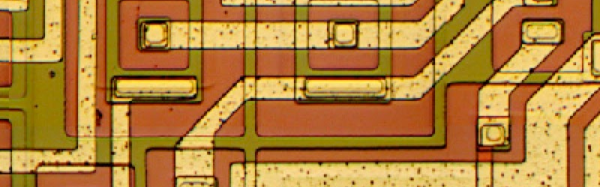
Around here, a new blog post from [Ken Shirriff] is almost as exciting as a new Star Trek movie. This time, [Ken] tears apart a 76477 sound effects chip. This chip was state-of-the-art in 1978 and used in Space Invaders, along with plenty of other pinball machines and games.

[Ken] started out with a die photo from [Sean Riddle] and mapped its functions. Unlike a modern sound chip, this one created sounds based on networks of attached resistors and capacitors. Even if you aren’t interested in the chip, per se, [Ken] explains how the die implements active and passive devices, along with some key analog design principles like current mirrors (although we are pretty sure he got his right and his left mixed up, or maybe it was a very subtle mirror joke).

Before electronics magazines were full of computer projects, they were full of music synthesis projects and the 76477 is like a crude synthesizer on a chip. It has voltage controlled oscillators (VCOs),  and generates envelopes with specific attack and decay times to create the sounds of interest.

This reminded us a little of the sounds from the more advanced MOS6581. [Ken] has looked inside a lot of ICs, including at the 2016 Hackaday SuperConference.

Ad Hoc MIDI To Music Box Project Shows Power Of Hacker Community

Fair warning: when you post a video of you doing an incredibly tedious process like manually punching holes in a paper tape to transfer a MIDI file to a music box, don’t be surprised when a bunch of hackers automates the process in less than a week.

The back story on this should be familiar to even casual Hackaday readers. [Martin] from the Swedish group “Wintergatan” is a prolific maker of unusual musical instruments. You’ll no doubt recall his magnificent marble music machine, a second version of which is currently in the works. But he’s also got a thing for music boxes that are programmed by paper tape, and recently posted a video showing his time-consuming and totally manual process for punching the holes in the tape. Since his source material was already in a MIDI file, a bunch of his fans independently came up with ways to automate the process.

The video below shows what he learned from his fans about automating his programming, but also what he learned about the community we all work and play in. Without specifically asking for help, random strangers brought together by common interests identified the problems, came up with solutions, sorted through the good and the bad ideas, and made the work publically available. Not bad for less than a week’s work.

Continue reading “Ad Hoc MIDI To Music Box Project Shows Power Of Hacker Community”

Hackaday Prize Entry: Electro-Magnetic Enabled Bagpipes

Bagpipes are an instrument at least a millennia old, the most popular of which, in modern times, is the Great Highland bagpipe. There are other types of bagpipes, some of which have a bellows rather than requiring the player to manually inflate the bag by breathing into it. The advantage of the bellows is that it delivers dry air to the bag and reed (instead of the moist air from the player’s breath) and this dryness means that the instrument stays in tune better and the reed lasts longer.

[TegwynTwmffat] has built his own Irish uilleann pipes, (one of the types that use a bellows) using a carbon steel chanter (the part with the finger holes) and a steel reed. The reed vibrates and a pickup is used to convert this vibration into an electric signal, similar to the way a guitar pickup converts a vibrating string into an electric signal. This means that the signal from [Tegwyn]’s pipes can be sent to an amplifier. It also means that the signal can be processed the same way as the signal from an electric guitar – through distortion, flanger, wah, or delay pedals, for example.

[Tegwyn] has put up a drawing of the chanter showing dimensions and locations of the holes and has posted a couple of songs so you can hear the pipe in action. The first has the pipes without any effects on them, the second with effects. The comments for the second say that there are no electric guitars in the song – it’s all the pipes! Bagpipes seem to be a (relatively) popular instrument to hack and we’ve seen a couple of them over the years, such as this one made from duct tape, and this one – an electronic version.

Continue reading “Hackaday Prize Entry: Electro-Magnetic Enabled Bagpipes”

Copper Foil Makes Music–With A Little Help

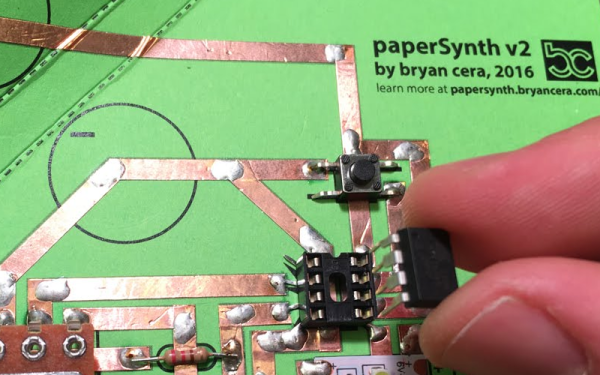
Craft stores are often the source of odd inspiration. In the stained glass section, we’ve seen the copper foil, and even used it to prototype some RF circuits on the tops of shoeboxes. However, we could never get a good method for connecting ICs to the relatively thick foil. [Bryan Cera] did it though. His paperSynth uses some paper and cardboard for a substrate, copper foil, and an ATtiny CPU to make music. You can see the device in operation in the video, below.

The copper foil is sticky and it isn’t conductive on the back, so anywhere the foil is supposed to touch, you need a blob of solder. We wouldn’t trust the insulation by itself to cross wires, but with a bit of insulating material between–a piece of paper or electrical tape, for example–you could probably cross with impunity. For an RF circuit, you might even make low-value capacitors like that.

Continue reading “Copper Foil Makes Music–With A Little Help”