The Swiss Army Knife Of Audio Synthesis

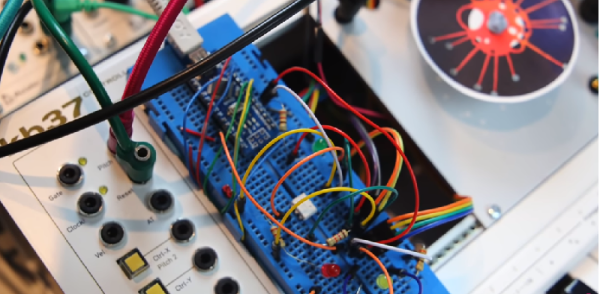
Thirty years ago, we would be lucky if a computer could play audio. Take a computer from twenty years ago, and you’ll be lucky if it can play an MP3 in real-time. Now, computers can handle hundreds of tracks of CD-quality audio, and microcontrollers are several times more powerful than a desktop computer of the mid-90s. This means, of course, that microcontrollers can do audio very, very well. For his entry to the Hackaday Prize, [Fabien] is capitalizing on this power to create a Swiss Army knife of audio synthesis. It’s called the Noise Nugget, and it’s just what you need when you want to put audio in anything.

The microcontroller in question is an ARM Cortex-M4 running at 180MHz, with a quality DAC. There’s connectivity in the form of USB, two audio outs, one audio in, I2C, UART, and GPIOs. With this, you’ve got a digital synthesizer with a MIDI interface, audio effects for guitar pedal tomfoolery, an audio effect trigger board for playing pre-recorded sounds, a digital recorder, and a USB sound interface.

So, with all that processing power, what can the Noise Nugget actually do? Well, first of all, it’s a sampler. [Fabien] has a video demo of the Noise Nugget set up in sampler mode, where it can play a lute-ish sample and a cat sound. All of this is controlled over MIDI and played through a cheap speaker. The results — except for the cat sample — sound great. You can check that video out below.

Continue reading “The Swiss Army Knife Of Audio Synthesis”

Wavetable General MIDI For Everyone

There are only so many ways to generate music with a computer, and by far the most popular method is MIDI. It’s been around for thirty-five years, and you don’t get to be a decades-old standard for no reason. That said, turning MIDI into audio is a pain, but this project in the Musical Instrument Challenge for the Hackaday Prize makes it easy. It’s a Fluxamasynth Module that turns MIDI into something you can hear.

The key to this build is a single chip that takes MIDI data in and spits out audio, according to the 128 general MIDI sounds. This might not sound like much, but if you’ve ever tried to turn MIDI into sound, you’ll find your options are limited. There is exactly one chip that can do this and is easily obtainable: the SAM2695 from Dream Sound Synthesis. This chip was originally designed for cheap toy keyboards, but if you have a chip, you can do anything with it.

The Fluxamasynth Modules are inspired by the original Fluxamasynth, an Arduino shield that is basically a breakout board for the SAM chip. There’s a MIDI in, and an 1/8″ jack for output, and not much else. The Fluxamasynth Modules extend the capability by adding more support, including stereo output, reverb, chorus, flange, and delay effects, and digs down deep into the configurable parameters for tuning.

The hardware is basically an audio appliance for the Arduino, Raspberry Pi, and the ESP32, and allows for generative music through code. You can see an example of this project in the video below.

Continue reading “Wavetable General MIDI For Everyone”

The Ultimate MIDI Wind Controller Is The Human Voice

When it comes to music, the human voice is the most incredible instrument. From Tuvan throat singing to sopranos belting out an aria, the human vocal tract has evolved over millions of years to be the greatest musical instrument. We haven’t quite gotten to the point where we can implant autotune in our vocal cords, but this project for the Hackaday Prize aims to be a bridge between singers and instrumentalists. It’s a hands-free instrument that relies on vocal gesture sensing to drive electronic musical instruments.

The act of speaking requires dozens of muscles, and of course no device that measures how the human vocal tract is shaped will be able to measure all of them, but the Multiwind does manage to measure breathing in, breathing out, the shape of the lower lip, the upper lip, and its own tilt, giving it far more feedback than any traditional wind instrument. It does this with IMUs and a mouthpiece mounted on a mount that is seemingly inspired by one of those hands-free harmonica neck mounts.

The output for this device is MIDI, although the team behind this build already has data streaming to an instance of Max, and once you have that, you have every musical instrument imaginable. It’s an innovative musical instrument, and something we’re really excited to see the results of.

With Grinning Keyboard And Sleek Design, This Synth Shows It All

Stylish! is a wearable music synthesizer that combines slick design with stylus based operation to yield a giant trucker-style belt buckle that can pump out electronic tunes. With a PCB keyboard and LED-surrounded inset speaker that resembles an eyeball over a wide grin, Stylish! certainly has a unique look to it. Other synthesizer designs may have more functions, but certainly not more style.

The unit’s stylus and PCB key interface resemble a Stylophone, but [Tim Trzepacz] has added many sound synthesis features as well as a smooth design and LED feedback, all tied together with battery power and integrated speaker and headphone outputs. It may have been originally conceived as a belt buckle, but Stylish! certainly could give conference badge designs a run for their money.

The photo shown is a render, but a prototype is underway using a milled PCB and 3D printed case. [Tim]’s Google photo gallery has some good in-progress pictures showing the prototyping process along with some testing, and his GitHub repository holds all the design files, should anyone want a closer look under the hood. Stylish! was one of the twenty finalists selected for the Musical Instrument Challenge portion of the 2018 Hackaday Prize and is therefore one of the many projects in the running for the grand prize!

Google's Piano Genie

Piano Genie Trained A Neural Net To Play 88-Key Piano With 8 Arcade Buttons

Want to sound great on a Piano using only your coding skills? Enter Piano Genie, the result of a research project from Google AI and DeepMind. You press any of eight buttons while a neural network makes sure the piano plays something cool — compensating in real time for what’s already been played.

Almost anyone new to playing music who sits down at a piano will produce a sound similar to that of a cat chasing a mouse through a tangle of kitchen pots. Who can blame them, given the sea of 88 inexplicable keys sitting before them? But they’ll quickly realize that playing keys in succession in one direction will produce sounds with consistently increasing or decreasing pitch. They’ll also learn that pressing keys for different lengths of times can improve the melody. But there’s still 88 of them and plenty more to learn, such as which keys will sound harmonious when played together.

Piano Genie training architectureWith Pinao Genie, gone are the daunting 88 keys, replaced with a 3D-printed box of eight arcade-style buttons which they made by following this Adafruit tutorial. A neural network maps those eight buttons to something meaningful on the 88-key piano keyboard. Being a neural network, the mapping isn’t a fixed one-to-one or even one-to-many. Instead, it’s trained to play something which should sound good taking into account what was play previously and won`t necessarily be the same each time.

To train it they use data from the approximately 1400 performances of the International Piano e-Competition. The result can be quite good as you can see and hear in the video below. The buttons feed into a computer but the computer plays the result on an actual piano.

For training, the neural network really consists of two networks. One is an encoder, in this case a recurrent neural network (RNN) which takes piano sequences and learns to output a vector. In the diagram, the vector is in the middle and has one element for each of the eight buttons. The second network is the decoder, also an RNN. It’s trained to turn that eight-element vector back into the same music which was fed into the encoder.

Once trained, only the decoder is used. The eight-button keyboard feeds into the vector, and the decoder outputs suitable notes. The fact that they’re RNNs means that rather than learning a fixed one-to-many mapping, the network takes into account what was previously played in order to come up with something which hopefully sounds pleasing. To give the user a little more creative control, they also trained it to realize when the user is playing a rising or falling melody and to output the same. See their paper for how the turned polyphonic sound into monophonic and back again.

If you prefer a different style of music you can train it on a MIDI collection of your own choosing using their open-sourced model. Or you can try it out as is right now through their web interface. I’ll admit, I started out just banging on it, producing the same noise I would get if I just hammered away randomly on a piano. Then I switched to thinking of making melodies and the result started sounding better. So some music background and practice still helps. For the video below, the researcher admits to having already played for a few hours.

This isn’t the first project we’ve covered by these Google researchers. Another was this music synthesizer again using neural networks but this time with a Raspberry Pi. And if our discussion of recurrent neural networks went a bit over your head, check out our overview of neural networks.

Continue reading “Piano Genie Trained A Neural Net To Play 88-Key Piano With 8 Arcade Buttons”

Chiptunes In An Altoids Tin

For [Dejan]’s entry to the Musical Instrument Challenge in this year’s Hackaday Prize, he’s tapping into some of the great work that has been done over the years to bring bleeps and bloops to the masses. He’s building a drum machine, a bass synth, and an arpeggiator that fits in your pocket, in a handy form factor that fits in an Altoids tin. It’s the FATCAT Altoids Tin Mod Tracker.

This is a simple build meant to fit in an Altoids tin, so you’re not getting a whole lot of hardware here. There’s a battery, there’s a boost circuit, and there’s a single chip, an ATtiny84. This tiny little microcontroller is the heart of the box, able to provide a drum track with a kick, snare, and a closed and open high hat. There’s a bass with a simple square wave and portamento, and an arp track that can be used as a lead or arpeggiated chords. All of this is programmed in C and uploaded straight to the chip.

The ATtiny series of microcontrollers are fairly popular for various means and methods of creating square wave bleeps and bloops. We’ve seen them become a MIDI synth that fits inside a MIDI jack, and we’ve seen how much chiptune goodness you can fit in thirty two bytes of RAM. Cornell even had a spat of rickroll vandalism with a coin cell throwie built on an ATtiny85. Anything that puts more ATtiny chiptunes into the hands of more people is great in our books, and this Altoids tin synth is just the thing.

You can check out a demo of the FATCAT below.

Continue reading “Chiptunes In An Altoids Tin”

Looks Like A Glove, Plays Like A Musical Instrument

The GePS is a musical project that shows how important integration work is when it comes to gesture controls. Creators [Cedric Spindler] and [Frederic Robinson] demonstrate how the output of a hand-mounted IMU (Inertial Measurement Unit) and magnetometer can be used to turn motion, gestures, and quick snap movements into musical output. The GePS is designed to have enough repeatability and low enough latency that feedback is practically immediate. As a result, it can be used and played like any other musical instrument that creates sound from physical movements in a predictable way. It’s not unlike a Theremin in that way, but much more configurable.

To do this, [Cedric] and [Frederic] made GePS from a CurieNano board (based on Intel’s Curie, which also has the IMU on-board) and an XBee radio for a wireless connection to software running on a computer, from which the sounds are played. The device’s sensitivity and low lag means that even small movements can be reliably captured, meaning that the kind of fluid and complex movements that hands do every day can be used as the basis for playing sounds with immediate feedback. In a very real sense, the glove-based GePS is an experimental kind of new instrument, which makes it a fascinating contender for the Musical Instrument Challenge portion of the 2018 Hackaday Prize.