Robot Solves Rubik’s Cube With One Hand Tied Behind Its Back

For all those who have complained about Rubik’s Cube solving robots in the past by dismissing purpose-built rigs that hold the cube in a non-anthropomorphic manner: checkmate.

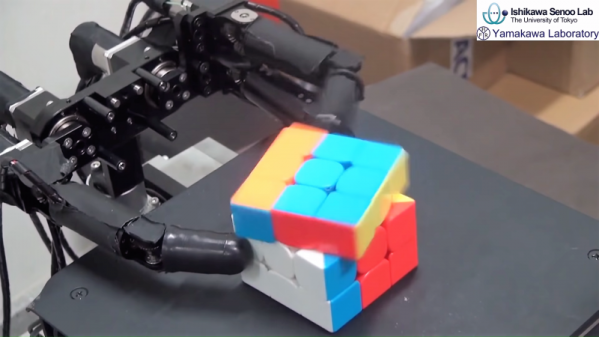
The video below shows not only that a robot can solve the classic puzzle with mechanical hands, but it can also do it with just one of them – and that with only three fingers. The [Yamakawa] lab at the University of Tokyo built the high-speed manipulator to explore the kinds of fine motions that humans perform without even thinking about them. Their hand, guided by a 500-fps machine vision system, uses two opposing fingers to grip the lower part of the cube while using the other finger to flick the top face of the cube counterclockwise. The entire cube can also be rotated on the vertical axis, or flipped 90° at a time. Piecing these moves together lets the hand solve the cube with impressive speed; extra points for the little, “How’s that, human?” flick at the end.

It might not be the fastest cube solver, or one that’s built right into the cube itself, but there’s something about the dexterity of this hand that we really appreciate.

Continue reading “Robot Solves Rubik’s Cube With One Hand Tied Behind Its Back”

A New Tilt On RC Car Controllers

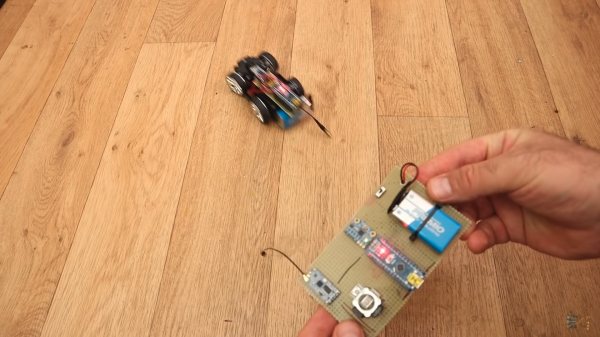
If you are a lover of all-things remote-conteolled, it’s likely that you know a thing or two about controllers. You’ll have one or two of the things, both the familiar two-joystick type and the pistol-grip variety. But had you ever considered that there m ight be another means to do it? [Andrei] over at ELECTRONOOBS has posted a guide to a tilt-controlled RC car. It is a good example of how simple parts can be linked together to make something novel and entertaining, and a great starter project for an aspiring hacker.

An Arduino Nano reads from an accelerometer over an I2C bus, and sends commands over a wireless link, courtesy of a pair of HC-12 wireless modules.  Another Nano mounted to the car decodes the commands, and uses a pair of H-bridges, which we’ve covered in detail, to control the motors.

The tutorial is well done, and includes details on the hardware and all the code you need to get rolling.  Check out the build and demo video after the break.

Continue reading “A New Tilt On RC Car Controllers”

Free ARM Cores For Xilinx FPGAs

In a surprising move, ARM has made two Cortex-M cores available for FPGA development at no cost.

In the over three decades since [Sophie Wilson] created the first ARM processor design for the Acorn Archimedes home computer, the architecture has been managed commercially such that it has become one of the most widely adopted on the planet. From tiny embedded microcontrollers in domestic appliances to super-powerful 64-bit multi-core behemoths in high-end mobile phones, it’s certain you’ll own quite a few ARM processors even if you don’t realise it. Yet none of those processors will have been made by ARM, instead the Cambridge-based company will have licenced the intellectual property of their cores to another semiconductor company who will manufacture the device around it to their specification. ARM core licences cost telephone-number sums, so unless you are a well-financed semiconductor company, until now you probably need not apply.

You will still have to shell out the dough to get your hands on a core for powerful chips like those smartphone behemoths, but if your tastes are more modest and run only to a Cortex M1 or M3 you might be in luck. For developers on Xilinx FPGAs they have extended the offer of those two processor cores at zero cost through their DesignStart Programme.

It’s free-as-in-beer rather than something that will please open-source enthusiasts, But it’s certainly a fascinating development for experimenters who want to take ARM for a spin on their own gate array. Speculation is swirling that this is a response to RISC-V, but we suspect it may be more of a partial lifting of the skirts to entice newbie developers such as students or postgraduates. If you arrive in the world of work already used to working with ARM IP at the FPGA level then you are more likely to be on their side of the fence when those telephone-number deals come up.

Thanks [Rik] for the tip!

Creating Antimatter On The Desktop — One Day

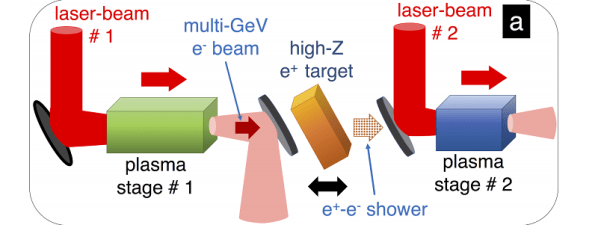
If you watch Star Trek, you will know one way to get rid of pesky aliens is to vent antimatter. The truth is, antimatter is a little less exotic than it appears on TV, but for a variety of reasons there hasn’t been nearly as much practical research done with it. There are well over 200 electron accelerators in labs around the world, but only a handful that work with positrons, the electron’s anti-counterpart. [Dr. Aakash Sahai] would like to change that. He’s got a new design that could bring antimatter beams out of the lab and onto the desktop. He hasn’t built a prototype, but he did publish some proof-of-concept simulation work in Physical Review Accelerators and Beams.

Today, generating high-energy positron beams requires an RF accelerator — miles of track with powerful electromagnets, klystrons, and microwave cavities. Not something you are going to build in your garage this year. [Sahai] is borrowing ideas from electron laser-plasma accelerators (ELPA) — a technology that has allowed electron accelerators to shrink to mere inches — and turned it around to create positrons instead.

Continue reading “Creating Antimatter On The Desktop — One Day”

Antennas That You Install With A Spray-Can

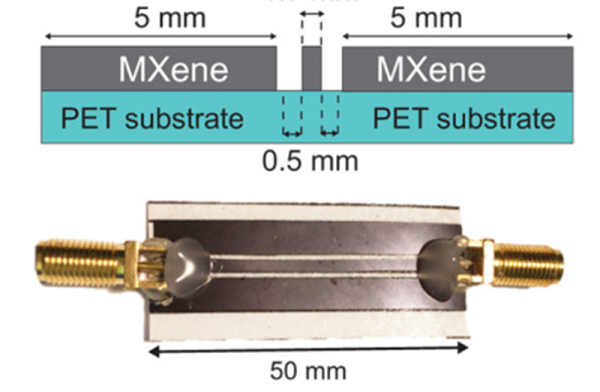
With the explosion in cell phones, WiFi, Bluetooth, and other radio technologies, the demand for antennas is increasing. Everything is getting smaller and even wearable, so traditional antennas are less practical than ever. You’ve probably seen PCB antennas on things like ESP8266s, but Drexel University researchers are now studying using titanium carbide — known as MXene — to build thin, light, and even transparent antennas that outperform copper antennas. Bucking the trend for 3D printing, these antennas are sprayed like ink or paint onto a surface.

A traditional antenna that uses metal carries most of the current at the skin (something we’ve discussed before). For example, at WiFi frequencies, a copper antenna’s skin depth is about 1.33 micrometers. That means that antennas have to be at least thick enough to carry current at that depth from all surfaces –practically 5 micrometers is about the thinnest you can reasonably go. That doesn’t sound like a lot, but when you are trying to make something thin and flexible, it is pretty thick. Using MXene, the researchers made antennas as thin as 100 nanometers thick — that’s 10% of a micrometer and only 2% of a conventional antenna.

Continue reading “Antennas That You Install With A Spray-Can”

The New, Improved Open Hardware Certification Program

Today at the Open Hardware Summit at MIT, OSHWA, the Open Source Hardware Association has announced a huge revision to the Open Hardware certification process. The goal here is to design a better platform for creating Open Hardware.

While all hardware already certified as Open Hardware will remain Open Hardware, this revamp of the ‘hub’ of the certification process is greatly improved. There’s a new website. There are learning modules telling everyone what it means to be Open Source hardware. There are community examples — real-life walk-throughs of projects that have already been created. There’s a streamlined certification process, and an improved listing of Open Hardware projects.

But Why A Certification Program?

While Open Source in the world of software is easily defined, it is effectively a hack of copyright law; all software is closed by default, and an Open Source software license is merely that; a license for anyone to use it, with the various restrictions and philosophical battles. Hardware, on the other hand, is big-O Open by default. The code used to program an FPGA is covered by copyright, but the circuit itself isn’t. The firmware on your Arduino project is covered by Open Source software licenses, but the physical implementation of your Fritzing picture isn’t.

In the absence of a legal framework to truly make an Open Hardware license work, the only other option is a certification program. The current Open Source Hardware certification program launched in 2016, and has since seen hundreds of projects certified from dozens of countries. It is, by any measure, a remarkable success. The people who make hardware are certifying that their work complies with community-set standards, and all of these projects are registered.

The New, Improved Interface for the Certification Program

While the core of the Open Hardware Certification program hasn’t changed, the user interface — the ‘killer app’ of a directory of Open Hardware projects — has. According to the press release put out by OSHWA ahead of the announcement, “The revamped website consolidates a broad range of information about open source hardware onto a single site. To maximize comprehension for people pursuing certification for their own hardware, important documentation and licensing concepts are illustrated with specific existing examples from the registry. An improved directory and search function makes it easy to find hardware that matches a broad range of criteria.”

Compared to last week’s version of OSHWA’s website, this is a huge improvement. Now, you can easily find information about what it means to make Open Hardware. The complete directory of Open Hardware projects isn’t just a spreadsheet on a webpage anymore, you can actually search for projects now. This is a huge improvement to the Open Hardware certification program, and we can’t wait to see how this new platform will be used.

You can check out the rest of the Open Hardware Summit over on the livestream.

Can You “Take Back” Open Source Code?

It seems a simple enough concept for anyone who’s spent some time hacking on open source code: once you release something as open source, it’s open for good. Sure the developer might decide that future versions of the project close up the source, it’s been known to happen occasionally, but what’s already out there publicly can never be recalled. The Internet doesn’t have a “Delete” button, and once you’ve published your source code and let potentially millions of people download it, there’s no putting the Genie back in the bottle.

But what happens if there are extenuating circumstances? What if the project turns into something you no longer want to be a part of? Perhaps you submitted your code to a project with a specific understanding of how it was to be used, and then the rules changed. Or maybe you’ve been personally banned from a project, and yet the maintainers of said project have no problem letting your sizable code contributions stick around even after you’ve been kicked to the curb?

Due to what some perceive as a forced change in the Linux Code of Conduct, these are the questions being asked by some of the developers of the world’s preeminent open source project. It’s a situation which the open source community has rarely had to deal with, and certainly never on a project of this magnitude.

Is it truly possible to “take back” source code submitted to a project that’s released under a free and open source license such as the GPL? If so, what are the ramifications? What happens if it’s determined that the literally billions of devices running the Linux kernel are doing so in violation of a single developer’s copyright? These questions are of grave importance to the Internet and arguably our way of life. But the answers aren’t as easy to come by as you might think.

Continue reading “Can You “Take Back” Open Source Code?”