Brits: Make A Vote, Put Cash A Hackerspace’s Way

Those of you who have been involved in the running of a hackerspace or makerspace will know the never-ending struggle to maintain financial solvency, and the quest for sources of income to move your organisation forward. It’s certainly a topic upon which Hackaday’s crew have some experience, more than one of us has helped run a space.

A good avenue to explore lies with community grants: money from organisations on a philanthropic basis to invest in community organisations. These can come from charities, governmental organisations, or even from companies as part of their corporate social responsibility. It’s this last source of grant money that claims our attention today, because we are in the final days of voting for the Aviva Community Fund, in which the British financial and insurance company makes grants for worthy causes across the country. The causes compete to gain as much support as they can, and hope to thus win their prize.

Among the many worthy recipients of the cash are a selection of hackerspaces. First up are Hitchin Hackspace, whose Big Hak full-size rendition of a Milton Bradley Big Trak toy was featured in our coverage of EMF Camp 2016. They are building a new space in what we’ll call a redundant community facility because it sounds better than “Former public toilet”, and winning a grant will help them a lot in that aim.

Then we have East London Makerspace. They have secured an unused garage to turn into a makerspace, as the capital’s population of our community swells to support ever more spaces in its different suburbs. Like Hitchin, the money would go to the essential work involved in creating a functioning space where previously there was nothing.

Finally, we have the unexpected, a heating system from Milton Keynes Men In Sheds. If you know about Men In Sheds as a community organisation for older people, you’ll be wondering why this is listed here. What we haven’t told you is that MK Makerspace is a subgroup of the MK Shed that occupies the upstairs portion of their building, and what warms the Shedders also warms the hacker community of one of Britain’s new towns.

These appear to be the only hackerspaces bidding for grant money, but votes can usefully be given to other allied causes. Linlithgow Remakery and Tool Library, for instance could use a boost, as could the other Men In Sheds groups scattered across the competition.

So if you are one of Hackaday’s British readers, please take a minute to stop by the voting pages listed above, and give them a boost. You have a couple of days to get your votes in, so make them count, and make a difference!

Disclosure: [Jenny List] is a member of Milton Keynes Makerspace.
Your Next Wearable May Not Need Electricity

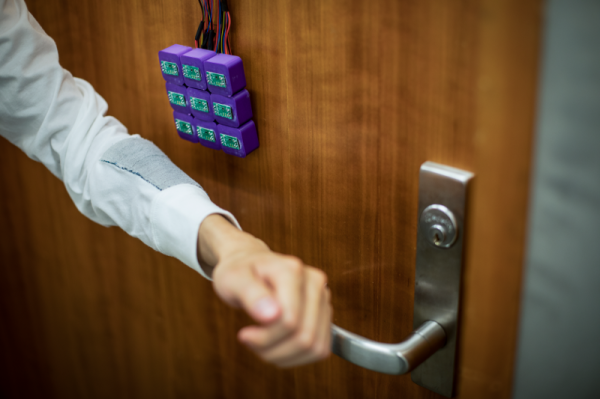
What if you could unlock a door with your shirtsleeve, or code a secret message into your tie? This could soon be a thing, because researchers at the University of Washington have created a fabric that can store data without any electronics whatsoever.  The fabric can be washed, dried, and even ironed without losing data. Oh, and it’s way cheaper than RFID.

By harnessing the ferromagnetic properties of conductive thread, [Justin Chen] and [Shyam Gollakota] have  proved the ability to store bit strings and 2D images through magnetization. The team used an embroidery machine to lay down thread in dense strips and patches, and then coded in ones and zeros by rubbing the threads with N and S neodymium magnets.

They didn’t use anything special, either, just this conductive thread, some magnets, and a Nexus 5 to read the data. Any phone with a magnetometer (so, most of them) could decode this type of binary data. The threads stay reliably magnetized for about a week and then begin to weaken. However, their tests proved that the threads can be re-magnetized over and over.

The team also created 2D images with magnets on a 9-patch made of conductive fabric. The images can be decoded piecemeal by a single magnetometer, or all at once by an array of them. Finally, the team made a glove with a magnetized patch of thread on the fingertip. They were able to get the phone to recognize six unique gestures with 90% accuracy, even with the phone tucked away in a pocket. See it in action in their demo video after the break.

Magnetic memory is certainly not a new concept. But for the wearable technology frontier, it’s a novel one.

Continue reading “Your Next Wearable May Not Need Electricity”

Goodbye, TechShop

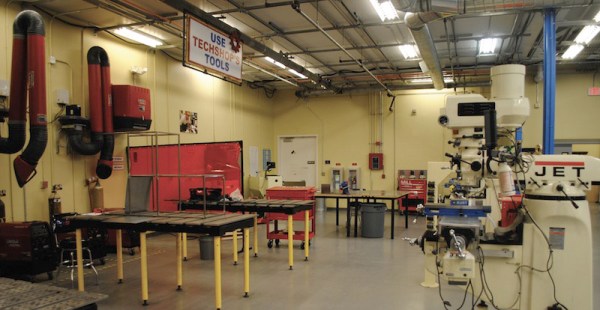
The CEO of TechShop, [Dan Woods], has hit the legal E-stop and declared Chapter-7 bankruptcy for the business. All ten US locations were shuttered on Wednesday with absolutely no advance warning. You can read the full statement from [Dan] here.

We are deeply saddened to hear of TechShop’s closing, and while it wasn’t implausible that this might happen someday, the abrupt shuttering must come as a painful shock to many for whom TechShop was an important part of their personal and professional lives. We owe a lot to the work and effort they put forth; they led the way as a pioneering makerspace and for more than ten years, TechShop provided access to tools, taught classes, and created opportunities for the DIY world that are still as important today as they were in the mid-aughts.

Leading the Way

Jim Newton, founder of TechShop, originally wanted a space to tinker with his pet projects. “I’m a frustrated inventor who needs to have access to this kind of stuff. And people always say that the best companies are the ones where the founders are passionate about what they are creating, which is exactly what I am,” Jim said in an interview in 2007, at the beginnings of TechShop.

It turned out that there were a lot of other tinkerers who wanted to work their pet projects too.

TechShop took a risk. All new business ventures are risky and most fail quite quickly, but in 2006, this whole movement, this idea that people could build things and take advantage of new technologies, personal fabrication, ad-hoc manufacturing, and rapid prototyping outside of universities and commercial R&D labs, was just a dream.

Adafruit was incubating in Limor’s dorm room. Arduino was just the name of some pub in Italy. Eben Upton was wiring prototype Raspberry Pi’s by hand. Nathan Seidle was still reflowing Sparkfun’s boards with a toaster oven. Maker Faire, “The World’s Largest Show and Tell,” wouldn’t even launch until the following year.

In the fading light of high school shop classes, people often were shown the ways of woodworking, light metalwork, and maybe how to fix a car or two. Filling a business with a smorgasbord of advanced machinery and teaching people how to use it, was, and still is, a relatively new concept. TechShop had a dream and made it real with the dedication of hardworking support staff and instructors around the country. Continue reading “Goodbye, TechShop”

Is Intel’s Management Engine Broken Yet?

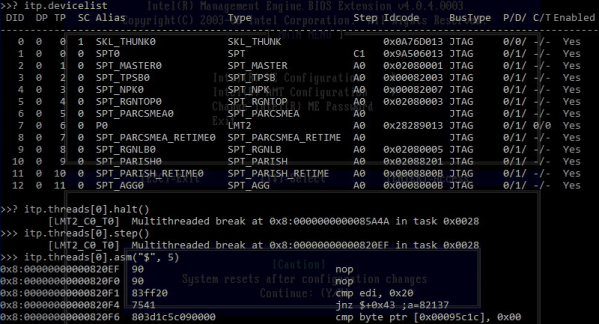
Our own [Brian Benchoff] asked this same question just six months ago in a similar headline. At that time, the answer was no. Or kind of no. Some exploits existed but with some preconditions that limited the impact of the bugs found in Intel Management Engine (IME). But 2017 is an unforgiving year for the blue teams, as lot of serious bugs have been found throughout the year in virtually every fields of computing. Researchers from Positive Technologies report that they found a flaw that allows them to execute unsigned code on computers running the IME. The cherry on top of the cake is that they are able to do it via a USB port acting as a JTAG port. Does this mean the zombie apocalypse is coming?

Before the Skylake CPU line, released in 2015, the JTAG interface was only accessible by connecting a special device to the ITP-XDP port found on the motherboard, inside a computer’s chassis. Starting with the Skylake CPU, Intel replaced the ITP-XDP interface and allowed developers and engineers to access the debugging utility via common USB 3.0 ports, accessible from the device’s exterior, through a new a new technology called Direct Connect Interface (DCI). Basically the DCI provides access to CPU/PCH JTAG via USB 3.0. So the researchers manage to debug the IME processor itself via USB DCI, which is pretty awesome, but USB DCI is turned off by default, like one of the researchers states, which is pretty good news for the ordinary user. So don’t worry too much just yet.

Continue reading “Is Intel’s Management Engine Broken Yet?”

Open Source Underwater Glider Wins 2017 Hackaday Prize

The Open Source Underwater Glider has just been named the Grand Prize winner of the 2017 Hackaday Prize. As the top winner of the Hackaday Prize, the Open Source Underwater Glider will receive $50,000 USD completes the awarding of more than $250,000 in cash prizes during the last eight months of the Hackaday Prize.

More than one thousand entries answered the call to Build Something That Matters during the 2017 Hackaday Prize. Hardware creators around the globe competed in five challenges during the entry rounds: Build Your Concept, Internet of Useful Things, Wings-Wheels-an-Walkers, Assistive Technologies, and Anything Goes. Below you will find the top five finisher, and the winner of the Best Product award of $30,000.

Open Source Underwater Glider

Grand Prize Winner ($50,000 USD): The Open Source Underwater Glider is an AUV (Autonomous Underwater Vehicle) capable of long-term underwater exploration of submarine environments. Where most AUVs are limited in both power and range, the Open Source Underwater Glider does not use active propulsion such as thrusters or propellers. This submersible glides, extending the range and capabilities of whatever task it is performing.

The Open Source Underwater Glider is built from off-the-shelf hardware, allowing anyone to build their own copy of this very capable underwater drone. Extended missions of up to a week are possible, after which the Glider would return home autonomously.

Connected Health: Open source IoT patient monitor

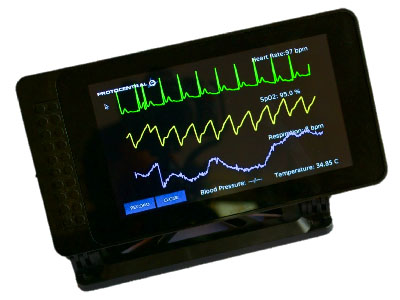
Second Place ($20,000): The Connected Health project aims to bring vital sign monitoring to the masses with a simple, inexpensive unit built around commodity hardware. This monitoring system is connected to the Internet, which enables remote patient monitoring.

Assistance System for Vein Detection

Third Place ($15,000): This Assistance System for Vein Detection uses off-the-shelf components and near-IR imaging to detect veins under the skin. This system uses a Raspberry Pi and camera module or a modified webcam and yet is just as reliable as professional solutions that cost dozens of times more than this team’s prototype.

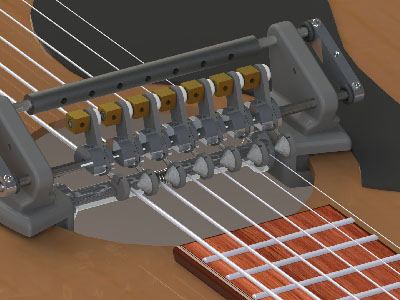
Adaptive Guitar

Fourth Place ($10,000): The Adaptive Guitar is an electromechanical system designed to allow disabled musicians to play the guitar with one hand (and a foot). This system strums the strings of a guitar while the musician frets each string.

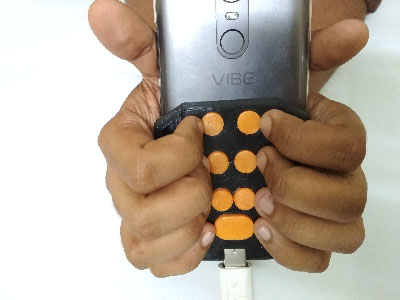
Tipo : Braille Smartphone Keypad

Fifth Place ($5,000): Tipo is effectively a Braille USB keyboard designed for smartphones. The advent of touchscreen-only phones has unfortunately left the visually impaired without a modern phone. Tipo allows for physical interaction with modern smartphones.

Best Product Winner: Tipo : Braille Smartphone Keypad

The winner of the Best Product is Tipo : Braille Smartphone Keypad. Tipo is the solution to the problem of the increasingly buttonless nature of modern smartphones. A phone that is only a touchscreen cannot be used by the visually impaired, and Tipo adds a Braille keypad to the back of any phone. It is effectively a USB keypad, designed for Braille input, that attaches to the back of any phone.

The Best Product competition ran concurrently with the five challenge rounds and asked entrants to go beyond prototype to envision the user’s needs, manufacturing, and all that goes into getting to market. By winning the Best Product competition, the creators of Tipo will refine their design, improve their mechanical build, start looking at injecton molding, and turn their 3D printed prototype into a real product that has the ability to change lives.

Congratulations to all who entered the Hackaday Prize. Taking time to apply your skill and experience to making the world better is a noble pursuit. It doesn’t end with the awarding of a prize. We have the ability to change lives by supporting one another, improving on great ideas, and sharing the calling to Build Something that Matters.

Take Robby Home

Ok, we’ll stipulate it right up front: this isn’t a hack. But you have to admit, it would make a fine starting point for a truly epic one. Robby the Robot — the robot from the 1956 movie Forbidden Planet is up for sale. Well, technically he isn’t so much a robot as he is a suit with some animatronics. The auction lot includes Robby, his (non-functioning) vehicle, a control panel, and some other accouterments. If you have deep pockets, you’ll need to bid before November 21.

MGM reportedly spent $125,000 on Robby which was a crazy amount of money in the 1950s. In today’s currency, that would be well over a million bucks. They got their money’s worth, though, as Robby appeared in movies and TV shows including Lost in Space and several episodes of the Twilight Zone. He even made a motionless cameo on The Big Bang Theory.

Continue reading “Take Robby Home”

Bionic Eye Trial Approved

Pixium Vision, a French company, has received the approval to begin in-human trials of a miniature wireless sub-retinal implant. Named PRIMA, the device may help those with advanced dry age-related macular degeneration get improvements in their eyesight. The company is in talks to also conduct trials in the United States.

The PRIMA implant is a photovoltaic chip about 2mm square and only 30 microns thick. That’s tiny, but the device has 378 electrodes. The patient uses a device that looks like a conventional pair of glasses but contains an integrated camera that sends data wirelessly to a small pocket-sized image processing computer. This computer then commands the glasses to send data to the implant via invisible infrared light. The chip converts the light to electrical impulses and conducts them to the optic nerve. You can see a video about how the system works below.

Continue reading “Bionic Eye Trial Approved”