Cyborg Olympics Is Coming This Fall

You heard right. There’s a team of scientists in Europe who are arranging the world’s first Cyborg Olympics, called the Cybathlon. Hosted in Zurich this October, it aims to help gauge the performance and advancement in the latest developments of prosthesis and other devices that can augment human ability beyond what is considered normal or baseline.

The best example of this is [Oscar Pistorius] — the man with fiberglass spring legs. He’s a double amputee who can run at an Olympic level — or maybe even faster. With the Cybathlon, his prosthesis would not only be accepted, but encouraged to help demonstrate and further the technology by adding a competitive angle to the companies manufacturing them.  Continue reading “Cyborg Olympics Is Coming This Fall”

Dr Who Returns To Earth

While searching for signs of Dalek activity in the vast depths of outer space, the Arecibo Observatory in Puerto Rico stumbled across a most interesting find. They were receiving modulated radio signals emanating from an invisible object about 25 light years away. The signals were all in the VHF band between 41 and 68 MHz. After a applying a little amplification and some wibbly wobbly timey wimey enhancements, it became clear what the signals were – 50 year old terrestrial television broadcasts. The site takes a minute or so to load due to the traffic its getting.

[Dr. Venn], the radio astronomer who discovered the signals, was able to talk NASA into pointing the Hubble Space Telescope in the direction of the now officially named “Bounce Anomaly”, but was unable to see anything. Meanwhile, a BBC team has been working with [Dr. Venn] to recover the 50 year old signals and is attempting to reconstruct entire broadcasts – some of which are the very first Dr. Who episodes.

Thanks to [PWalsh] for the tip.

World Standard Organizations To Release Entirely Reworked Standards

After months of cross-disciplinary meetings, some of the largest professional associations just announced their plans to submit an entire standard set for engineers with egos too fragile to accept design criticism. The Special Snowflake Standard or S2 (in compliance with Godwin’s law) ensures compromised mechanical and electrical integrity by ignoring proper design methodologies for more fluid definitions of success. The Special Snowflake Standard allows the modern engineer greater flexibility in avoiding self-improvement in their field while maintaining an advanced level of apparent competency.

The Standard follows an ingenious randomly generated naming scheme to hinder cross-checking and look-up. The honesty being the only change from the current system. It took us a while to navigate the websites built to serve the standards, as they themselves were built to the W3C.S2.01.d.f4r.7 Special Snowflake Standard For Geriatric Exclusion From The Study of Modern Web Development and therefore were only accessible through the Gopher protocol running specifically on SPARC workstations.

Nonetheless, after working through multiple W3C.S2.u.r.f4.u17 Probably PEBKAC Self Exclusion Of Responsibility Standard errors, we found a few standards we’re really excited about. Let’s take a look at a the highlights:

Continue reading “World Standard Organizations To Release Entirely Reworked Standards”

Roll Your Own Amazon Echo On A Raspberry Pi

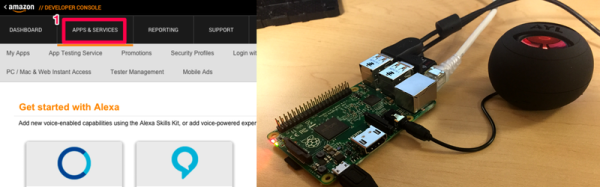
Speech recognition coupled with AI is the new hotness. Amazon’s Echo is a pretty compelling device, for a largish chunk of change. But if you’re interested in building something similar yourself, it’s just gotten a lot easier. Amazon has opened up a GitHub with instructions and code that will get you up and running with their Alexa Voice Service in short order.

If you read Hackaday as avidly as we do, you’ve already read that Amazon opened up their SDK (confusingly called a “Skills Kit”) and that folks have started working with it already. This newest development is Amazon’s “official” hello-world demo, for what that’s worth.

There are also open source alternatives, so if you just want to get something up and running without jumping through registration and licensing hoops, you’ve got that option as well.

Whichever way you slice it, there seems to be a real interest in having our machines listen to us. It’s probably time for an in-depth comparison of the various options. If you know of a voice recognition system that runs on something embeddable — a single-board computer or even a microcontroller — and you’d like to see us look into it, post up in the comments. We’ll see what we can do.

Thanks to [vvenesect] for the tip!

Windows And Ubuntu: “Cygwin Can Suck It”

For the last ten years or so, computing has been divided into two camps: Windows, and everything else with a *nix suffix. Want a computing paradigm where everything is a file? That’s Linux. Want easy shell scripting that makes the command line easy? Linux. Want a baroque registry with random percent signs and dollar symbols? That would be Windows. Want to run the most professional productivity apps for design and engineering? Sadly, that’s Windows as well.

*nix runs nearly the entire Internet, the top 500 supercomputers in the world, and is the build environment for every non-Windows developer. Yet Windows is the most popular operating system. The divide between Windows and *nix isn’t so much a rivalry, as much as people who still spell Microsoft with a dollar sign would tell you. It’s just the way personal computing evolved by way of legacy apps and IT directors.

Now, this great divide in the world of computing is slowly closing. At Microsoft’s Build 2016 developer’s conference, Microsoft and Canonical, Ubuntu’s parent company, announced a partnership that will allow Ubuntu to run using native Windows libraries.

In short, this announcement means bash and the Linux command line is coming to Windows 10. The command line is great, but userland is where it’s at, and here this partnership really shines. Unlike Cygwin, the current way to get *nix stuff running in a Windows environment, Windows’ bash will allow unmodified Linux programs to run unmodified on Windows 10.

It is not an understatement to say this is the most important development in operating systems in the last 10 years. For the last decade, every developer who is not purely a Windows developer has picked up a MacBook for the sole reason of having BSD under the hood. If you’re looking for a reason Apple is popular with devs, it’s *nix under the hood. This announcement changes all of that.


FBI Vs Apple: A Postmortem

By now you’ve doubtless heard that the FBI has broken the encryption on Syed Farook — the suicide terrorist who killed fourteen and then himself in San Bernardino. Consequently, they won’t be requiring Apple’s (compelled) services any more.

A number of people have written in and asked what we knew about the hack, and the frank answer is “not a heck of a lot”. And it’s not just us, because the FBI has classified the technique. What we do know is that they paid Cellebrite, an Israeli security firm, at least $218,004.85 to get the job done for them. Why would we want to know more? Because, broadly, it matters a lot if it was a hardware attack or a software attack.

Continue reading “FBI Vs Apple: A Postmortem”

They Put The “P” In Power

Fuel cells are like batteries, sort of. Both use chemical reactions to produce electricity. The difference is that when a battery exhausts its reactants, it goes dead. In some cases, you can recharge it, but you typically get less energy back with each recharge. A fuel cell, on the other hand, will make electricity as long as you keep supplying fuel. What kind of fuel? Depends on the cell, but most often it is hydrogen or methanol.

Researchers at the University of Bath, Queen Mary University of London, and the Bristol Robotics Laboratory want to use a different fuel: urine. According to the researchers, that’s one resource we will never deplete. The fuel cell is a type of microbial fuel cell which is nothing new. The breakthrough is that the new cell is relatively inexpensive, using carbon cloth and titanium wire. Titanium isn’t usually something you think of as cheap, until you realize that conventional cells usually use platinum.

Continue reading “They Put The “P” In Power”