Prime Numbers Are Stranger Than You Thought

If you’ve spent any time around prime numbers, you know they’re a pretty odd bunch. (Get it?) But it turns out that they’re even stranger than we knew — until recently. According to this very readable writeup of brand-new research by [Kannan Soundararajan] and [Robert Lemkein], the final digits of prime numbers repel each other.

More straightforwardly stated, if you pick any given prime number, the last digit of the next-largest prime number is disproportionately unlikely to match the final digit of your prime. Even stranger, they seem to have preferences. For instance, if your prime ends in 3, it’s more likely that the next prime will end in 9 than in 1 or 7. Whoah!

Even spookier? The finding holds up in many different bases. It was actually first noticed in base-three. The original paper is up on Arxiv, so go check it out.

This is a brand-new finding that’s been hiding under people’s noses essentially forever. The going assumption was that primes were distributed essentially randomly, and now we have empirical evidence that it’s not true. What this means for cryptology or mathematics? Nobody knows, yet. Anyone up for wild speculation? That’s what the comments section is for.

(Headline photo of researchers Kannan Soundararajan and Robert Lemke: Waheeda Khalfan)
Solder At Room Temperature

Have you ever seen the science experiment (or magic trick?) where you get water supercooled to where it isn’t frozen, but then it freezes when you touch it, pour it, or otherwise disturb it? Apparently, ice crystals form around impurities or disturbances in the liquid and then “spread.” A similar effect can occur in metals where the molten metal cools in such a way that it stays melted even below the temperature that would usually cause it to melt.

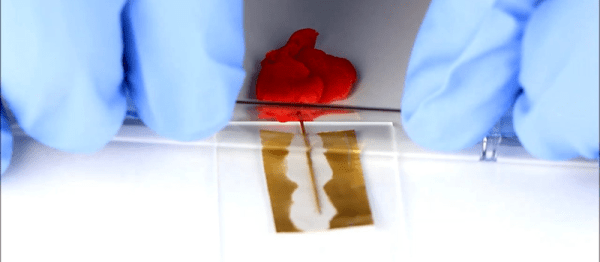
[Martin Thuo] at Iowa University used this property to make solder joints at room temperature using Field’s metal (a combination of bismuth, indium, and tin). The key is a process that coats the molten metal with several nanolayers that protect it from solidifying until something disturbs the protective layer.

Continue reading “Solder At Room Temperature”

Ask Hackaday: Google Beat Go; Bellwether Or Hype?

We wake up this morning to the news that Google’s deep-search neural network project called AlphaGo has beaten the second ranked world Go master (who happens to be a human being). This is the first of five matches between the two adversaries that will play out this week.

On one hand, this is a sign of maturing technology. It has been almost twenty years since Deep Blue beat Gary Kasparov, the reigning chess world champion at the time. Although there are still four games to play against Lee Sedol, it was recently reported that AlphaGo beat European Go champion Fan Hui in five games straight. Go is generally considered a more difficult game for machine minds to play than chess. This is because Go has a much larger pool of possible moves at any given time.

Does This Matter?

Okay, the news part of this event has been covered: machine beats man. Does it matter? Will this affect your life and how? We want to hear what you think in the comments below. But I’m going to keep going with some of my thoughts on the topic.

You're still better at Ms. Pacman [Source: DeepMind paper in Nature]
You’re still better at Ms. Pacman [Source: DeepMind paper in Nature]
Let’s look first at what AlphaGo did to win. At its core, the game of Go is won by figuring out where your opponent will likely make a low-percentage move and then capitalizing on that choice. Know Your Enemy has been a tenet of strategy for a few millennia now and it holds true in the digital age. In addition to the rules of the game, AlphaGo was fed a healthy diet of 30 million positions from expert games. This builds behavior recognition into the system. Not just what moves can be made, but what moves are most likely to be made.

DeepMind, the company behind AlphaGo which was acquired by Google in 2014, has published a paper in Nature about their approach. They were even nice enough to let us read without dealing with a paywall. The secret sauce is the learning process which at its core tries to mimic how living entities learn: observe repetitively while assigning values to outcomes. This is key as it leads past “intellect”, to “intelligence” (the “I” in AI that everyone seems to be waiting for). But this is a bastardized version of “intelligence”. AlphaGo is able to recognize and predict behavior, then make choices that lead to a desired outcome. This is more than intellect as it does value the purpose of an opponent’s decisions. But it falls short of intelligence as AlphaGo doesn’t consciously understand the purpose it has detected. In my mind this is exactly what we need. Truly successful machine learning will be able to make sense out of sometimes irrational input.

The paper from Nature doesn’t go into details about Go, but it explains the approach of the learning system applied to Atari 2600. The algorithm was given 210×160 color video at 60Hz as an input and then told it could use a joystick with one button. From there it taught itself to play 49 games. It was not told the purpose or the rules of the games, but it was given examples of scores from human performance and rewarded for its own quality performances. The chart above shows that it learned to play 29 of them at or above human skill levels.

Continue reading “Ask Hackaday: Google Beat Go; Bellwether Or Hype?”

Philip Friedin Takes Us On A Deep Dive Into His OSHChip

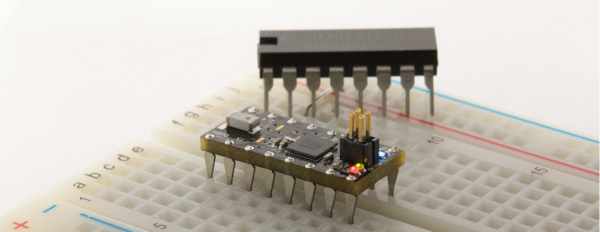
Once a month, Bay-area hackers and engineers-by-night gather in the grand office of our evil overlords (Supplyframe) and take us on an adventure in hardware. This past month, [Philip Friedin] gave us the hands-on tour of the OSHChip, a project we’ve seen floating around our pages for the last year. OSHChip might look like another open source development board, but the DIP package and all the packaged features are telltale signs that OSHChip is the offspring of a seasoned double-E. Scroll down to watch his presentation in full.

Continue reading “Philip Friedin Takes Us On A Deep Dive Into His OSHChip”

Reviving The Best Keyboard Ever

For the last few decades, the computer keyboard has been seen as just another peripheral. There’s no need to buy a quality keyboard, conventional wisdom goes, because there’s no real difference between the fancy, ‘enthusiast’ keyboards and ubiquitous Dell keyboards that inhabit the IT closets of offices the world over.

Just like the mechanic who will only buy a specific brand of wrenches, the engineer who has a favorite pair of tweezers, or the amateur woodworker who uses a hand plane made 150 years ago, some people who use keyboards eight or twelve hours a day have realized the older tools of the trade are better. Old keyboards, or at least ones with mechanical switches, aren’t gummy, they’re precise, you don’t have to hammer on them to type, and they’re more ergonomic. They sound better. Even if it’s just a placebo effect, it doesn’t matter: there’s an effect.

This realization has led to the proliferation of high-end keyboards and keyboard aficionados hammering away on boards loaded up with Cherry MX, Alps, Gateron, Topre, and other purely ‘mechanical’ key switches. Today, there are more options available to typing enthusiasts than ever before, even though some holdouts are still pecking away at the keyboard that came with the same computer they bought in 1989.

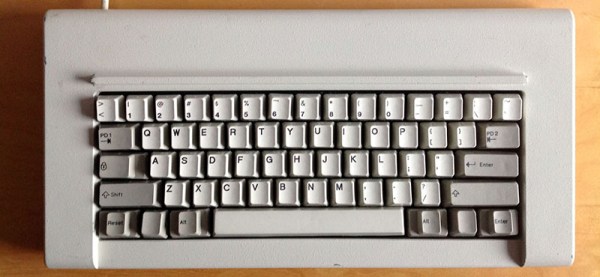
The market is growing, popularity is up, and with that comes a herculean effort to revive what could be considered the greatest keyboard of all time. This is the revival of the IBM 4704 terminal keyboard. Originally sold to banks and other institutions, this 62-key IBM Model F keyboard is rare and coveted. Obtaining one today means finding one behind a shelf in an IT closet, or bidding $500 on an eBay auction and hoping for the best.

Now, this keyboard is coming back from the dead, and unlike the IBM Model M that has been manufactured continuously for 30 years, the 62-key IBM Model F ‘Kishsaver’ keyboard is being brought back to life by building new molds, designing new circuit boards, and remanufacturing everything IBM did in the late 1970s.
Continue reading “Reviving The Best Keyboard Ever”

Wiring Was Arduino Before Arduino

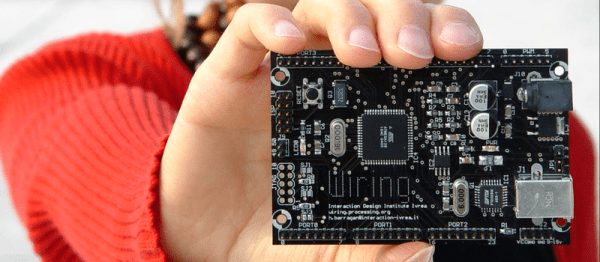
Hernando Barragán is the grandfather of Arduino of whom you’ve never heard. And after years now of being basically silent on the issue of attribution, he’s decided to get some of his grudges off his chest and clear the air around Wiring and Arduino. It’s a long read, and at times a little bitter, but if you’ve been following the development of the Arduino vs Arduino debacle, it’s an important piece in the puzzle.

Wiring, in case you don’t know, is where digitalWrite() and company come from. Maybe even more importantly, Wiring basically incubated the idea of building a microcontroller-based hardware controller platform that was simple enough to program that it could be used by artists. Indeed, it was intended to be the physical counterpart to Processing, a visual programming language for art. We’ve always wondered about the relationship between Wiring and Arduino, and it’s good to hear the Wiring side of the story. (We actually interviewed Barragán earlier this year, and he asked that we hold off until he published his side of things on the web.)

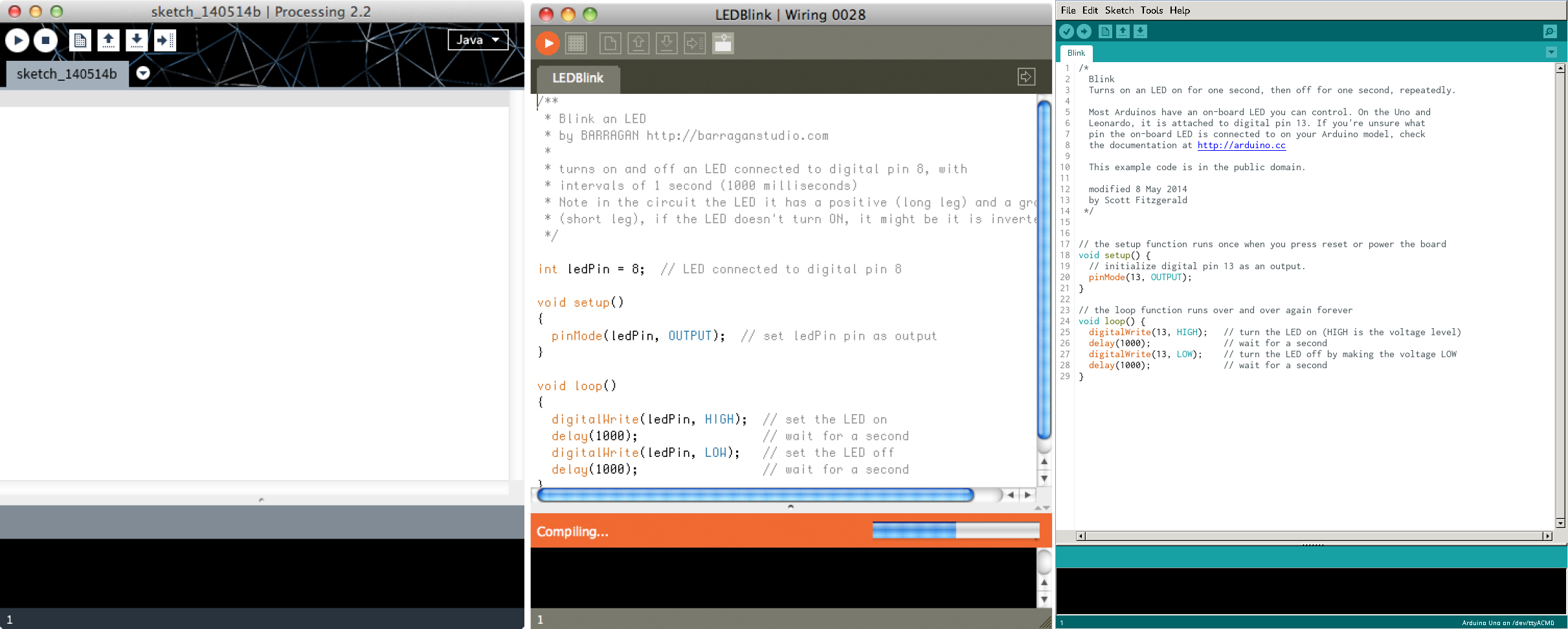
The short version is that Arduino was basically a fork of the Wiring software, re-branded and running on a physical platform that borrowed a lot from the Wiring boards. Whether or not this is legal or even moral is not an issue — Wiring was developed fully open-source, both software and hardware, so it was Massimo Banzi’s to copy as much as anyone else’s. But given that Arduino started off as essentially a re-branded Wiring (with code ported to a trivially different microcontroller), you’d be forgiven for thinking that somewhat more acknowledgement than “derives from Wiring” was appropriate.

screenshots_comparo
See what we mean?

The story of Arduino, from Barragán’s perspective, is actually a classic tragedy: student comes up with a really big idea, and one of his professors takes credit for it and runs with it.

Continue reading “Wiring Was Arduino Before Arduino”

Google Is Building A 100kW Radio Transmitter At A Spaceport And No One Knows Why

You can find the funniest things in public government documents. There’s always ample evidence your local congress critter is working against the interests of their constituency, nation, and industry controlled by the commission they’re chairperson of. Rarely, though, do you find something surprising, and rarer still does it portend some sort of experiments conducted by Google at a spaceport in New Mexico.

In a publication released last week, Google asked the FCC to treat some information relating to radio experiments as confidential. These experiments involve highly directional and therefore high power transmissions at 2.5 GHz, 5.8GHz, 24GHz, 71-76GHz, and 81-86GHz. These experiments will take place at Spaceport America, a 12,000 foot runway in the middle of New Mexico occasionally used by SpaceX, Virgin Galactic, and now Google.

For the most part, this document only tells the FCC that Google won’t be causing harmful interference in their radio experiments. There few other details, save for what bands and transmitters Google will be using and an experimental radio license call sign (WI9XZE) that doesn’t show up in the FCC database.

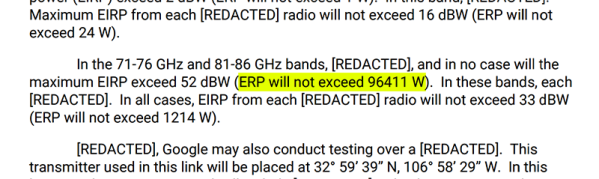
Of the few details listed in the documents, one thing does pop out as exceptionally odd: a 70-80 GHz transmitter with an effective radiated power (ERP) 96,411 W. That’s close enough to 100 kilowatts to call it as such. This is the maximum effective radiated power of the highest power FM stations in the US, but radio stations are omnidirectional, whereas Google is using very high gain antennas with a beam width of less than half a degree. The actual power output of this transmitter is a mere half watt.

The best guess for what Google is doing out in the New Mexico desert is Project Skybender, a project to use millimeter waves to bring faster Internet to everyone. There aren’t many details, but there is a lot of speculation ranging from application in low Earth orbit to something with Google Loon.