Samsung ARTIK Dev Boards Start To Ship

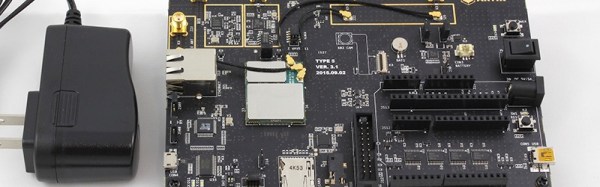
Another week’s news, another single board computer aimed at Internet of Things applications is launched. This time it’s Samsung’s Artik 5, a platform they’ve been talking about for a while now but which you can now buy as a dev board from Digi-Key for $99.99. For that you get Wi-Fi, Bluetooth and Zigbee connectivity, a dual-core ARM Cortex A7 running at 1GHz, 512MB of memory, and 4GB of eMMC storage. There are the usual plethora of interfaces: GPIO, I2C, SPI, UART, SDIO, USB 2.0, JTAG, and analogue.

The single board computer marketplace is starting to look rather crowded, and with so many competitors to choose from at more reasonable prices you might ask yourself why the ARTIK could be of interest to a maker. And given that Samsung are positioning it in their literature on its increased security for use in commercial  applications such as IoT hubs, IP cameras and industrial and commercial lighting systems, you’d probably be on to something. If you were to make a very rough analogy with the Raspberry Pi range this has more in common with the Compute Module when it comes to intended marketplace than it does with the Pi Zero.

One answer to that question though could be that it is one of the first devices to support the Thread networking protocol for IoT devices. Thread is a collaboration between Google and a range of other interested parties that has been designed to deliver reliable and secure mesh networking for IoT devices in connected homes. As with all new connectivity protocols only time will tell whether Thread is the Next Big Thing, but it is interesting to note in this board nevertheless.

The ARTIK hasn’t made many waves as yet, though we covered the story when it was announced last year. It is worth mentioning that the ARTIK 5 is only the first of three platforms, the ARTIK 1 will be a tiny board with Bluetooth LE aimed at portable and wearable applications while the ARTIK 10 will be an octo-core powerhouse aimed at mulitmedia processing and network storage applications.
The Internet Of Linux Things

The Linux Foundation is a non-profit organization that sponsors the work of Linus Torvalds. Supporting companies include HP, IBM, Intel, and a host of other large corporations. The foundation hosts several Linux-related projects. This month they announced Zephyr, an RTOS aimed at the Internet of Things.

The project stresses modularity, security, and the smallest possible footprint. Initial support includes:

  • Arduino 101
  • Arduino Due
  • Intel Galileo Gen 2
  • NXP FRDM-K64F Freedom

The project (hosted on its own Website) has downloads for the kernel and documentation. Unlike a “normal” Linux kernel, Zephyr builds the kernel with your code to create a monolithic image that runs in a single shared address space. The build system allows you to select what features you want and exclude those you don’t. You can also customize resource utilization of what you do include, and you define resources at compile time.

By default, there is minimal run-time error checking to keep the executable lean. However, there is an optional error-checking infrastructure you can include for debugging.

The API contains the things you expect from an RTOS like fibers (lightweight non-preemptive threads), tasks (preemptively scheduled), semaphores, mutexes, and plenty of messaging primitives. Also, there are common I/O calls for PWM, UARTs, general I/O, and more. The API is consistent across all platforms.

You can find out more about Zephyr in the video below. We’ve seen RTOS systems before, of course. There’s even some for robots. However, having a Linux-heritage RTOS that can target small boards like an Arduino Due and a Freedom board could be a real game changer for sophisticated projects that need an RTOS.

Continue reading “The Internet Of Linux Things”

ARM Unveils New, High Efficency CPU

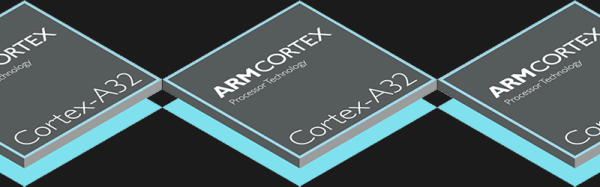
ARM has announced their latest IP core the Cortex A32. This 32-bit chip brings the benefits of the ARMv8-A architecture to low-power devices, ostensibly ones that will be the backbone of the Internet of Things.

For the last few years, the state of ARM CPUs has been firmly planted in the world of ARMv7 instructions. These chips, the Cortex A5, A7, A9, A15, and A17 are divided into ‘good, better, best’ segments, with the A7 pulling its weight as the processor in the Raspberry Pi 2, and a dual-core A15 finding its way into the latest BeagleBoard. While these CPUs are very capable, they don’t support the latest ARM architecture, ARMv8. For the last few years, the only ARM processors with the v8 architecture fell into the ‘better’ and ‘best’ segments. Although the A53, A57, and A72 chips are very capable, there hasn’t been a low power ARMv8 chip until this announcement.

So what does this announcement mean for the next generation of the Internet of Things, single board computers, and the wearable electronics of tomorrow? Absolutely nothing. Only the processor IP was released, and it will take at least a year for this core to make it into a chip. It will be 18 to 24 months until you can find this core in a consumer device. On the other hand, when these devices do appear, they will be significantly faster than current devices with a Cortex A5 and A7.

BBC Micro:Bit Gets An App

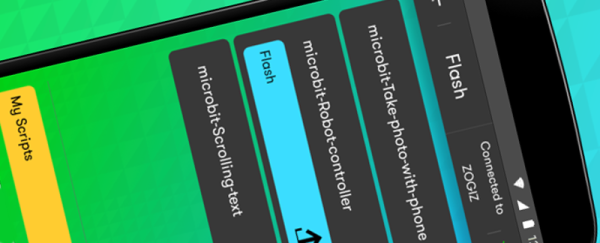
It’s a small, cheap, British single board computer, and nobody can get hold of them. Another Raspberry Pi Zero story, you might think, but no, this is about the other small cheap and difficult to find British SBC, the BBC micro:bit. Samsung UK have produced an app for the micro:bit that allows owners to write code on their Android phones, and upload it to their micro:bit via Bluetooth.

The micro:bit story has played out with agonising slowness over the last year, but it seems that there may now be light at the end of the tunnel. The idea is a good one: give a small but very capable single board computer to every Year 7 (about 12 years old) child, and watch them learn something more useful about computers than how to use a Windows application. It has echoes of the BBC Micro 8-bit computer for schools sponsored by the UK government in the 1980s, and the hope is that it will help reproduce the same technical literacy enjoyed by 1980s kids.

The plan was for the youngsters to receive their boards last October but the project as been plagued by a series of delays and the latest estimate from January was that the boards would reach the kids after the school half-term. In other words within the next couple of weeks, depending on which part of the UK the school is located in.

We recently had a brief opportunity here at Hackaday to examine a micro:bit in the wild. It is a capable little board in its own right, being at heart an mbed, however the recommended web-based micro:bit IDE and compiler differs from the more usual mbed toolchain. One thing that caught our attention in the demo we were given was the micro:bit’s use of USB to deploy code; since schools lock down computer hardware to the n’th degree we were concerned that the micro:bits might not be visible on school USB ports. Easy Bluetooth deployment through the Samsung app promises to bypass that barrier, which can only be a good thing.

We’ve been watching the micro:bit story here at Hackaday from the start, most recently we noted the arrival of Python on the platform. If it has a formative influence on the generation of developers and engineers you’ll be hiring in the mid-2020s then we expect it to feature in many future stories.


Star Wars Droid Translating Helmets

Now how’s this for an expo costume? [AEInnovations] put together a set of Droid helmets that talk to each other in droid speak!

Before you get too excited, we have to let you know, they aren’t actually translating anything. One, there’s no such thing as a complete droid speak language from Star Wars, and two, it’d be ridiculous. No, what he’s created is a bit simpler, but nonetheless awesome and very clever.

The helmets have walkie talkies built in, so two people wearing the helmets can simply talk to each other, in plain old English — well, or maybe Klingon. But when you speak, a sensor in the helmet notices you speaking, and starts broadcasting a randomized droid speech for everyone else to hear.

Continue reading “Star Wars Droid Translating Helmets”

Waiting For China To Re-Open, From Huaqiangbei

The Chinese New Year is something we keep in mind at least half of the year, and probably still don’t plan for properly. In case you’re new to the situation: The Chinese New Year celebration empties out Shenzhen of its more than 12 million residents for the better part of a month. It’s the one time of year that manufacturing sector workers (and everyone that supports that ecosystem) travels home to visit family.

For those involved in manufacturing goods in Shenzhen, this part of the year leaves us cut off from one of our vices and we count the days until our tracking numbers and order confirmations start to show signs of life. It’s an inconvenience of an entirely different nature if you are one of the lonely few that stays in the city during the holiday. [Ian] over at Dangerous Prototypes wrote a blog post from his office in Huaqiangbei which is a sub-district of Shenzhen, China to share the experience with us.

Shenzhen is uniquely a migrant-worker city, and when emptied of the factory employees there are not enough people to patronize local services like markets and restaurants so they also shut down. But an empty city offers its own interesting entertainment like wicked fireworks sessions. As always, [Ian] does a great job of sharing this peculiar part of Shenzhen culture. He also kindly points out some of the offensive offers that come through the inter-webs from desperate customers who have poorly planned around the holiday.

$3 Smartphone From India

The release of the Ringing Bells Freedom 251 means exciting things for India, and if it goes well possibly the hacker community, too. This $3 device comes with all the things you’d expect from your standard smartphone. Considering any of the individual components alone (4″ IPS screen, cell modem, 1450 mAh battery, 1.3 GHz quad-core processor, 3.2 MP front and 0.3 MP rear cameras) could cost more than the whole thing put together, some skepticism is warranted.

There is speculation about how this is possible given Ringing Bells’ claims of no government subsidies. Considering the prototype presented to the media was from Chinese company Adcom, this may be a big scam in the making. The BBC does an examination of the many ways this seems sketchy, including the lack of appropriate government approvals (like the Indian equivalent of the FCC), and the experience of the company selling it (established in 2015).

Still, consider us curious and hopeful that we may have a new tool as useful and cheap as the ESP8266 has been. That said, it will be interesting to see if the company can maintain stock and limit hardware sales to their intended market or will a curious world electronics ecosystem make them a scarce stock item.

[via BBC]