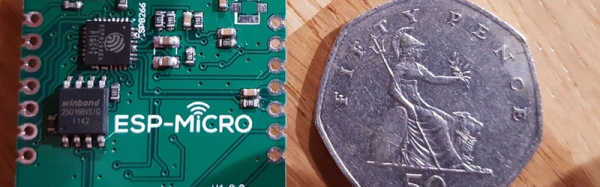
ESP-Micro Is A Tiny Development Board

The ESP-8266 packs a lot of networking power into a small package. Some would say too small, which is why they often come on a slightly larger carrier PCB. The PCB is usually little more than a breakout with an optional 3.3V regulator. [Frazer Barnes] went one step further: he put an equally tiny USB to serial bridge, an oscillator, and some power management on an ESP-8266 breakout board.

You can program the ESP-8266 via the serial port, so having a built-in USB port is handy. Of course, you might not need it in the final product, but with the board being 25x30mm, you can probably cram it into most projects. [Frazer] posted a bit about the project on Hackaday.io, and has a GitHub project, although right now the upload of the design files is pending.

There’s no shortage of ESP-8266 projects. We saw a small Zigbee to ESP8266 board last year, and also the antidote for a tiny carrier board that includes an LCD, switches, and more. We also have tons of breakouts on Hackaday.io: here’s one with all the bells and whistles, and a similar, stripped-down version. All open-everything, and ready to go.

Microchip To Acquire Atmel For $3.56 Billion

Just last week, there was considerable speculation that Microchip would buy Atmel. The deal wasn’t done, and there was precedent that this deal wouldn’t happen – earlier this year, Dialog made an approach at Atmel. Now, though, the deal is done: Microchip will acquire Atmel for $3.56 Billion.

There are three main companies out there making microcontrollers that are neither ancient 8051 clones or ARM devices: TI’s MSP430 series, Microchip and Atmel. Microchip has the very, very popular PIC series microcontrollers, which can be found in everything. Atmel’s portfolio includes the AVR line of microcontrollers, which are also found in everything. From phones to computers to toasters, there’s a very high probablitiy you’re going to find something produced by either Atmel or Microchip somewhere within 15 feet of your person right now.

For the hobbyist electronic enthusiast, this has led to the closest thing we have to a holy war. Atmel chips were a little easier (and cheaper) to program, but were a little more expensive. Microchip’s chips have a very long history and proportionally more proper engineers who are advocates. PIC isn’t Arduino, though, a community that has built a large and widely used code base around the AVR family.

Microchip’s acquisition of Atmel follows several mergers and acquisitions in recent months: NXP and Freescale, Intel and Altera, Avago and Broadcom, and On Semiconductor and Fairchild. The semiconductor industry has cash and wants to spend it. What this means for the Atmel product line is left to be seen. The most popular micros probably won’t be discontinued, but if you’re using unpopular Atmel micros such as the ATtiny10 you might want to grab a reel or two before they’re EOL’d.


Cyborg Photosynthetic Bacteria!

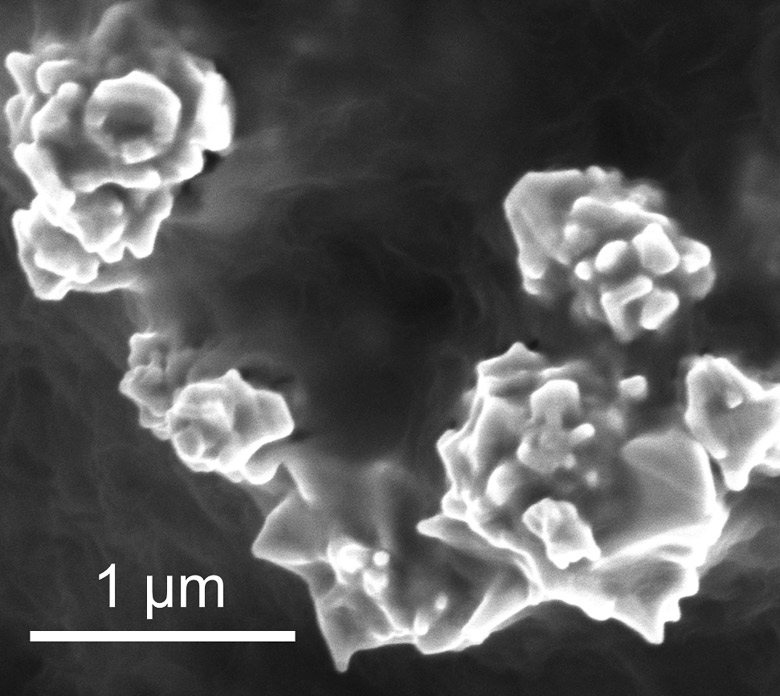
This is weird science. Researchers at Lawrence Berkeley National Laboratory have taken some normal bacteria and made them photosynthetic by adding cadmium sulfide nanoparticles. Cadmium sulfide is what makes the garden-variety photoresistor work. That’s strange enough. But the bacteria did the heavy lifting — they coated themselves in the inorganic cadmium — which means that they can continue to grow and reproduce without much further intervention.

Bacteria are used as workhorses in a lot of chemical reactions these days, and everybody’s trying to teach them new tricks. But fooling them into taking on inorganic light absorbing materials and becoming photosynthetic is pretty cool. As far as we understand, the researchers found a chemical pathway into which the electrons produced by the CdS would fit, and the bacteria took care of the rest. They still make acetic acid, which is their normal behavior, but now they produce much more when exposed to light.

If you want to dig a little deeper, the paper just came out in Science magazine, but it’s behind a paywall. But with a little searching, one can often come up with the full version for free. (PDF).

Or if you’d rather make electricity, instead of acetic acid, from your bacteria be our guest. In place of CdS, however, you’ll need a fish. Biology is weird.

Headline images credit: Peidong Yang

Nanotech Makes Safer Lithium Batteries

Lithium-ion batteries typically contain two electrodes and an electrolyte. Shorting or overcharging the battery makes it generate heat. If the temperature reaches about 300 degrees Fahrenheit (150 degrees Celsius), the electrolyte can catch fire and explode.

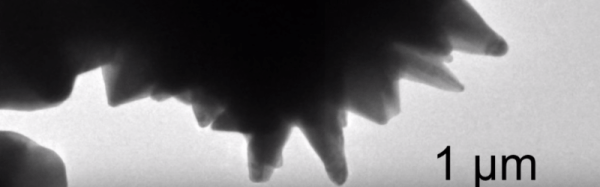
spikesThere have been several attempts to make safer lithium-ion cells, but often these safety measures render them unusable after overheating. Stanford University researchers have a new method to protect from overheating cells that uses–what else–nanotechnology graphene. The trick is a thin film of polyethylene that contains tiny nickel spikes coated with graphene (see electron micrograph to the right).

Continue reading “Nanotech Makes Safer Lithium Batteries”

Microchip’s Proposal To Acquire Atmel

A proposal from Microchip to acquire Atmel has been deemed a ‘superior proposal’ by Atmel’s board of directors (PDF). This is the first step in the acquisition of a merger between Microchip and Atmel, both leading semiconductor companies that have had a tremendous impact in the electronics industry.

Microchip is a leading manufacturer of microcontrollers, most famously the PIC series of micros that can be found in any and every type of electronic device. Atmel, likewise, also has a large portfolio of microcontrollers and memory devices that are found in every type of electronic device. Engineers, hackers, and electronic hobbyists are frequently sided with Microchip’s PIC line or Atmel’s AVR line of microcontrollers. It’s the closest thing we have to a holy war in electronics.

Last September, Dialog acquired announced plans to acquire Atmel for $4.6 Billion. Today’s news of a possible acquisition of Atmel by Microchip follows even larger mergers such as NXP and Freescale, Intel and Altera, Avago and Broadcom, On Semiconductor and Fairchild, and TI and Maxim. The semiconductor industry has cash on hand and costs to cut, these mergers and acquisitions are the natural order of things.

While the deal is not done, the money is on the table, and Atmel’s board is apparently interested.

“Makerspace” Trademark Application Rejected

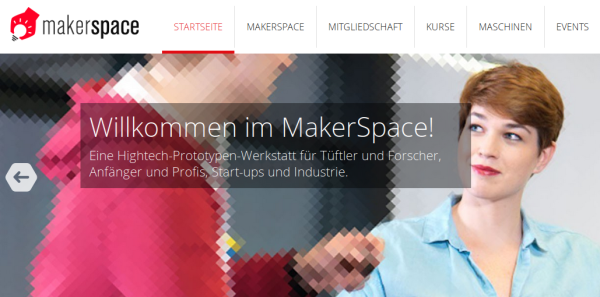
The German Patent and Trademark Office has denied the application from UnterhehmerTUM for a trademark on the word “Makerspace”.  It wasn’t likely to be a threat to the community anyway, but now it’s entirely off the table. So Kwartzlab Makerspace, Houston Makerspace, Rochester Makerspace, Anchorage Makerspace, … you can all breathe easy!

To be fair, there was never any danger, just a misunderstanding.  We reported earlier on the trademark application and within a day or so got an official reply in the comments from Phil (“Mr. Mobile”) Handy that they weren’t looking to enforce anything, but were just essentially trying to make sure that nobody else could pull the rug out from under them.  (Thanks [Gentleman Nerd] for pushing them on this.)

The makerspace in question is an open-access offshoot of a business incubator that’s associated with Munich’s Technical University, and it looks like they pumped a couple million Euros into the deal, so there were doubtless layers of bureaucracy that wanted to make sure that their asses were legally covered.

Anyway, the Trademark Office did the right thing, denying the trademark because it wasn’t “unique”, and the makerspace looks awesome.  All’s well that ends well.

via [Make Magazine] (Germany)

Introducing The BeagleBone Blue

The BeagleBone is a board that doesn’t get a lot of attention in a world of $5 Raspberry Pis, $8 single board computers based on router chipsets, and a dizzying array of Kickstarter projects promising Android and Linux on tiny credit card-sized single board computers. That doesn’t mean the BeagleBone still isn’t evolving, as evidenced by the recent announcement of the BeagleBone Blue.

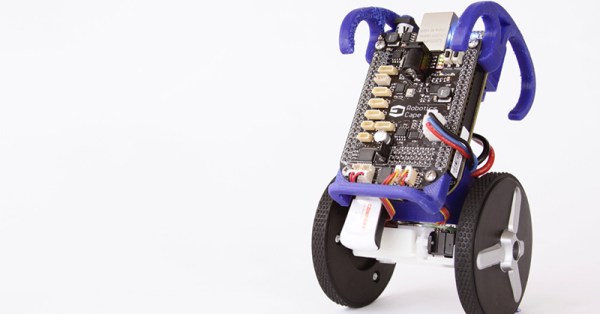
The BeagleBone Blue is the latest board in the BeagleBone family, introduced last week at CES. The Blue is the result of a collaboration between UCSD Engineering and TI, and with that comes a BeagleBone built for one specific purpose: robotics and autonomous vehicles. With a suite of sensors very useful for robotics and a supported software stack ideal for robots and drones, the BeagleBone Blue is the perfect board for all kinds of robots.

On board the BeagleBone Blue is a 2 cell LiPo charger with cell balancing and a 6-16 V charger input. The board also comes with eight 6V servo outputs, four DC motor outputs and inputs for four quadrature encoders. Sensors include a nine axis IMU and barometer. Unlike all previous BeagleBones, the BeagleBone Blue also comes with wireless networking: 802.11bgn, Bluetooth 4.0 and BLE. USB 2.0 client and host ports are also included.

Like all of the recent BeagleBoards, including the recently released BeagleBone Green, the Blue uses the same AM3358 1 GHz ARM Cortex 8 CPU, features 512 MB of DDR3 RAM, 4GB of on board Flash, and features the main selling point of the BeagleBoard, two 32-bit programmable real-time units (PRUs) running at 200 MHz. The PRUs are what give the BeagleBone the ability to blink pins and control peripherals faster than any other single board Linux computer, and are extremely useful in robotics, the Blue’s target use.

Right now, the BeagleBone Blue isn’t available, although we do know you’ll be able to buy one this summer. Information on pricing and availability – as well as a few demos – will come in February.