Chaos Computer Club (and Hackaday) Blocked By British Porn Filters

The Chaos Computer Club, Europe’s largest association of hackers and hackerspaces, has been blocked by several UK ISPs as part of a government filter to block adult content.

Since July, 2013, large UK ISPs have been tasked with implementing what has been dubbed the Great Firewall of Britain, a filter that blocks adult content, content related to alcohol, drugs, and smoking, and opinions deemed ‘extremist’ by the government. This is an opt-out filter; while it does filter out content deemed ‘unacceptable’, Internet subscribers are able to opt out of the filter by contacting their ISP.

Originally envisioned as a porn filter, and recently updated with list of banned sexual acts including spanking, aggressive whipping, role-playing as non-adults, and humiliation, the British Internet filter has seen more esoteric content blocked from British shores. Objectionable material such as, “anorexia and eating disorder websites,” “web forums,” “web blocking circumvention tools”, and the oddly categorized, “esoteric material” are also included in the filter.

A site built by the Open Rights Group is currently tracking which ISPs blocking which domains. http://ccc.de is currently blocked by ISPs Three and Vodafone. Interestingly, this site – Hackaday – is blocked by the ‘Moderate’ British Telecom filter. The ‘Light’ BT filter – and all other British ISPs – still somehow let Hackaday through, despite posts about building shotguns cropping up from time to time.

UPDATE: Upon reflection, it comes to my attention that Brits have a choice of ISP.

A 16-voice Homebrew Polyphonic Synth

Homebrew synths – generating a waveform in a microcontroller, adding a MIDI interface, and sending everything out to a speaker – are great projects that will teach you a ton about how much you can do with a tiny, low power uC. [Mark] created what is probably the most powerful homebrew synth we’ve seen, all while using a relatively low-power microcontroller.

The hardware for this project is an LPC1311 ARM Cortex M3 running at 72 MHz. Turning digital audio into something a speaker can understand is handled by a Wolfson WM8762, a stereo 24-bit DAC. Both of these chips can be bought for under one pound in quantity one, something you can’t say about the chips used in olde-tyme synths.

The front panel, shown below, uses 22 pots and two switches to control the waveform, ADSR, filter, volume, and pan. To save pins on the microcontroller, [Mark] used a few analog multiplexers. As far as circuitry goes, it’s a fairly simple setup, with the only truly weird component being the optocoupler for the MIDI input.

goom2

The software for the synth is written mostly in assembly. In a previous version where most of the code was written in C, everything was a factor of two slower. Doing all the voice generation in assembly allowed for twice as many simultaneous voices.

It’s a great project, and compared to some of the other synth builds we’ve seen before, [Mark]’s project is at the top of its class. A quick search of the archives says this is probably the most polyphonic homebrew synth we’ve seen, and listening to the sound sample on the project page, it sounds pretty good, to boot.

Laser-cut Album Released

In some alternate universe, where laser cutters and phonographs are more common than MP3 players, it makes a ton of sense to release laser-cutter files for your band’s new album (Translated). In this universe, it’s wacky and awesome.

The new EP from ASIC, alias [Patric] from Fablab Zürich, is out as PDF before it’s out in other forms of digital download, and the trailer video (embedded below the break) looks fantastic.

The release draws on this Instructable by Amanda Ghassaei to turn the music into PDFs suitable for feeding into a laser cutter, and we think it’s classy that she gets a shout-out on the label’s release page.  Everything else about the album will be released under a Creative Commons license to boot.

Continue reading “Laser-cut Album Released”

Harmonic Analyzer Mechanical Fourier Computer

If you’re into mechanical devices or Fourier series (or both!), you’ve got some serious YouTubing to do.

[The Engineer Guy] has posted up a series of four videos (Introduction, Synthesis, Analysis, and Operation) that demonstrate the operation and theory behind a 100-year-old machine that does Fourier analysis and synthesis with gears, cams, rocker-arms, and springs.

In Synthesis, [The Engineer Guy] explains how the machine creates an arbitrary waveform from its twenty Fourier components. In retrospect, if you’re up on your Fourier synthesis, it’s pretty obvious. Gears turn at precise ratios to each other to create the relative frequencies, and circles turning trace out sine or cosine waves easily enough. But the mechanical spring-weighted summation mechanism blew our mind, and watching the machine do its thing is mesmerizing.

In Analysis everything runs in reverse. [The Engineer Guy] sets some sample points — a square wave — into the machine and it spits out the Fourier coefficients. If you don’t have a good intuitive feel for the duality implied by Fourier analysis and synthesis, go through the video from 1:50 to 2:20 again. For good measure, [The Engineer Guy] then puts the resulting coefficient estimates back into the machine, and you get to watch a bunch of gears and springs churn out a pretty good square wave. Truly amazing.

The fact that the machine was designed by [Albert Michelson], of Michelson-Morley experiment fame, adds some star power. [The Engineer Guy] is selling a book documenting the machine, and his video about the book is probably worth your time as well. And if you still haven’t gotten enough sine-wavey goodness, watch the bonus track where he runs the machine in slow-mo: pure mechano-mathematical hotness!

Continue reading “Harmonic Analyzer Mechanical Fourier Computer”

The Future Of The Internet Of Things

When buying anything, you’re going to have a choice: good, fast, or cheap. Pick any two. A plumber will fix a drain good and fast, but it won’t be cheap. The skeezy guy you can call will fix a drain fast and cheap, but it won’t be good.

Such it is with radios. You can have long-range (good), high bandwidth (fast), or a low price (cheap). Pick any two. The Internet of Things demands a cheap, long-range radio module, but until now this really hasn’t existed. At Electronica last week, Microchip demoed their IoT solution, the LoRa. This module has a 15km (rural) or ~3km (heavy urban) range, works for a year on two AAA batteries, and is very cheap. Bandwidth? That’s crap, but you’re not streaming videos to your shoe.

Continue reading “The Future Of The Internet Of Things”

Bricked Raspberry Pi Displays History

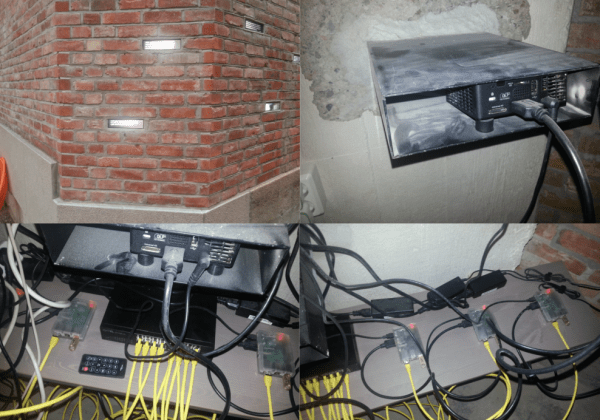
[eN0Rm’s] Raspberry Pis are much more than just another brick in the wall. He’s used the popular embedded Linux platform to build several small rear projection screens in a brick wall (Imgur link). Brick shaped metal enclosures were mortared into the wall of the building. Each rear projection screen is illuminated by a DLP projector which sits inside the metal enclosure. The Raspberry Pis sit on a shelf below all this.  The bricks are in a building in the Aker Brygge section of Oslo, Norway, and show historical facts and short videos about the local area.

[eN0Rm] could have used a PC for this task, the price for a low-end PC with a few graphics cards probably wouldn’t have been much more expensive than several Raspberry Pi’s with cases. However, this system has to just work, and a PC would represent a single point of failure. Even if one Raspberry Pi goes down, the others will continue running.

The current installation is rather messy, but it’s just a test setup.  [eN0Rm] has already been taken to task for the lack of cable management in his Reddit thread.  As [eNoRm] says – first get it working, then make it pretty.

[Ben Krasnow] Shows Us How A Crookes Radiometer Works

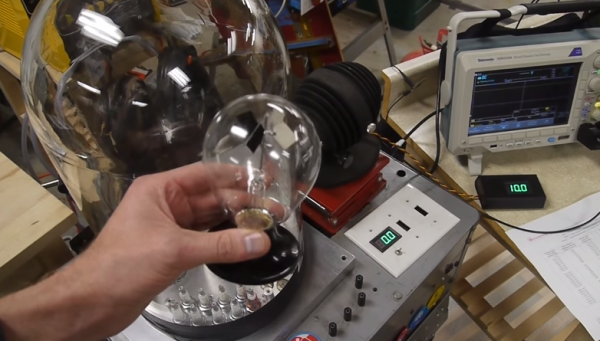
[Ben Krasnow] is tackling the curious Crookes Radiometer on his Applied Science YouTube channel. The Crookes Radiometer, a staple of museum gift shops everywhere, is a rather simple device. A rotor with black and white vanes rotates on the head of a needle. The entire assembly is inside a glass envelope. The area inside the glass is not at a hard vacuum, nor is it filled with some strange gas. The radiometer only works when there is a partial vacuum inside.

The radiometer’s method of operation was long misunderstood. Sir William Crookes and James Clerk Maxwell both believed that the vanes moved due to the pressure of the photons hitting the vanes. If that were true though, the radiometer would spin in the opposite direction it normally does when held near a light source.  It was eventually discovered that the system is a thermodynamic one. [Ben] proves this by cooling down the radiometer’s glass with a can of freeze spray.  The radiometer immediately begins spinning backwards, with no light source present.

From there [Ben] mounts the rotor of a radiometer inside his vacuum chamber, which many will recognize as the chamber from his DIY electron microscope. As expected, the vanes don’t spin at a hard vacuum. In fact, [Ben] find the vanes spin fastest when the pressure is about 7 mTorr.

Continue reading “[Ben Krasnow] Shows Us How A Crookes Radiometer Works”