Announcing: Hackaday Videos And Behind The Scenes Mailing List

hadfilm2

We’re starting a few new things at hackaday. As always, our goal is to share awesome hacks from as diverse a crowd as possible. We’ve played with video a bit before, but now we’re really going to start having some fun with it.

Our first exploration into this area was the hacked portal gun. People enjoyed looking at it, and those seeking more in depth technical knowledge came to the site to get it. Instead of focusing the video on the technology or the build itself, we used it as an interesting way to get the attention of people with relevant interests. This video proved to us that our idea was solid.

We have now stepped up our production in terms of quality and quantity.  We will be releasing videos that may be humorous, like a fake commercial or skit, or may be serious in the style of a documentary. They will all have some kind of hack at their core and that hack will be broken down in an article here.

I would also like to extend the opportunity for you to help. There are two ways you can do so:

  1. Sign up for our email list(it is in the right column). I’ll be sharing behind the scenes info and previews about upcoming video projects and asking for ideas on how to improve them.  The list will be very informal, and only deal with behind the scenes kind of stuff it will not be a mailing of the daily posts.
  2. Submit a project or idea that you think would make a cool video. You can email that directly to caleb@. Of course, we would prefer projects that haven’t been released yet, but that isn’t necessary. We’re looking for things that are visually stunning, or could possibly have highly cinematic potential. Not necessarily the most technically difficult thing.

We hope to start releasing videos next week, so keep your eyes peeled. We filmed all week, and my cheeks hurt from laughing so much.


This Has Not Been A Good Week For The Hacker Community

RIP

The Internet lost a few great minds this week. [Aaron Swartz], confronted with an upcoming federal trial for his actions in downloading and releasing public domain academic articles from JSTOR, hanged himself this week. As one of the co-developers for RSS, the Creative Commons license, and slew of other works, [Aaron]’s legacy expanded the freedoms and possibilities of the most important human invention since the book.

Perhaps overshadowed in the news by [Aaron] is [Fabio Varesano], the man behind FreeIMU and Femtoduino. He died of a sudden heart attack at the much too young age of 28. The RC helicopter/plane/drone and HCI/physical computing communities lose a great mind with [Fabio]’s passing.

There is talk on the Dangerous Prototypes forum of continuing the development of FreeIMU, a project it seems [Fabio] worked on alone. We’d love to see someone pick up the reigns of the FreeIMU project, hopefully after doing a run of the current hardware and donating the proceeds to [Fabio]’s family.

Bluetooth Network Monitor

Bluetooth Network Monitor

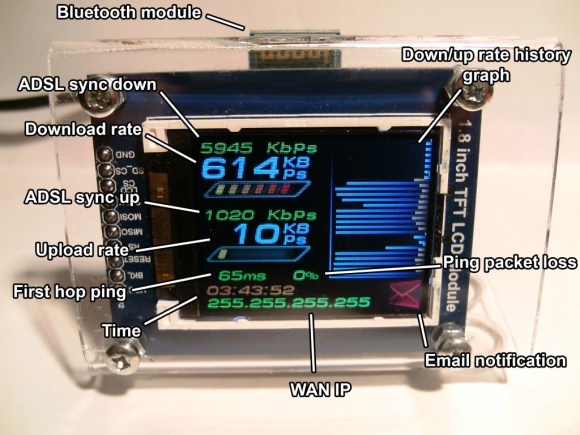
[Zak] wanted to keep tabs on his network connection without needing to log into his router. Since his router was a PC running Debian Linux, he rigged up a Bluetooth Network Monitor to display the information.

The monitor is based on a ATMega328P that reads data from a Bluetooth serial connection and displays it on the TFT screen. It uses a low cost Bluetooth module to receive data from a router. A shell script fetches the data and formats it into a string that can be sent over the Bluetooth link.

A USB connection with a desktop computer is used to power the device, but [Zak] also added USB support using V-USB. He plans to use it to get data from the desktop. For example, he could display CPU load and temperature data.

Overall, this is a nice project for fetching data wirelessly and displaying it on your desk. [Zak] has provided the code and Eagle files with his write up for anyone interested in building their own.

This Day In Hack A Day History: January 1st 2005

TIMEHAX

A new feature that we’re playing with is an occasional look back at this day in Hack a Day history. While we’re still hotly disputing exactly what, when, and how to show, we thought today would be a great day to introduce the idea.

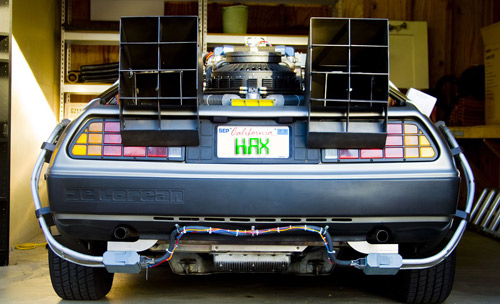
So, in on this day in Hack a Day history we’re reaching back to our very first January 1, which was 2005.  There are some interesting things to consider when reading this post. At this point in time, we were still sort of  a growth off the side of engadget like [Kuato] from the 1990 version of Total Recall.  We were less than a year old and still hadn’t completely developed our style, we didn’t really share much information about the project, and yep, the very first comment is “not a hack”.

Continue reading “This Day In Hack A Day History: January 1st 2005”

Stellaris Launchpad And Booster Packs Used As Frequency Analyzer

stellaris-frequency-analyzer-using-booster-packs

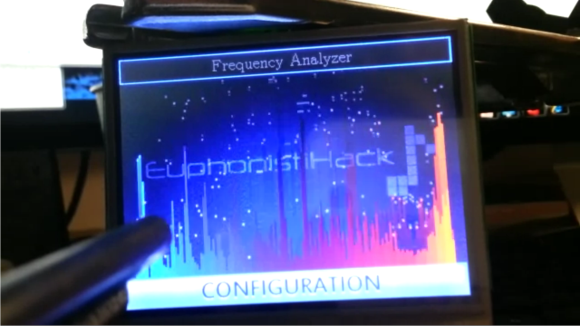
[Jordan Wills] got tired of being limited to eight pixels of resolution and having jumper wires littering his work space. He set out to upgrade his Stellaris Launchpad frequency analyzer project using booster packs. You may remember the initial iteration of the project which used an 8×8 LED matrix to map audio spectrum. With this upgrade he’s really putting the power of that ARM chip to use.

His first improvement with this project was to spin his own audio input board. It has a standard headphone jack for input and a few passive components to shift the signals to rest nicely within the ADC measurement range. The shield has two double pin headers and a group of four stand offs to serve as legs. This way it plugs into the female headers on the bottom of the Launchpad and provides a stable base for the assembly.

The second portion of the setup is an LCD booster pack for the hardware. Kentec manufactures this 3.5″ 320×240 LCD (EB-LM4F120-L35) complete with a resistive overlay making it touch sensitive. The increase in resolution, and availability of different colors gave [Jordan] plenty to work on. Since this add-on is designed for the Launchpad and has a driver library already available he was able to focus on adapting the FFT output for display and adding in new features. Don’t miss seeing what he’s accomplished in the clip after the break.

Continue reading “Stellaris Launchpad And Booster Packs Used As Frequency Analyzer”

Welding With Over A Hundred A123 Lithium Cells

a123-cell-powered-welder

[Doctor Bass] needed to do some welding on his electric bicycle. The problem is that he’s never welded before and doesn’t have any tools for it. As you can see, that didn’t stop him. He used a bicycle battery made from reclaimed DeWalt A123 cells to power his diy welding rig.

He has a huge adjustable resistor which is responsible for limiting the current. 80 Amps seems to work the best with the welding rods he’s chosen. It is worth noting that when he shows off each part of the welder (see the clip after the break) the color of the wire used for positive and negative leads is opposite of convention. His positive wiring is black while his ground connection is red.

To get the welding under way he connects a jumper-cable-like clamp to his work piece which serves as the positive electrode. To hold the welding rod he drilled a hole in a pair of vice grip pliers and bolted on the negative lead. This way the end of the welding rod can be clamped in the vice grips while his other hand guides the tip. So far he’s still practicing, but it looks like he’s nearly ready to take on the job at hand.

Continue reading “Welding With Over A Hundred A123 Lithium Cells”