Upgrading An Old Super Scope

rechargeable_super_scope

[Brian Knoll] still uses his Super Nintendo with relative frequency, and he just can’t get enough Super Scope action. If you never owned one, the Super Scope can be a ton of fun, but it’s also an incredible battery hog. It eats through AA batteries by the caseful, so [Brian] wanted to make the switch to rechargeable cells. Since NIMH AA batteries just don’t cut it in the Super Scope, he put together a rechargeable solution of his own.

He started off by calculating what sort of battery he would need for 8 hours of game play, then he started work on designing his circuit. The board he built contains both a DC/DC converter to provide the 9V required by the Super Scope, as well as built-in LiPo charger. He had his board made by BatchPCB, and after working through a small production error, he put everything together and gave his revamped scope a shot.

Things worked great, and while he says that he really should have built a low-voltage shutoff into his circuit, he is very happy with the results.

SNES Gamepad Coversion To USB

[Kekszumquadrat] wanted to use a classic controller to play emulator games on his Android tablet so he set out to convert an SNES gamepad to connect via USB. He found an old USB keyboard at a yard sale for about 3 Euros. He knew that the emulator he prefers has the option of remapping all the inputs to keyboard keys which means a USB keyboard has all of the electronics he would need to pull this off.

Once he had separated the keyboard circuitry from the case [Kekszumquadrat] plugged it into his Linux box and used Xev to establish how the keyboard matrix is set up. Xev is a common package that opens up an active window on the X desktop. When run from command line, any events that happen to the window will be echoed along with verbose data about that event. When it comes to keypresses, you’ll get the keycode you need. He simply shorted columns and rows until he found the desired mapping, then it was on to soldering.

The SNES controllers are very simple devices. As we’ve seen with previous projects, they use a serial-to-parallel shift register to gather button data and send it to the console. [Kekszumquadrat] simply soldered between button traces and keyboard matrix contacts. Once he finished, the keyboard parts were tucked inside of the controller case and he’s left with a USB controller that appears to be unaltered.

Update: Bluetooth Super Nintendo Controller For Android

[Rich’s] newest version of a Bluetooth connected Super Nintendo controller takes what was already good and makes it better. We looked at the original version back in May, which is built into a knockoff controller  — [Rich] mentions that he got a lot of flack for defacing retro equipment and wants to set the record straight. The most notable difference between the two controllers is that the batteries are now housed inside the case. He switched over to an 850 mAh Lithium Ion battery, which takes much less room than the four AA batteries did. There is an integrated charger which connects via a mini USB jack as seen in the image above. Bother versions of the controller can be used to play emulators without rooting your Android device.

Unfortunately you won’t get to look inside the case. What we can tell you is that the build no longer uses a BlueSMiRF board , opting for a less expensive Bluetooth solution. We also know that the build is still Arduino compatible, sporting an ATmega328 chip running the bootloader. The lack of detail is because [Rich] is working to market the controller with a limited-quantity preorder. Check out his video presentation of the new version after the break.

Continue reading “Update: Bluetooth Super Nintendo Controller For Android”

Playing SNES With An R/C Controller

Normally when we see an R/C transmitter used in a build we’re prepared for robots, quadcopters, or UAVs. [Alex] found a new use for his Futaba radio – hooking it up to his Super Nintendo.

We’ve seen a lot of builds using game controllers as interfaces to other hardware. The N64 media remote comes to mind, as does the NES iPod dock. Outside of a few builds to automatically win in-game currency for you, we haven’t seen much of anything to control a video game with additional electronics. [Alex]’s build happily bucks that trend, and technically gives the SNES an analog controller.

The build uses an mBed microcontroller to capture the radio’s button and stick positions. This is sent through a two shift registers to produce the 16-bit packet required of the SNES controller protocol. [Alex] posted all the software for his build, and from the looks of it the code seems pretty portable. [Alex] says he’s working on getting his Sega Saturn running with his Futaba, so we can’t wait to see some Panzer Dragoon action. Check out [Alex] demoing his controller with Gradius III after the break.

Continue reading “Playing SNES With An R/C Controller”

Wii Homebrew Hack – No Game Discs Required

Jailbreaking hacks have come and gone for the Wii, ever changing as Nintendo tweaks their software to prevent homebrew from running. Piracy concerns aside, there is a legitimate Wii homebrew scene, and a  new, easy to use tool has been released for those looking to give it a try.

Many of the previous jailbreaks relied on bugs found within official Wii games, but there’s a new kid on the block that requires nothing more than an Internet connection and an SD card. LetterBomb is the latest jailbreaking tool, which was created by an individual named [blasty]. It seems incredibly easy to use, requiring little more than entering your Wii’s MAC address into a web form. The site generates a customized jailbreak file, which your run on your Wii via the SD card – that’s all there is to it!

If I had a Wii, I would be hesitant to enter any sort of globally-unique number that could identify my console into a random web site, but perhaps I am being overly paranoid. Either way, it would be great to see an open-source version of this tool released so that jailbreaks could be done offline, without any risk of having your MAC address recorded.

[Thanks, blurry]

Virtual Segway Tours Using The Wii Balance Board

Take a tour of anywhere on earth without leaving your home. This virtual Segway tour uses the Wii Fit Balance Board and Google Earth to let the rider control a virtual tour by leaning in the direction they want to travel. It’s the product of a hackathon at SVI Hackspace, a new hackerspace in Stanford’s Huang Engineering Center.

The project was undertaken by four people who had just met for the first time that night. Seven hours later, they had a working system that combines a huge number of software packages; OS X, Osculator, Node.js, Socket.io, the Google Earth API, Monster Milk Truck, and Google 3D Warehouse. Most of those packages are used to get the board talking to the computer and then interpreting the data. Monster Milk Truck – which we had never heard of – is a plugin that lets you drive through Google Earth environments using button presses and arrows (which are simulated by the balance board data translations).

This is a nice complement to some of the other balance board hacks we’ve seen, like the one used to control World of Warcraft. Don’t forget to peek at the video after the break.

Continue reading “Virtual Segway Tours Using The Wii Balance Board”

Sleek, Disc-less GameCube Handheld

sd_card_gamecube_handheld

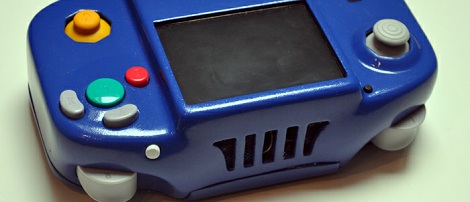
Console hacker [techknott] has a skill set that is quite possibly second to none. We do love [Ben Heck] and think that his portable consoles are beyond awesome, but you’ve got to check out this portable GameCube [techknott] put together.

While the construction details are pretty sparse, the video below shows off the bulk of the portable ‘Cube’s best features. Far smaller than his Flip-Top GameCube or Dreamcast portables we’ve featured in the past, his new handheld sports a wider screen and is completely disc-less. While the legality of booting backup copies of games from an SD card is something we won’t delve into, we do like the concept.

The console itself is probably only about one and a half times the width of a standard GameCube controller, and while it doesn’t sport an internal battery pack, we wouldn’t turn one down. Besides, who wants to play GameCube outside? With one of these in hand, we are more than happy to keep our pasty selves indoors, thank you very much.

The only complaint we have here is the lack of build details. [techknott’s] handheld consoles are pretty amazing – we just wish that we could see how the magic was made!

Be sure to check out the video below to see the console in action.

[Thanks, Dave]

Continue reading “Sleek, Disc-less GameCube Handheld”