Parts: 4×4 RGB Button Pad Controller SPI

cover

We covered SparkFun’s new RGB button pad controller a few weeks ago. This is a full-color clone of the monome interface; a 4×4 grid of buttons with tri-color LEDs underneath. Each LED has 24bits of color control, for more than 16million color combinations. Up to 10 panels can be chained together to create huge button grids, like SparkFun’s Tetris table. We previously used a smaller version in our RGB combination lock.

We asked SparkFun to send us the SPI version of the button controller to test. This is a new product developed in-house at SparkFun, with open source hardware and software. Read about our experience interfacing this board below.

Continue reading “Parts: 4×4 RGB Button Pad Controller SPI”

Parts: 32KB SPI SRAM Memory (23K256)

23k256ii

Microchip’s new 23K256 is a serially interfaced 32 kilobyte SRAM memory chip, available in 8 pin DIP and 8 pin SO packages. SRAM, like EEPROM, is a data storage medium. Data stored in SRAM is lost without constant power, but it’s really fast and there’s no limits to the number of write cycles. EERPOM stores data even without power, but it’s slow and usually limited to around a million write cycles.

32K SRAM chips typically have 15 address lines and 8 data lines, like the IS61LV256AL we used on our CPLD development board.  The 23K256 requires just four signal lines, but sacrifices the speed of a parallel memory interface. It’s a great way to add extra memory to a low-pin count microcontroller without routing 23 signal traces. We’ll show you how to interface this chip below.

Continue reading “Parts: 32KB SPI SRAM Memory (23K256)”

Parts: Analog Distance Sensors (Sharp GP2D12/2Y0A02)

[youtube=http://www.youtube.com/watch?v=iGiRK0vmcUw]

Sharp GP2D12 and 2Y0A02 infrared rangers output a voltage proportionate to the distance of an object from the sensor.  The GPD12 senses objects at a distance of 10-80cm, while the 2Y0A02 has twice the range.

We’ve previously looked at the Sharp GP2Y0D02 digital proximity sensor. It only signals the presence of objects, while the GP2D12 and 2Y0A02 measure distance to them. If you’ve got a GP2YoD02, it might still be possible to tap the analog output. We’ll show you how use these sensors below.

Continue reading “Parts: Analog Distance Sensors (Sharp GP2D12/2Y0A02)”

Parts: I2C Audio Volume Potentiometer (DS1807)

ds1807ii

The DS1807 contains two logarithmic digital potentiometers (pots) for audio volume adjustment. Each pot has 64 volume levels plus a mute setting. The volume level of each pot is set over a two-wire I2C serial interface. We’ll show you how to connect and interface the DS1807 below.

Continue reading “Parts: I2C Audio Volume Potentiometer (DS1807)”

Tools: Smart Tweezers

We’re big fans of surface mount parts. SMD components are cheaper, take less board space, and don’t require drilling; all the coolest new parts are only available in SMD packages.

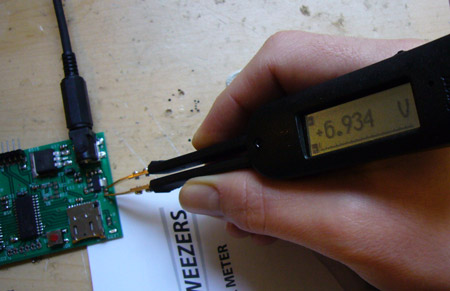
Smart Tweezers are an advanced multimeter tool specifically designed to test and troubleshoot SMD circuits. It automatically identifies resistors, capacitors, and inductors, and displays the relevant measurements. Advanced Devices sent us a pair of Smart Tweezers to review. We used them while building our last few SMD projects, read about our experience with this tool after the break.

Continue reading “Tools: Smart Tweezers”

Parts: LTC2631A I2C Digital To Analog Converter

ltc2640

Linear Technology’s LTC2631A-LZ8 is an 8bit digital to analog converter (DAC) with an I2C interface. This DAC can output 255 different voltages, spaced evenly between 0 and 2.5volts. We previously demonstrated the LTC2640 with a three-wire SPI interface, but this version is controlled with only two signal wires.

Continue reading “Parts: LTC2631A I2C Digital To Analog Converter”

Parts: AT Keyboard

atkeyboard

Last week we introduced a new version of the Bus Pirate universal serial interface tool. The last firmware update included an AT keyboard decoder library for both hardware versions.

There’s a ton of old AT keyboards making their way to the landfill. We’ll show you how to recycle one as an input device for your next project.

Continue reading “Parts: AT Keyboard”