Detect Lightning Strikes With An Arduino

Lightning is a powerful and seemingly mysterious force of nature, capable of releasing huge amounts of energy over relatively short times and striking almost at random. Lightning obeys the laws of physics just like anything else, though, and with a little bit of technology some of its mysteries can be unraveled. For one, it only takes a small radio receiver to detect lightning strikes, and [mircemk] shows us exactly how to do that.

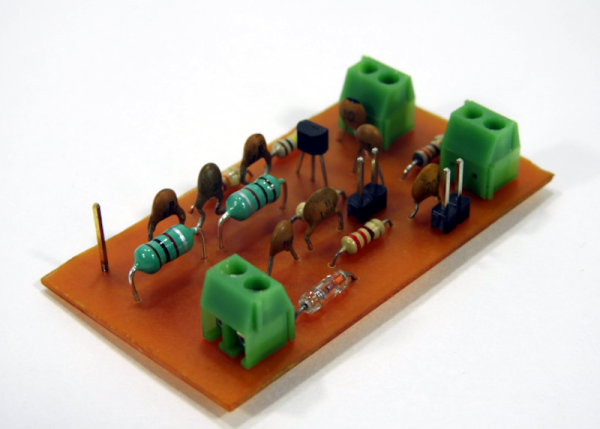
When lightning flashes, it also lights up an incredibly wide spectrum of radio spectrum as well. This build uses an AM radio built into a small integrated circuit to detect some of those radio waves. An Arduino Nano receives the signal from the TA7642 IC and lights up a series of LEDs as it detects strikes in closer and closer proximity to the detector. A white LED flashes when a strike is detected, and some analog circuitry supports an analog galvanometer which moves during lightning strikes as well.

While this project isn’t the first lightning detector we’ve ever seen, it does have significantly more sensitivity than most other homemade offerings. Something like this would be a helpful tool to have for lifeguards at a pool or for a work crew that is often outside, but we also think it’s pretty cool just to have around for its own sake, and three of them networked together would make triangulation of strikes possible too.

Continue reading “Detect Lightning Strikes With An Arduino”

Building A Hundred-Year-Old Radio Transmitter

Our Hackaday team is spread across the world, but remains in easy contact through the magic of the Internet. A number of us hold amateur radio callsigns, so could with a bit of effort and expenditure do the same over the airwaves. A hundred years ago this would have seemed barely conceivable as amateurs were restricted to the then-considered-unusable HF frequencies.

Thus it was that in December 1921 a group of American radio amateurs gathered in a field in Greenwich Connecticut in an attempt to span the Atlantic. Their 1.3 MHz transmitter using the callsign 1BCG seems quaintly low-frequency a hundred years later, but their achievement of securing reception in Ardrossan, Scotland, proved that intercontinental communication on higher frequencies was a practical proposition. A century later a group from the Antique Wireless Association are bringing a replica transmitter to life to recreate the event.

A free-running oscillator is today rarely seen in a radio transmitter, but at the time their single-tube Colpitts oscillator using a UV-204 transmitting tube would have been considered a stable source. That fed a 1KW power amplifier using three more UV-204s in parallel, which in turn fed a Marconi-style T antenna design with an earth counterpoise of multiple radial wires. The replica was originally built for an event in 1996, and substitutes the similar 204A tube for the now unobtainable UV-204. Even then, hundred-year-old tubes are hard to find in 2021, so they could only muster a single working example for the PA.

All in all it’s a very interesting project, and one of which we hope we’ll hear more as the anniversary approaches. If we can get the transmission details we’ll share them with you, and let’s see whether the same distances can be traversed with the more noisy conditions here in 2021.

To demonstrate how advanced this transmitter was for 1921, take a look at the Alexanderson alternator, its mechanical contemporary.

Regen Receiver With Few Parts

We like regenerative receivers. They perform well and they are dead simple to create. Example? [Radio abUse] modified a few existing designs and built a one-transistor receiver. Well, one transistor if you don’t count the dozens that are probably on the audio amplifier IC, but we won’t quibble. You can watch a video about the simple receiver — which looks good on a neatly done universal board — below.

The coil of #22 wire dominates the visual layout, and we imagine winding it might have been the most time-consuming part of the project. The layout would work with a single-sided PCB and would be a great board to produce by hand if you were inclined to develop that skill.

Regenerative receivers work by holding an amplifier just shy of oscillating at a certain frequency. This provides extremely high gain at a particular frequency which allows just a single stage to really pull in signals.

We were a little sad to find out there was a plan to tear the radio down to build something else. But, we suppose, that’s progress. We’d be tempted to make a module out of the audio amplifier and then keep the RF section intact. But, then again, we have a lot of partial projects like that gathering dust on the shelf, so maybe that’s not such a great idea.

While regenerative receivers aren’t the most common architecture today, they still have their place. The inventor, Edwin Armstrong, developed quite a bit of radio tech that we still use today.

The Curious Case Of The Radio Amateur And The Insulin Pump

A substantial part of gaining and holding an amateur radio licence relates to the prevention of radio interference. In days past this meant interference to analogue television broadcasts, but with ever more complex devices becoming commonplace in homes it applies to much more. This has hit the news in Marion County Florida, where a radio amateur in a senior’s community has shut down his radio station after a potential link emerged between it and another resident’s insulin pump. There is a legal challenge ongoing that relates to the complex’s rules over transmitting antennas.

It’s obviously a serious occurrence for an insulin pump to be affected by anything, and it sounds as though the radio amateur concerned has done the right thing. But it’s clear that something has gone badly wrong in this case whether it’s due to the amateur radio transmissions or not, because for a manufacturer to produce a medical device so easily affected by RF fields should be of concern to everyone. We’d hope that the FCC might take an interest in this story and get to the bottom of it in an impartial manner, because whether it’s the radio amateur at fault, the insulin pump, or something else entirely, it presents a risk to anyone dependent upon such a device.

Perhaps this might also be a case for the ARRL, as we’ve reported before they have some form when it comes to radio investigations.

[Main image source: MailariX, CC-BY-SA 4.0]

Cable Modem Turned Spectrum Analyzer

Hopefully by now most of us know better than to rent a modem from an internet service provider. Buying your own and using it is almost always an easy way to save some money, but even then these pieces of equipment won’t last forever. If you’re sitting on an older cable modem and thinking about tossing it in the garbage, there might be a way to repurpose it before it goes to the great workbench in the sky. [kc9umr] has a way of turning these devices into capable spectrum analyzers.

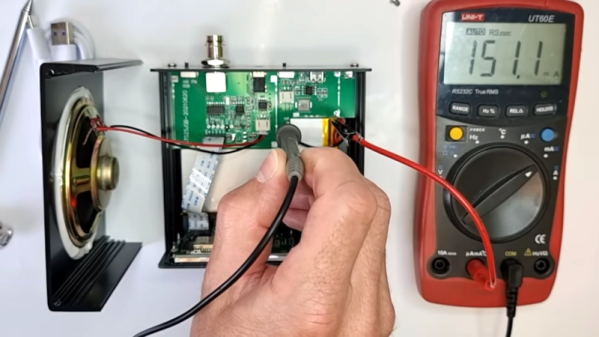
The spectrum analyzer feature is a crucial component of cable modems to help take advantage of the wide piece of spectrum that is available to them on the cable lines. With some of them it’s possible to access this feature directly by pointing a browser at it, but apparently some of them have a patch from the cable companies to limit access. By finding one that hasn’t had this patch applied it’s possible to access the spectrum analyzer, and once [kc9umr] attached some adapters and an antenna to his cable modem he was able to demonstrate it to great effect.

While it’s somewhat down to luck as to whether or not any given modem will grant access to this feature, for the ones that do it seems like a powerful and cheap tool. It’s agnostic to platform, so any computer on the network can access it easily, and compared to an RTL-SDR it has a wider range. There are some limitations, but for the price it can’t be beat which will cost under $50 in parts unless you happen to need two inputs like this analyzer .

Thanks to [Ezra] for the tip!

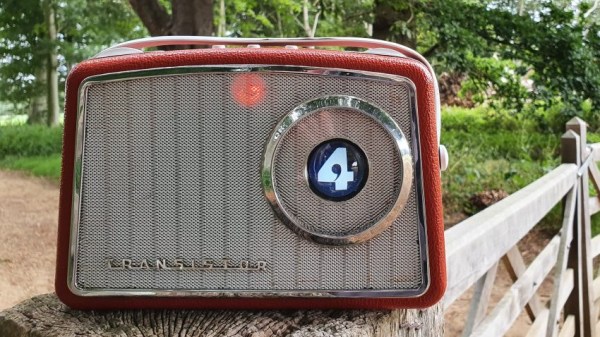
FM Radio, The Choice Of An Old Generation

Had the pandemic not upended many of this summer’s fun and games, many of my friends would have made a trip to the MCH hacker camp in the Netherlands earlier this month. I had an idea for a game for the event, a friend and I were going to secrete a set of those low-power FM transmitters as numbers stations around the camp for players to find and solve the numerical puzzles they would transmit. I even bought a few cheap FM transmitter modules from China for evaluation, and had some fun sending a chiptune Rick Astley across a housing estate in Northamptonshire.

To me as someone who grew up with FM radio and whose teen years played out to the sounds of BBC Radio 1 FM it made absolute sense to do a puzzle in this way, but it was my personal reminder of advancing years to find that some of my friends differed on the matter. Sure, they thought it was a great idea, but they gently reminded me that the kids don’t listen to any sort of conventional broadcast radio these days, instead they stream their music, so very few of them would have the means for listening to my numbers stations. Even for me it’s something I only use for BBC Radio 4 in the car, and to traverse the remainder of the FM dial is to hear a selection of easy listening, oldies, and classical music. It’s becoming an older person’s medium, and it’s inevitable that like AM before it, it will eventually wane.

There are two angles to this that might detain the casual hacker; first what it will mean from a broadcasting and radio spectrum perspective, and then how it is already influencing some of our projects.

Continue reading “FM Radio, The Choice Of An Old Generation”

Traditional Analogue And An FPGA Make This Junkbox HF Receiver A Bit Special

We will have all at some point seen a fascinating project online, only to find not enough information to really appreciate and understand it. Such a project came [Bill Meara]’s way over at the SolderSmoke podcast, and he was fortunately able to glean more from its creator. What [Tom] had made from junkbox parts was a fairly traditional analogue receiver for the 20m amateur band which would be quite an achievement in itself, but what makes it special is its use of an FPGA to augment the analogue tuning.

A traditional analogue radio has a local oscillator which is mixed with the signal from the antenna, and an intermediate frequency of the difference between oscillator and desired signal is filtered from the result and amplified. The oscillator on older receivers would have used a free running tuned circuit, while a newer device might use a phase-locked loop to derive a stable frequency from a crystal.

What [Tom]’s receiver does is take a free-running traditional receiver and use the FPGA as a helper. It has a frequency meter that drives the display, but it also uses the measured figure to adjust the oscillator and keep it on frequency. It has two modes; while tuning it’s a traditional analogue receiver, but when left alone the FPGA stops it drifting. We like it, it’s definitely a special project.

We’ve featured a lot of radio receivers over the years, and this certainly isn’t the only one that’s a bit unconventional.