Time’s Almost Up For The FrankenFMs: The Impending Switchoff Of Analog TV

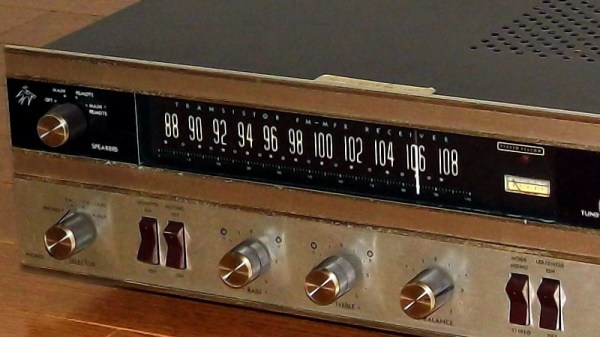
In a time when multi-channel digital TV is the norm it’s a surprise to find that a few low-power analog stations are still clinging on in some American cities. These are sometimes fill-in stations for weak signal areas, or more usually the so-called “FrankenFM” stations who transmit static images or digital patterns and derive income from their sound channel lying at the bottom end of the FM band to form unintended radio stations. Their days are numbered though, because the FCC is requiring that they be turned off by July 13th. There’s a way forward for the broadcasters to upgrade to low-power digital, but as you might expect they’re more interested in retaining the FrankenFM frequency from which they derive income.

The industry is represented by the LPTV coalition, who have requested permission to retain their FM frequency alongside their digital service. This has faced stiff opposition from other broadcasters, who see the very existence of the FrankenFM stations as a flagrant flouting of the rules that shouldn’t be rewarded. The FCC have yet to make a ruling, so there remains a slim chance that they may win a reprieve.

The sad tale of the few lingering analog TV stations in the USA is a last flickering ember of a once-huge industry that has been eclipsed without anyone but a few vintage technology geeks noticing, such has been the success of digital broadcasting. But analog TV is a fascinating and surprisingly intricate system whose passing however faint is worth marking.

Header: Tiia Monto, CC BY-SA 3.0.

Getting On The Air With A 10-Minute-ish Ham Transmitter

Artificially constrained designs can be among the most challenging projects to build, and the most interesting to consider. The amateur radio world is no stranger to this, with homebrew radio designs that set some sort of line in the sand. Such designs usually end up being delightfully minimalist and deeply instructive of first principles, which is one reason we like them so much.

For a perfect example of this design philosophy, take a look at [VK3YE]’s twist on the classic “10-Minute Transmitter”. (Video, embedded below.)

The design dates back to at least the 1980s, when [G4RAW] laid down the challenge to whip up a working transmitter from junk bin parts and make a contact within 15 minutes — ten for the build and five for working the bands. [VK3YE] used the “oner” — one-transistor — design for his 10-minute transmitter, but invested some additional time into adding a low-pass filter to keep his signal clean, and a power amplifier to boost the output a bit.

Even with the elaborations, the design is very simple and easy to understand. Construction is the standard “ugly style” that hams favor for quick builds like this. There are no parts that would be terribly hard to find, and everything fits into a small metal box. The video below shows the design and build, along with some experiments with WebSDR receivers to check out range both with and without the power amplifier.

Seeing these kinds of builds really puts us in the mood for some low-power action. Could something like this pop up in “The $50 Ham” series? Quite possibly yes.

Continue reading “Getting On The Air With A 10-Minute-ish Ham Transmitter”

Monitor SpaceX Rocket Launches With Software-Defined Radio

The amateur radio community has exploded with activity lately especially in the software-defined radio (SDR) area since it was found that a small inexpensive TV tuner could be wrangled to do what only expensive equipment was able to do before. One common build with these cards is monitoring air traffic, which send data about their flights out in packets over the radio and can easily be received and decoded now. It turns out another type of vehicle, SpaceX’s Falcon 9 spacecraft, reports data via radio as well and with some slightly upgraded hardware it’s possible to “listen in” to these flights in a similar way.

Reddit users [derekcz] and [Xerbot] used a HackRF module to listen in to the Falcon 9’s data transmissions during its latest launch. While the HackRF is a much more expensive piece of equipment compared to the RTL-SDR dongles used to listen in on aircraft, it is much more capable as well, with a range from 1 MHz to 6 GHz. Using this SDR peripheral as well as a 1.2 m repurposed satellite dish, the duo were able to intercept the radio transmissions from the in-flight rocket. From there, they were recorded with GNU Radio, converted into binary data, and then translated into text.

It seems as though the data feed included a number of different elements including time, location information, and other real-time data about the rocket’s flight. It’s a great build that demonstrates the wide appeal of software-defined radio, and if you want to get started it’s pretty easy to grab a much cheaper dongle and use it for all kinds of applications like this. Go check out [Tom Nardi]’s piece on the last seven years of RTL-SDR to get caught up to speed.

Thanks to [Adrian] for the tip!

What Can A $30 USB Spectrum Analyser Do For Me?

As mildly exotic silicon has become cheaper and the ingenuity of hardware hackers has been unleashed upon it, it’s inevitable that some once-unattainably expensive instruments will appear as cheap modules from China. The LTDZ spectrum analyser on the bench today covers 35 MHz to 4.4 GHz, and has a USB interface and tracking source. It has been available from all the usual outlets for a while now either as a bare PCB or in a metal box about the size of a pack of cards.

We’ve already taken a look at the $50 VNA, and this time it’s the turn of the $30 spectrum analyser, in the form of a little device that I succumbed to while browsing Banggood.

I ordered one, along with an attenuator and RF bridge for SWR measurements, and after the usual wait for postage my anonymous grey package arrived and it was time to give it a look and consider its usefulness. It’s a design derived from one published in Germany’s Funkamateur (“amateur radio”) magazine early in the last decade, and unscrewing the end plate to slide out the board from its extruded enclosure we can see what makes it tick. Continue reading “What Can A $30 USB Spectrum Analyser Do For Me?”

The Digital Radio Era (Partially) Ends In Ireland

It’s commonly agreed that the future of broadcast radio lies in the eventual replacement of AM and FM analogue transmissions with digital services. A wide range of technologies exist to service this change-over, and for much of the world the most visible of them has been Digital Audio Broadcasting, or DAB. This VHF service has slowly increased in popularity to the extent that in some countries the FM or AM switch-off process has already happened or is well under way. It’s thus a surprise to hear a piece of news from a country that’s going the other way, as the Irish broadcaster RTÉ is about to turn off its national DAB multiplex.

The reason cited is cost-effectiveness, the take up of DAB in the Republic by listeners is low (Northern Ireland having the UK multiplexes instead), and that the broadcaster is the only one maintaining a national multiplex. Our Irish friends tell us that as in other parts of the world the rural coverage can be patchy, and with only RTÉ and no commercial stations on offer it’s easy to see why the allure of a DAB set is lacking.

In case anyone is tempted to prophecy the demise of digital broadcasting from this news, that’s not the real story. This is simply an abandonment of DAB. Plenty of Irish people listen to the radio through digital media just as anywhere else, this is simply an indication that they’re choosing not to do so via DAB. The Irish DVB television multiplexes carry the same stations and more, and meanwhile, the inexorable rise of online listening through smart speakers and mobile phones has eaten DAB’s lunch. But it does raise the point for other places: when your mobile phone delivers any radio station or streaming service you desire and is always in your pocket, why would you want a radio?

For more on DAB including some of its shortcomings, a few years ago we took an in-depth look at the system.

Thanks [Laura] for the header image.

Spectrogram Drawing For Fun And Coding

It probably can’t have taken long after the first spectrum waterfall display was created, before somebody had a go at creating a waveform that would create an image in the waterfall. We don’t know who that pioneer was, but it’s over 20 years since Aphex Twin famously used the technique in their music, so it’s nothing new. If you fancy a go for yourself, [Gokberk Yaltirakli] has the project for you, creating waterfall images with an SDR from image files, using a bit of Python code.

The value here isn’t necessarily in creating the waterfall of Bitcoin logos that can be seen in the video he’s put on the page, instead it’s in the simple explanation of creating I and Q values for an SDR. The code is a bit slow so writes its values to a file which is output by a HackRF, but it could just as easily be used by any other capable output device such as GNU Radio and a soundcard if you too want an Aphex Twin moment. The hardware for displaying a spectrum waterfall doesn’t even have to be very complex.

Thanks [Leo] for the tip.

Capstan Winch Central To This All-Band Adjustable Dipole Antenna

The perfect antenna is the holy grail of amateur radio. But antenna tuning is a game of inches, and since the optimum length of an antenna depends on the frequency it’s used on, the mere act of spinning the dial means that every antenna design is a compromise. Or perhaps not, if you build this infinitely adjustable capstan-winch dipole antenna.

Dipoles are generally built to resonate around the center frequency of one band, and with allocations ranging almost from “DC to daylight”, hams often end up with a forest of dipoles. [AD0MZ]’s adjustable dipole solves that problem, making the antenna usable from the 80-meter band down to 10 meters. To accomplish this feat it uses something familiar to any sailor: a capstan winch.

The feedpoint of the antenna contains a pair of 3D-printed drums, each wound with a loop of tinned 18-gauge antenna wire attached to some Dacron cord. These make up the adjustable-length elements of the antenna, which are strung through pulleys suspended in trees about 40 meters apart. Inside the feedpoint enclosure are brushes from an electric drill to connect the elements to a 1:1 balun and a stepper motor to run the winch. As the wire pays out of one spool, the Dacron cord is taken up by the other; the same thing happens on the other side of the antenna, resulting in a balanced configuration.

We think this is a really clever design that should make many a ham happy across the bands. We even see how this could be adapted to other antenna configurations, like the end-fed halfwave we recently featured in our “$50 Ham” series.