Acrylic RPi Case You Can Make Without A CNC Machine

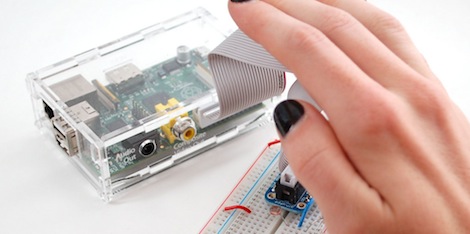
[Simon Inns] is showing off the Raspberry Pi case which he built out of acrylic. It provides a lot more protection than a flimsy film case, but it is also a little bit more involved to fabricate. No, this doesn’t need to be laser cut, but to get the nice edges [Simon] used a band saw which many don’t already have in their shop. Ask around, or poke your head in at the local Hackerspace. It only takes a few minutes to cut out the parts.

It sounds like either 8mm or 6mm acrylic will work for this project. Aluminum pipe serves as a spacer to keep the two main sheets in place. The RPi board itself is held in position by a few well-place acrylic chunks super glued in place. You can see the entire build process, including rounding cut edges with a torch, in his video embedded after the break.

Continue reading “Acrylic RPi Case You Can Make Without A CNC Machine”

Raspberry Pi Prototyping Boards Available At Adafruit

If you’re one of the lucky few with a Raspberry Pi, adafruit has two things you might be interested in if you’re into GPIO hacking.

First up is the Pi Cobbler kit. It’s a 2×13 ribbon cable with a breakout PCB ready to attach to a solderless breadboard; perfect for playing around with (or cobbling together… get it?) the GPIO pins on your Raspi.

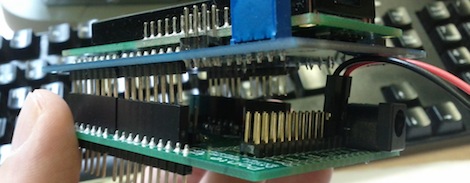
Next up is the Pi Plate kit that comes complete with enough perfboard space, screw terminals, and female headers to kill a yak. All the GPIO, I2C, and SPI pins are broken out on the Pi Plate, making it very easy to prototype a semi-permanent Raspi circuit.

They might be just prototyping boards now, but we expect these Pi Plates to quickly evolve into a truly useful device with the addition of a few level shifters, port expanders and a few ADCs and DAC thrown in for good measure. If you’re still on the fence and thinking about buying a Raspi, I ordered one last week from element14 and now have an expected ship date of November 5th. These things must be really popular.

Flimsy Pi Case Still Provides A Level Of Protection

This flimsy case isn’t going to protect your Raspberry Pi if you knock it off the workbench. It will provide a level of protection against shorting out from contact with metal objects, or from liquids spilled in the near vicinity. [CGPatterson] ended up making this case from a single sheet of transparency film.

The project is basically papercraft. He started with the dimensions published on the Raspberry Pi FAQ, which turned out to be wrong. Not having a caliper available to help with the precision of the measurements, he grabbed his ruler and did the best he could. The first two cases were a poor fit, but as you can see the third is like a glove. Luckily you don’t have to go through this same trial and error as he release the design. Both A4 and US Letter sized PDFs are available for download. Print them out on the transparency, cut along the lines, apply transparent double-sided tape to the tabs and you’re in business. If you wish to alter the design he has also posted the SVG source he made in Inkscape.

This is certainly a good option for those of us without the ability to produce laser cut parts.

Interfacing SNES Controllers With Your Raspberry Pi

This lovely set of wires lets [Florian] connect stock Super Nintendo controllers to his Raspberry Pi. The IDC connector in the upper left plugs into the GPIO header on the RPi rather than going the route of using an intermediary USB converter.

The setup lets you connect two controllers at once, so you’ll have no trouble going head-to-head on Mario Kart as seen in the clip after the break. The ports themselves were pulled from a pair of SNES extension cables. Since button signals are pushed to the console via a shift register there’s just five wires needed for each (voltage, ground, data, clock, and latch). As far was we know the Raspberry Pi pins are not 5V tolerant so you probably want to add some level conversion to this circuit if you build it yourself.

[Florian] wrote a C program which shifts in data from the controllers and converts it to HID keyboard inputs. This should make it extremely flexible when it comes to emulator setup, and using the technique for different styles of controllers should also be pretty easy.

Continue reading “Interfacing SNES Controllers With Your Raspberry Pi”

Ti Chronos Watch Controls Raspberry Pi

[Mike Field] was working on interfacing his TI Chronos eZ430 watch with the Raspberry Pi. As things were going pretty well, he took a side-trip from his intended hack and implemented watch-based control for an RPi audio player.

It really comes as no surprise that this is possible, and even easy. After all, the RPi board has native USB capability for hosting the watch‘s RF dongle, and it’s running Linux which we know already works well with the Chronos platform. But we still love the thought of having automation controls strapped to our wrist!

mpg321 is the audio playback program used for this hack. It plays MP3 files using ALSA for sound, which does have a few hiccups on the RPi. [Mike] found workarounds and included them in the C program he uses to gather everything into one nice code package. Control depends on keypresses sent from the watch (meant for use with PowerPoint) which are translated by his code and pushed to the audio/mp3 programs.

Getting A Console And Quake II Running On A Raspberry Pi

Those Raspberry Pi boards are flying into the mailboxes of tinkerers all around the globe, so our tip line is currently awash in a deluge of Raspi hacks. Here’s two that came in over the weekend:

First up is [reefab]’s port of Quake II for the Raspberry Pi. The build is based of Yamagi Quake II and is mostly playable. The Quake III port for the Raspberry Pi is old hat, but we’re happy to relive the pulse-pounding action of Quake II any day.

Next up is [Joonas]’ take on getting a serial console up and running with the Raspi. The Raspberry Pi has a UART serial console on its 26-pin header, but you can’t just connect those pins to a serial port. To shift the +/- 12V down to the 3.3 Volts the Raspi can understand, [Joonas] used a MAX3232 – the 3.3 Volt version of everyone’s favorite RS-232 transceiver. With a breadboard and a couple of caps, it’s easy to connect your Raspi to a serial console. Neat.

Raspberry Pi Controlled Tank Goes Deeper Than You Might Think

This remote control tank now takes its orders from a Raspberry Pi board. Well, actually it’s taking orders from commands pushed to the RPi board via SSH. The control scheme works out quite well. Using a low-profile WiFi dongle the RPi automatically connects to the wireless network when it is powered on. This makes it a snap to SSH into the device, and a more user-friendly controller will put a nice front-end into play at some time in the future.

But the real meat and potatoes of the hack comes in getting the RPi to talk to the tank’s circuitry. Just getting the Heng Long Tiger I remote control tank apart proved to be a ton of work as the treads need to be removed to do so and there’s a lot of screws holding it together. Instead of just replacing all of the control circuitry [Ian] wanted to patch into the original controller. To do so he spent a bit of time analyzing the signals with an oscilloscope and discovered that commands were coming in a Manchester encoded format. He established what various packets were doing, used a transistor to protect the GPIO pin on his board, and now has full control of the Tank. The final part of the hardware alteration was to power the RPi from the Tank’s battery.

After the break you can catch a demo of the reassembled tank sporting its new wireless controller.

Continue reading “Raspberry Pi Controlled Tank Goes Deeper Than You Might Think”