Advanced Robotic Arm Control Using Kinect

kinect_teleoperation

[Ryan Lloyd], [Sandeep Dhull], and [Ruben D’Sa] wrote in to share a robotics project they have been keeping busy with lately. The three University of Minnesota students are using a Kinect sensor to remotely control a robotic arm, but it’s not as simple as it sounds.

Using OpenNI alongside PrimeSense, the team started out by doing some simple skeleton tracking before working with their robotic arm. The arm has five degrees of freedom, making the task of controlling it a bit tricky. The robot has quite a few joints to play with, so the trio not only tracks shoulder, elbow, and wrist movements, but they also monitor the status of the user’s hand to actuate the robot’s gripper.

When everything was said and done, the results were pretty impressive as you can see in the video below, but the team definitely sees room for improvement. Using inverse kinematics, they plan on filtering out some of the joint tracking inaccuracies that occur when the shoulders are moved in a certain way. They also plan on using a robotic arm with even more degrees of freedom to see just how well their software can perform.

Be sure to check out their site to see more details and videos.

Continue reading “Advanced Robotic Arm Control Using Kinect”

Real-time Robotic Arm Control With Blender

robotic_arm

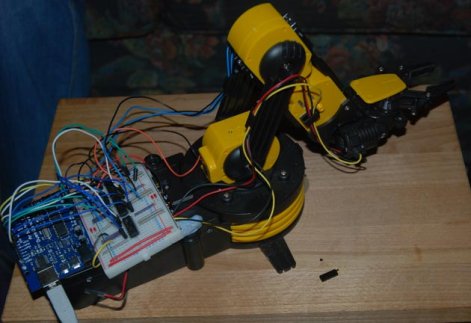
Last year, [Justin Dailey] was coming down the home stretch of his senior year as a Computer Engineering student and needed to build a final design project. He always wanted to construct a robotic arm, and figured that there was no better way to legitimize such a project, than to claim that it was “homework”.

While he originally wanted to control the arm with a joystick, he had been messing with Blender quite a bit leading up to his final project, and thought it would be pretty cool to let Blender do the work. He started out by testing his ability to control a single servo with Blender, then slowly increased the complexity of the project. He prototyped the arm using cardboard, and satisfied with his progress thus far, began constructing the arm out of aluminum.

Once he had all six of his servos attached to the arm’s joints and wired to his Roboduino, he got busy constructing a 3D model in Blender. Using a few Python scripts, the movements inside Blender are translated to serial data in real-time, which is relayed to the Roboduino in order to control the arm.

Check out his site if you get a chance – there’s plenty of code to be had, as well as several videos of the arm in various stages of construction and testing.

Scout, The Autonomous Transatlantic Boat

autonomous_boat

Sailing a small boat across the Atlantic ocean is quite the daunting task. As many have discovered, it is a journey often fraught with perils, typically ending in failure. A team of four college students decided the best way to get a small boat across the ocean would be to remove the human element from the process, so they set off to build an autonomous craft to take on the task.

Like most projects, this one started as a handful of wild ideas exchanged between friends [Dylan Rodriguez and Max Kramers]. As they thought about it more, they decided that turning [Max’s] sailboat into an autonomous ocean-going craft would be pretty awesome, so they got to work. Recruiting help from their friends [Brendan Prior and Ricky Lyman], the project started to quickly take shape, and Scout was born.

Scout is 8 feet long and consists of foam core covered in carbon fiber. It is filled with various electronic components such as a SPOT tracker, a battery bank that will power the boat for up to 25 hours, and the various servos and motors which will be used to pilot the craft.

It’s a rather ambitious project, though the boat is nearly complete – just in time for their launch, slated for May 29th. We’ll certainly be keeping an eye on this project as the launch date approaches – good luck guys!

Head on over to their Kickstarter page to see a promo video introducing Scout.

Continue reading “Scout, The Autonomous Transatlantic Boat”

Mini Quadrocopter Is Crazy Awesome

crazyflie_quadrocopter

Quadrocopters are all the rage lately, and while we have seen our fair share of large devices, [Arnaud Taffanel, Tobias Antonsson, and Marcus Eliasson] have been dutifully working to buck that trend. Their CrazyFlie is a miniature quadrocopter that uses its PCB as the main structure of the device.

Since the goal was to use a PCB as its frame, the copter’s footprint from the edge of one motor to the other is a modest 8cm, and it weighs in at a measly 20 grams! The entire platform runs on a Cortex-M3 CPU that takes input from an accelerometer and pair of gyroscopes to help keep its balance. Wireless communications are handled via a 2.4Ghz radio transmitter, and the quadrocopter’s power is supplied by a tiny 110 mAh LIPO battery pack scavenged from an R/C plane.

All of the control and telemetry is handled by a PC, which relays control messages it receives from the pilot’s game pad to the CrazyFlie. We’d love to see if they could retain this small footprint if everything was handled by the quadrocopter itself. Either way, this thing rocks – we most definitely want one!

Stick around to see a quick video of their mini quadrocopter in action, and be sure to check out our coverage of U. Penn’s quadrocopter creations if you are interested in seeing more.

Continue reading “Mini Quadrocopter Is Crazy Awesome”

The Concepts Behind Robotic Maze Solving

[Patrick McCabe’s] latest offering is a well-built maze-solving bot. This take on the competitive past-time is a little more approachable for your common mortal than the micro-bot speed maze solving we’ve seen. Don’t miss seeing the methodical process play out in the clips below the fold.

The playing field that [Patrick’s] robot is navigating is made up of a electrical-tape track on a white background. The two-inch tall double-decker bot is every economical. It uses an RBBB Arduino board to read an optical reflectance sensor array made by Pololu, then it drives a couple of geared motors using an L293D h-bridge breakout board. But we already know that [Patrick’s] a talented robot builder, this time around we’re happy to see his in-depth discussion of how to program a robot to solve a maze. In it he covers all of the different situations your robot might face and how to deal with them. Once you’ve dug through all of the concepts, dust off that bot you’ve got lying in the corner and start writing some new firmware.

Continue reading “The Concepts Behind Robotic Maze Solving”

Internet-controlled Robotic Arm

internet_robotic_arm

[Trav] was pondering virtual reality and decided it was no longer all that it was cracked up to be, so he created an experience in what he calls “Remote Reality”. While we have seen many installations over the years that allow people to remotely interact with objects across the globe, his Orbduino project consists of more than simply toggling lights on and off (though he’ll let you do that too).

In his house, he has set up a robotic playground of sorts that allows anyone who visits a chance to play around with the robotic arm he has installed there. The arm is situated in a pen filled with random objects which can be stacked and moved around. He also promises to show you something fun, provided you can guide the arm to pick up an object and hold it against the target positioned outside the pen.

He didn’t forget the obligatory remote light controls either. You can turn the overhead lights on and off, as well as control a multi-colored orb situated in the corner of the room. Most of the project’s interface is done with an Arduino Mega, which handles the robot arm interface, as well as messing with the light installations.

If you have some free time, swing by his site and give the robotic arm a try. It’s a fun little time waster that you will likely enjoy.  Just make sure to take it easy on his web server!

Amazing Quad Pick And Place System Tirelessly Sorts Your Legos

delta_robots

[Chris] is quite the devoted tinkerer. He recently wrote in to share what can only be described as a labor of love. His Quad Delta Robot system has been in the works for about six years now, split into periods of research, building, more research, and rebuilding until arriving at its current form.

The system is made up of four Lego NXT robots which are tasked with sorting Lego cubes by color as they come down a pair of conveyer belts. The robots were built to mimic commercially available pick and place robots which can be found on assembly lines all over the world.

Each robot operates independently, receiving signals via a light sensor which tells the robot where the next brick is located, as well as what color it is. This data is sent by the main NXT unit, which uses a lights sensor to determine brick color and position, relaying the information to the other bots via flashing LEDs. All of the robots receive the same signal, but much like NIC cards ignore frames not destined for their MAC, the bots ignore messages that are not addressed to them.

The machine is truly amazing to watch – it’s clear that all of [Chris’] research and planning has paid off. You have to check out the video embedded below to truly appreciate all of the work that went into this system. Also, be sure to swing by his site for a far more in-depth look at how the machines work, it is definitely worth the time.

Continue reading “Amazing Quad Pick And Place System Tirelessly Sorts Your Legos”