Nanoassembly With Water

Water is sometimes known as the universal solvent. But researchers at Harvard want to use water to put things together instead of taking them apart. Really small things. In the video below, you can see a simple 3D-printed machine that braids microscopic fibers.

The key appears to be surface tension and capillary action. A capillary machine uses channels that repel floating objects. By moving the channel, materials move to avoid the channel, and by shaping the channel, various manipulations can occur, including braiding. This is one of those things that is easier to understand when you see it, so if it doesn’t make sense, watch the video below. The example uses tiny Kevlar fibers.

Continue reading “Nanoassembly With Water”

Europe’s Energy Squeeze Pushes Large Hadron Collider To Halt Operations

Energy prices have been in the news more often than not lately, as has war. The two typically go together, as conflicts tend to impact on the supply and trade of fossil fuels.

With Europe short on gas and its citizens contemplating a cold winter, science is feeling the pinch, too. CERN has elected to shut down the Large Hadron Collider early to save electricity.

Continue reading “Europe’s Energy Squeeze Pushes Large Hadron Collider To Halt Operations”

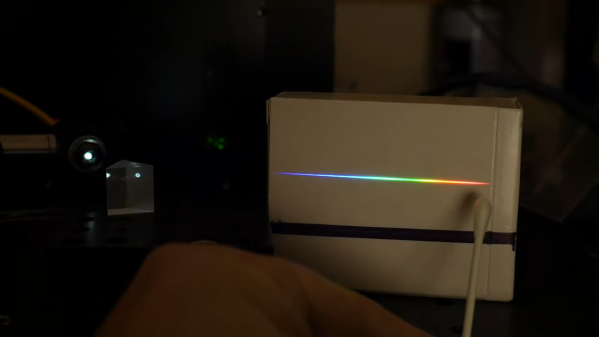
PySpectrometer version 2, showing mini spectroscope, 4 inch display and hand for scale

Pi-based Spectrometer Gets An Upgrade

Here at Hackaday, we love to see projects re-visited and updated after we’ve covered them on the site. It’s always exciting to see what the creators come up with next, and this Pi-Based Spectrometer project is a great example of that.

[LesWright] found himself with a problem when the new version of Raspberry Pi operating system was released (Bullseye), and it broke some functionality on his original software. Rather than just fix the issues, [Les] chose to rewrite the software more dramatically and has ended up with a much more capable spectrometer that is able to match professional devices costing many times more.

Screenshot of Waterfall Display for PySpectrometer 2

By using multi-wavelength calibration and polynomial regression data, the new version is much more accurate and can now resolve wavelengths down to +/- 1nm.

The whole project is now written in OpenCV, and there’s a nifty new waterfall spectrum display, that will show changes in measured spectra over time.

A low-cost benchtop spectroscope is coupled to a RaspberryPi Camera via a CCTV zoom lens and the whole setup is mounted to a small block of aluminium for thermal and mechanical stability. The spectroscope is pointed at a fluorescent lamp and the user is guided through a calibration routine to tune the software to the hardware.

We’re impressed with the precision [Les] has achieved with his builds, and the write-up is sufficiently detailed to allow others to follow in his footsteps. We’d love to see if readers build one themselves, and what they use them for!

If you want to read up on the original build, you can find our article here. We’ve covered several spectrometry projects in the past, including this Gamma-Ray Spectrometer and this one based around an STM32 Nucleo board. Continue reading “Pi-based Spectrometer Gets An Upgrade”

Get Clear Insights Into Cloudy Water With The Open Colorimeter

A basic scientific tool for chemistry and biology is a colorimeter device used to measure which wavelengths of light a particular sample solution absorbs. Some applications of colorimeters are measuring pH or chlorine levels, measuring pollutants, such as oil or pesticides, and, in some cases, can even be used to measure RNA/DNA concentrations. Even most washing machines today have a specialized colorimeter sensor, of sorts, to measure turbidity (cloudiness) to provide feedback on the cleaning process. To help in building your home scientific lab, [IORodeo] has released an Open Colorimeter.

A blown out diagram of the Open Colorimeter showing the 3d enclosure, the PyBadge, the LED board and sensor along with text describing each element

The Open Colorimeter is a self-contained device that accepts cuvettes filled with liquids for testing. The basic structure is an LED mounted onto a board that shines through the cuvette filled with a sample that is then measured at the other end by a TSL2591 color sensor. The Open Colorimeter has separate specialized LED boards for a range of wavelengths from 470nm to 630nm and incorporates a PyBadge that serves as the main microcontroller, as well as display and input.

[IORodeo] has done extensive documentation on the assembly, usage, and testing of the device. They have also provided protocols for the measurement of Ammonia, Nitrate, Nitrite, and Phosphates in addition to providing resources for absorption profiles of many other substances. All files relating to the 3D enclosure, firmware source code, schematics and Gerbers are provided under an open source hardware compatible license. For those not wanting to build it themselves, [IORodeo] is offering them for sale.

This isn’t the first time we’ve featured colorimeters, with some building a DIY version and others using it in a Tricorder project. The Open Colorimeter is a nice addition to this list and is ready for hacking and extending!

Fourteen-Legged Cell Carries Nature’s Tiny Computer

Computers are, after all, frighteningly complex state machines. Quite of bit of the software we write can be modeled as a state machine, too. A great technological achievement by humans? Turns out, state machines exist in some of nature’s tiniest natural computers, according to biologists studying Euplotes eurystomus, a kind of water-dwelling eukaryote. This single-cell organism uses fourteen protolegs known as cirri that move in a particular gait, in response to certain stimuli.

As you might expect, a single-celled organism doesn’t have the infrastructure to support a brain, so scientists wondered what could control the way the beast walks using the cirri. The answer was fibers made of bundles of microtubles that acted as a mechanical state machine.

While we are used to state machines using bi-stable electronic elements, older machines often used cams and microswitches along with a timing motor. For example, a phone answering machine might have a three-minute motor. One cam would depress a micro switch to run the outgoing message for 15 seconds. Then another cam would depress a microswitch to start recording, and a final switch and cam would keep the motor running until the very end. To start the process, a ringing phone would goose the motor so that that last cam engaged. Simple and no computer needed. The “brain fibers” of the Euplotes seem to work in a similar way. They enforce which states can be reached from what other states and react to outside stimuli, as well.

Is any of this practical? Maybe not, although we often see technology mimic biological systems. But we can’t help but wonder if future microscopic-scale machines might not need this same sort of mechanical state machine for many purposes, including locomotion.

You can apparently make single-cell organisms your servants, more or less. We’ve covered state machines many times if you need a refresher.

Leading Edge Erosion: When Precipitation Destroys Wind Turbine Blades

Erosion is all around us, from the meandering course of rivers and other waterways, to the gradual carving out of channels in even the toughest mountains, and the softening of features in statues. Yet generally we expect erosion from precipitation to be gradual and gentle, taking decades to make a noticeable difference. This of course takes into account gentle flows and the soft pitter-patter of rain on stone, not turbine blades passing through the air at many times the terminal velocity of rain drops of up to 9 m/s.

As wind turbines have increased in size and diameter of their blades, this has noticeably increased the speed of especially the blade tips. With more and more wind turbine blade tips now exceeding speeds of 100 m/s, this has also meant a significant increase in the impact of rain drops, hail and other particulates on the lifespan of these turbine blades. As comparison, 100 m/s is 360 km/h (224 mph), which is only slightly slower than the top speed of a Formula 1 car.

The effect of turbine blade leading edge erosion (LEE) not only decreases aerodynamic efficiency, but also invites premature failure. Over the past years, special coatings and leading edge tapes have been developed that act as sacrificial surfaces, but as wind turbines only keep getting larger, so does the effect of LEE. Beyond simply replacing LE tape every year on every turbine, what other options are there?

Continue reading “Leading Edge Erosion: When Precipitation Destroys Wind Turbine Blades”

DIY Wind Tunnel Aims To Educate The Youth

Typically, when we talk about wind tunnels, we think of the big facilities in use by the aerospace and motorsports industries. However, there’s nothing stopping you building a wind tunnel of your very own, and it may even be easier than you think! [Jude Pullen] has whipped up just such a design with DIY in mind.

Intended for high school Design & Technology (D&T) classes, it uses relatively simple materials construction techniques. The airflow straightener is built out of PVC pipes, and the end boxes built out of cardboard. The transparent walls for observation are created out of acrylic, while a simple fan provides the necessary flow. The desk-sized wind tunnel can then be instrumented with a manometer, tachometer, and anemometer to measure pressure, fan speed, and wind speed. [Jude] also explores experiments that can be run in the wind tunnel, such as working with a small balsa wood glider and measuring the lift it generates with a scale.

[Jude] has a very pragmatic and real-world understanding of such projects, too. He notes the difference between making things to measure, and making them to fit, and highlights the values of both approaches. It’s a much more holistic approach than simply berating students to “do it right” or “do it better” when making things in a D&T class.

Use of a basic wind tunnel is often not taught to engineering students until at least the second or third year of an engineering degree, after all the boring math and static analysis has been dealt with. However, there’s no reason high school physics students can’t understand the physics involved, and they’re more than capable of undertaking such a build. Starting such education early often nets huge benefits for individuals and their eventual careers.

Once you’ve got yourself a wind tunnel, you might want to start thinking about some flow visualization, which gets really exciting.

Continue reading “DIY Wind Tunnel Aims To Educate The Youth”