About five years ago, a Kickstarter popped up for the air umbrella. It wasn’t long before the project fell apart and the company made at least some refunds. Old news, we know. But [The Action Lab] recently explored the physics behind the air umbrella and why it wouldn’t be very practical. (Video, embedded below.)
Notice we said not very practical, not unworkable. It is possible to shoot rain away from you by using pressurized air. The problem is you need a lot of air pressure. That means you also need a lot of battery. In particular, [The Action Lab] used a leaf blower and even with that velocity, there was only minimal water deflection. In other words, you are still going to get wet.
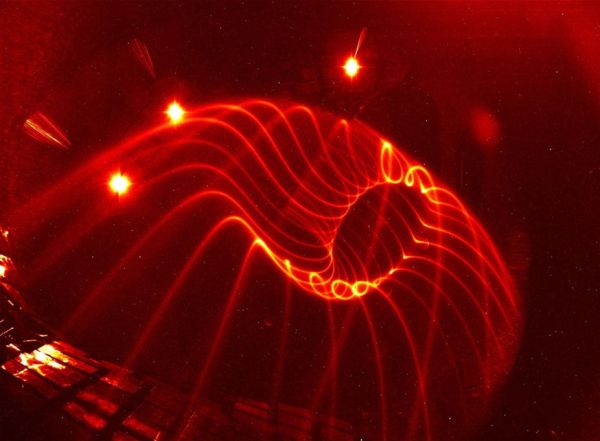
It’s hardly a secret that nuclear fusion has had a rough time when it comes to its image in the media: the miracle power source that is always ‘just ten years away’. Even if no self-respecting physicist would ever make such a statement, the arrival of commercial nuclear fusion power cannot come quickly enough for many. With the promise of virtually endless, clean energy with no waste, it does truly sound like something from a science-fiction story.
Meanwhile, in the world of non-fiction, generations of scientists have dedicated their careers to understanding better how plasma in a reactor behaves, how to contain it and what types of fuels would work best for a fusion reactor, especially one that has to run continuously, with a net positive energy output. In this regard, 2020 is an exciting year, with the German Wendelstein 7-X stellarator reaching its final configuration, and the Chinese HL-2M tokamak about to fire up.
Join me after the break as I look into what a century of progress in fusion research has brought us and where it will take us next.
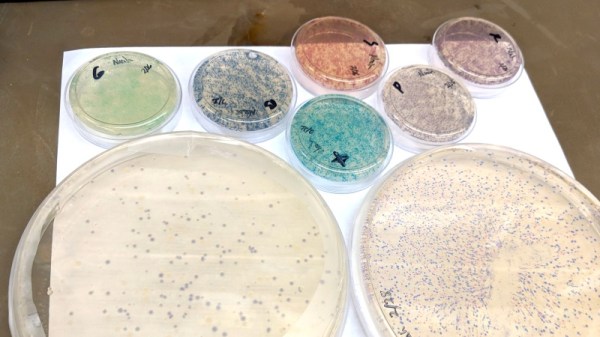
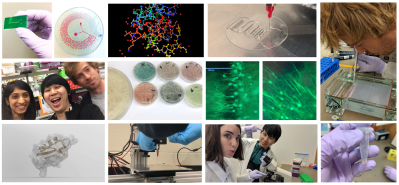
An off-shoot of the infamous “How to Make (Almost) Anything” course at the Massachusetts Institute of Technology, “How to Grow (Almost) Anything” tackles the core concepts behind designing with biology – prototyping biomolecules, engineering biological computers, and 3D printing biomaterials. The material touches elements of synthetic biology, ethics of biotechnology, protein design, microfluidic fabrication, microbiome sequencing, CRISPR, and gene cloning.
In a similar fashion to the original HTMAA course, HTGAA works by introducing a new concept each week that builds up to a final project. Students learn about designing DNA experiments, using synthesized oligonucleotide primers to amplify a PCR product, testing the impact of genes on the production of lycopene in E coli., protein analysis and folding, isolating a microbiome colony from human skin and confining bacteria to image, printing 3D structures that contain living engineered bacteria, and using expansion microscopy (ExM) to visualize a mouse brain slice. The final projects run the gamut from creating a biocomputer in a cream to isolating yeast from bees.
Growing out from an initiative to create large communities around biotechnology research, the course requires minimal prior exposure to biology. By working directly with hands-on applications to biodesign concepts, students are able to direct apply their knowledge of theoretical biology concepts to real-world applications, making it an ideal springboard for bio-inspired DIY projects. Even though the syllabus isn’t fully available online, there’s a treasure trove of past projects to browse through for your next big inspiration.
With Earth in the throes of climate change and no suitable Planet B lined up just yet, oceanography is as important now as it has ever been. And yet, the instruments relied upon for decades to test ocean conditions are holding steady within the range of expensive to prohibitively expensive. Like any other area of science, lowering the barrier of entry has almost no disadvantages — more players means more data, and that means more insight into the inner workings of the briny deep.
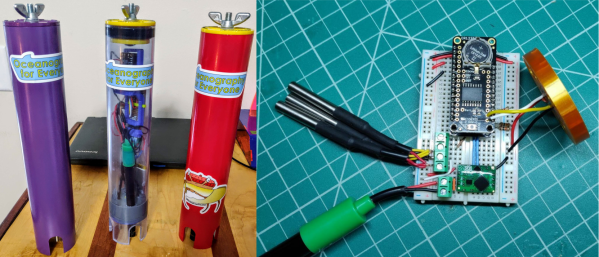
[Oceanography for Everyone] aims to change all that by showing the world just how easy it is to build an oceanographic testing suite that measures conductivity (aka salinity), temperature, and depth using common components. OpenCTD is designed primarily for use on the continental shelf, and has been successfully tested to a depth of 100 meters.
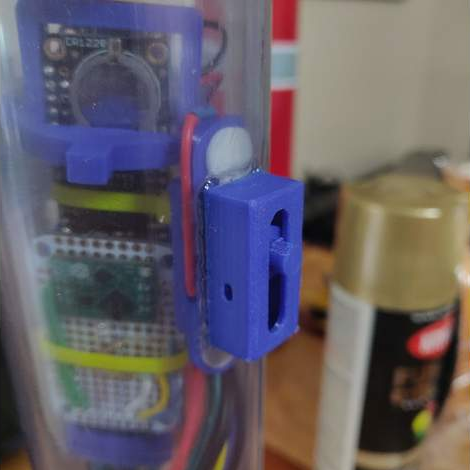
An Adalogger M0 and RTC Featherwing run the show from their waterproof booth in the center of the PVC tube. There’s a 14-bar pressure sensor for depth, a trio of DS18B20s for temperature averaging, and a commercial conductivity probe that gathers salinity data. These sensors are fed through a 3D-printed base plate and ultimately potted in stainless steel epoxy. The other end of the tube is sealed with a mechanical plug that seats and unseats with the whirl of a wingnut.
We particularly like the scratch-built magnetic slide switch that turns OpenCTD on and off without the need to open the cylinder. If you’d like to build one of these for yourself, take a deep dive into [Oceanography for Everyone]’s comprehensive guide — it covers the components, construction, and calibration in remarkable detail. The switch is explained starting on page 50. You can find out more about the work Oceanography for Everyone is doing at their site.
Lithium-ion batteries are notorious for spontaneously combusting, with seemingly so many ways that it can be triggered. While they are a compact and relatively affordable rechargeable battery for hobbyists, damage to the batteries can be dangerous and lead to fires.
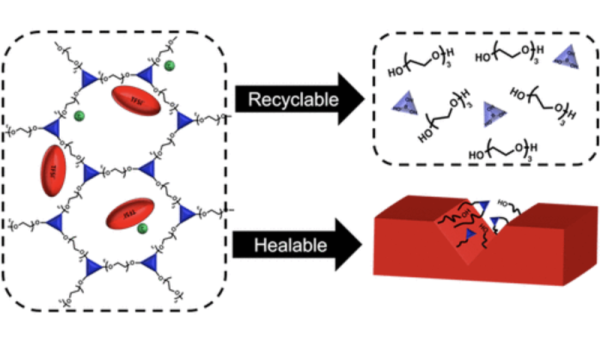
Several engineers from the University of Illinois have developed a solid polymer-based electrolyte that is able to self-heal after damage, preventing explosions.The material can also be recycled without the use of high temperatures or harsh chemical catalysts. The results of the study were published in the Journal of the American Chemical Society.
As the batteries go through cycles of charge and discharge, they develop branch-like structures known as dendrites. These dendrites, composed of solid lithium, can cause electrical shorts and hotspots, growing large enough to puncture internal parts of the battery and causing explosive chemical reactions between the electrodes and electrolyte liquids. While engineers have been looking to replace liquid electrolytes in lithium-ion batteries with solid materials, many have been brittle and not highly conductive.
The high temperatures inside a battery melt most solid ion-conducting polymers, making them a less attractive option for non-liquid electrolytes. Further studies producing solid electrolytes from networks of cross-linked polymer strands delays the growth of dendrites but produces structures that are too complex to be recovered after damage. In response, the researchers at University of Illinois developed a similar network polymer electrolyte where the cross-link point undergoes exchange reactions and swaps out polymer strands. The polymers stiffen upon heating, minimizing the dendrite problem and more easily breaking down and resolidifying the electrolyte after damage.
Unlike conventional polymer electrolytes, the new polymer also shows properties of conductivity and stiffness increasing with heating. The material dissolves in water at room temperature, making it both energy-efficient and environmentally friendly as well.
From the 1920s until the 1970s, most gasoline cars in the USA were using fuel that had lead mixed into it. The reason for this was to reduce the engine knocking effect from abnormal combustion in internal combustion engines of the time. While lead — in the form of tetraethyllead — was effective at this, even the 1920s saw both the existence of alternative antiknock agents and an uncomfortable awareness of the health implications of lead exposure.
We’ll look at what drove the adoption of tetraethyllead, and why it was phased out once the environmental and health-related issues came into focus. But what about its antiknock effects? We’ll also be looking at the alternative antiknock agents that took its place and how this engine knocking issue is handled these days.
If you were asked to imagine a particle accelerator, you would probably picture a high-energy electron beam contained within a kilometers-long facility, manned by hundreds of engineers and researchers. You probably wouldn’t think of a chip smaller than a fingernail, yet that’s exactly what the SLAC National Accelerator Laboratory’s Accelerator on a Chip International Program (ACHIP) has accomplished.
The Stanford University team developed a device that uses lasers to accelerate electrons along etched channels on a silicon chip. The idea for a miniature accelerator has existed since the laser’s invention in 1960, but the requirement for a device to generate electrons made the early proof-of-concepts difficult to manufacture in bulk.
via Scientific American
The electromagnetic waves produced by lasers have much shorter wavelengths than the microwaves used in full-scale accelerators, allowing them to accelerate electrons in a far more confined space – channels can be shrunk to three one-thousandths of a millimeter wide. In order to couple the lasers and electrons properly, the light waves must push the particles in the correct direction with as much energy as possible. This also requires the device to generate electrons and transmit them via the proper channel. With an accelerator engraved in silicon, multiple components can fit on the same chip.
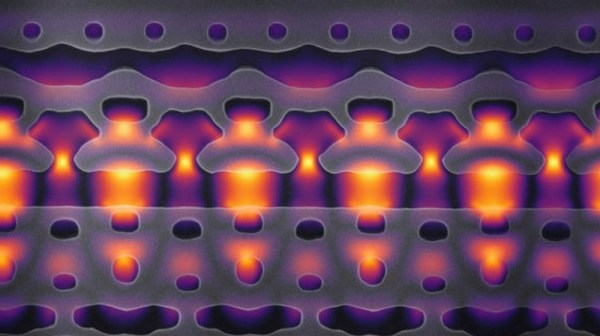
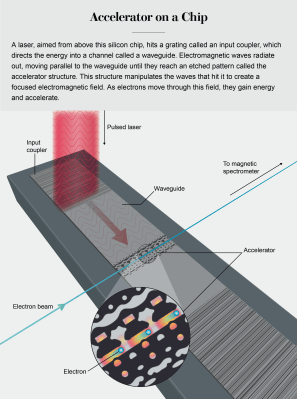
Within the latest prototype, a laser hits a grating from above the chip, directing the energy into a waveguide. The electromagnetic waves radiate out, moving with the waveguide until they reach an etched pattern that creates a focused electromagnetic field. As electrons move through the field, they accelerate and gain energy.
The results showed that the prototype could boost the electrons by 915 electron volts, equivalent to the electrons gaining 30 million electron volts over a meter. While the change is not on the scale of SLAC, it does scale up more easily since researchers can fit multiple accelerating paths onto future designs without the bulk of a full-scale accelerator. The chip exists as a single stage of the accelerator, allowing more researchers to conduct experiments without the need to reserve space in expensive full-scale particle accelerators.