Interactive Project Teaches Lessons About Electromagnets And Waves

Whether you’re a kid or a nerdy adult, you’ll probably agree that the interactive exhibitions at the museum are the best. If you happened to get down to the Oregon Science Festival in the last couple of years, you might have enjoyed “Catch The Wave!”—a public education project to teach people about electromagnets and waves. Even better, [Justin Miller] has written up how he built this exciting project.

Catch The Wave! consists of four small tabletop cabinets. Each has physical controls and a screen, and each plays its role in teaching a lesson about electromagnets and sound waves, with a context of audio recording and playback.

The first station allows the user to power up an electromagnet and interact with it using paper clips. They can also see the effect it has on a nearby compass. The second illustrates how reversing current through an electromagnet can reverse its polarity, and demonstrates this by using it to swing a pendulum. The third station then ties this to the action of a speaker, which is effectively a fancy electromagnet—and demonstrates how it creates sound waves in this way. Finally, the fourth station demonstrates the use of a microphone to record a voice, and throws in some wacky effects for good fun.

If you’ve ever tried to explain how sound is recorded and reproduced, you’d probably have loved to had tools like these to do so. We love a good educational project around these parts, too.

Static Electricity And The Machines That Make It

Static electricity often just seems like an everyday annoyance when a wool sweater crackles as you pull it off, or when a doorknob delivers an unexpected zap. Regardless, the phenomenon is much more fascinating and complex than these simple examples suggest. In fact, static electricity is direct observable evidence of the actions of subatomic particles and the charges they carry.

While zaps from a fuzzy carpet or playground slide are funny, humanity has learned how to harness this naturally occurring force in far more deliberate and intriguing ways. In this article, we’ll dive into some of the most iconic machines that generate static electricity and explore how they work.

Continue reading “Static Electricity And The Machines That Make It”

First Tentative Sales Of Tandem Perovskite-Silicon PV Panels

To anyone who has spent some time in photovoltaic (PV) power circles, the word ‘perovskite’ probably sounds familiar. Offering arguably better bandgap properties than traditional silicon cells, perovskite-based PV panels also promise to be cheaper and (literally) more flexible, but commercialization has been elusive. This is something which Oxford PV seeks to change, with the claim that they will be shipping the first hybrid perovskite-silicon panels to a US customer.

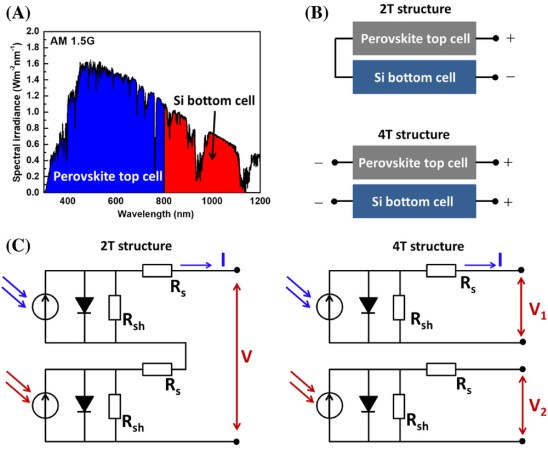
Although Oxford PV prefers to keep the details of their technology classified, there have been decades of research on pure perovskite PV cells as well as tandem perovskite-silicon versions. The reason for the tandem (i.e. stacked) construction is to use more of the solar rays’ spectrum and total energy to increase output. The obvious disadvantage of this approach is that you need to find ways to make each layer integrate in a stable fashion, with ideally the connecting electrodes being transparent. A good primer on the topic is found in this 2021 review article by [Yuanhang Cheng] and [Liming Ding].

The primary disadvantage of perovskites has always been their lack of longevity, with humidity, UV irradiation, temperature and other environmental factors conspiring against their continued existence. In a 2022 study by [Jiang Liu] et al. in Science it was reported that a perovskite-silicon tandem solar cell lost about 5% of its initial performance after 1,000 hours. A 2024 study by [Yongbin Jin] et al. in Advanced Materials measured a loss of 2% after approximately the same timespan. At a loss of 2%/1,000 hours, the perovskite layer would be at 50% of its initial output after 25,000 hours, or a hair over 2.85 years.

A quick glance through the Oxford PV website didn’t reveal any datasheets or other technical information which might elucidate the true loss rate, so it would seem that we’ll have to wait a while longer on real data to see whether this plucky little startup has truly cracked the perovskite stability issue.


Top image: Summary of tandem perovskite-silicon solar cell workings. (Credit: Yuanhang Cheng, Liming Ding, SusMat, 2021)

Spectroscopy On The Cheap

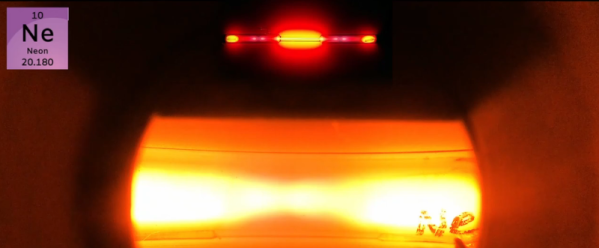
[Project 326] wanted to know exactly what gas was in some glass tubes. The answer, of course, is to use a spectrometer, but that’s an expensive piece of gear, right? Not really. Sure, these cheap devices aren’t perfect, but they are serviceable and, as the video below shows, there are ways to work around some of the limitations.

The two units in question are “The Little Garden” spectrometer and a TLM-2. Neither are especially sensitive, but both are well under $100, so you can’t expect much. Because the spectrometers were not very sensitive, a 3D printed jig and lens were used to collect more light and block ambient light interference. The jigs also allowed the inclusion of special filters, which enhanced performance quite a bit. The neon bulbs give off the greatest glow when exposed to high voltage. Other bulbs contain things like helium, xenon, and carbon dioxide. There were also tubes with mercury vapor and even deuterium.

We’ll admit it. Not everyone needs a spectrometer, but if you do, there’s a lot of really interesting info on how to get the most out of these cheap devices. Apparently, [Project 326] was frustrated that he couldn’t buy an X-ray spectrometer and has vowed to create one, so we’ll be interested to see how that goes.

Some homebrew spectrometers can get pretty fancy. Of course, there’s more to spectroscopy than just optics.

Continue reading “Spectroscopy On The Cheap”

Making A Split-Anode Magnetron

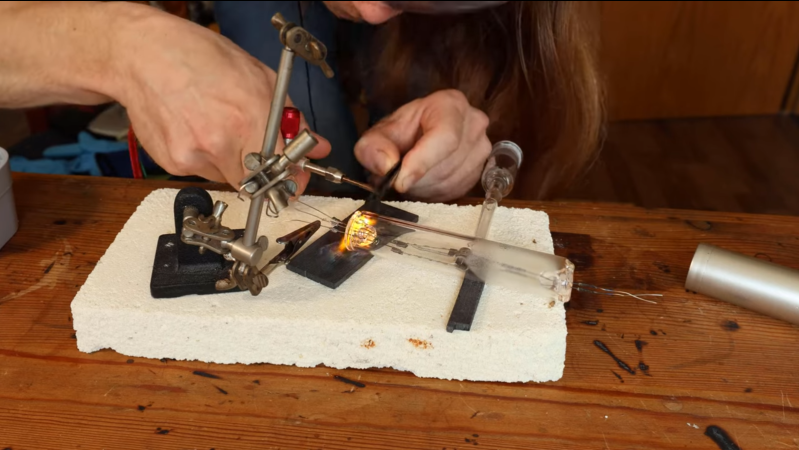
YouTuber The Science Furry has been attempting to make a split-anode magnetron and, after earlier failures, is having another crack at it. This also failed, but they’ve learned where to focus their efforts for the future, and it sure is fun to follow along.

The magnetron theory is simple enough, and we’ve covered this many times, but the split anode arrangement differs slightly from the microwave in your kitchen. The idea is to make a heated filament the cathode, so electrons are ejected from the hot surface by thermionic emission. These are forced into a spiral path using a perpendicular magnetic field. This is a result of the Lorentz force. A simple pair of magnets external to the tube is all that is needed for that. Depending on the diameter of the cavity and the gap width, a standing wave will be emitted. The anodes must be supplied with an alternating potential for this arrangement to work. This causes the electrons to ‘bunch up’ as they cross the gaps, producing the required RF oscillation. The split electrodes also allow an inductor to be added to tune the frequency of this standing wave. That is what makes this special.

Fizz, pop, ah well.

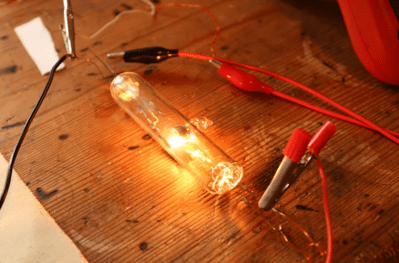
The construction starts with pre-made end seals with the tungsten wire electrode wire passing through. In the first video, they attempted to coat the cathode with barium nitrate, but this flaked off, ruining the tube. The second attempt replaces the coiled filament with a straight wire and uses a coating paste made from Barium Carbonate mixed with nitrocellulose in a bit of acetone. When heated, the nitrocellulose and the carbonate will decompose, hopefully leaving the barium coating intact. After inserting the electrode assembly into a section of a test tube and welding on the ends, the vacuum could be pulled and sealed off. After preheating the cathode, some gasses will be emitted into the vacuum, which is then adsorbed into a nearby titanium wire getter. At least, that’s the theory.

Upon testing, this second version burned out early on for an unknown reason, so they tried again, this time with an uncoated cathode. Measuring the emission current showed only 50 uA, which is nowhere near enough, and making the filament this hot caused it to boil off and coat the tube! They decide that perhaps this is one step too many and need to experiment with the barium coating by making simpler diode tubes to get the hang of the process!

If this stuff is over your head, you need a quick history lesson about the magnetron. Next check out this teardown. Finally, we have covered DIY magnetrons before, like this excellent DIY magnetron-powered plasma sputtering device. Yes, you read that correctly.

Continue reading “Making A Split-Anode Magnetron”

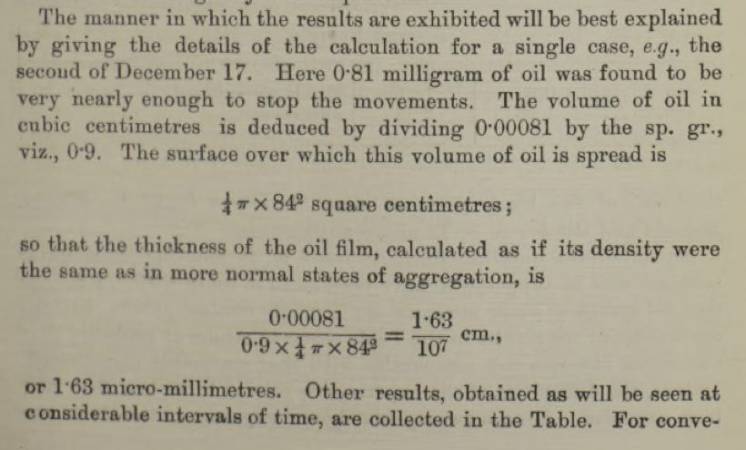
An excerpt from Lord Rayleigh’s published manuscript.

Estimating The Size Of A Single Molecule Of Oil Using Water

What is the size of a single molecule of oil? What may initially seem like a trick question – answerable only through the use of complicated, high-tech scientific equipment – is actually as easy to calculate as the circumference of planet Earth. Much like how [Eratosthenes] used a couple of sticks to achieve the latter feat back in about 240 BCE, the size of a molecule of olive oil was calculated in 1890 by [Lord Rayleigh], which is the formal title of [John William Strutt]. Using nothing but water and said olive oil, he managed to calculate the size of a single olive oil molecule as being 1.63 nanometers in length.

To achieve this feat, he took 0.81 mg of olive oil and put it on a known area of water. Following the assumption that the distributed oil across the water surface would form a monolayer, i.e. a layer of oil one molecule thick, he divided the volume of the oil by the covered area, which gave him the thickness of the oil layer. Consequently, this result would also be the dimension (diameter) of a single olive oil molecule.

Many years later we know now that olive oil is composed of triacylglycerols, with a diameter of 1.67 nm, or only about 2% off from the 1890 estimate. All of which reinforces once more just how much science one can do with only the most basic of tools, simply through logical deduction.

Labelled die of the Ramtron FM24C64 FeRAM chip. (Credit: Ken Shirriff)

Inside A 1999 Ramtron Ferroelectric RAM Chip

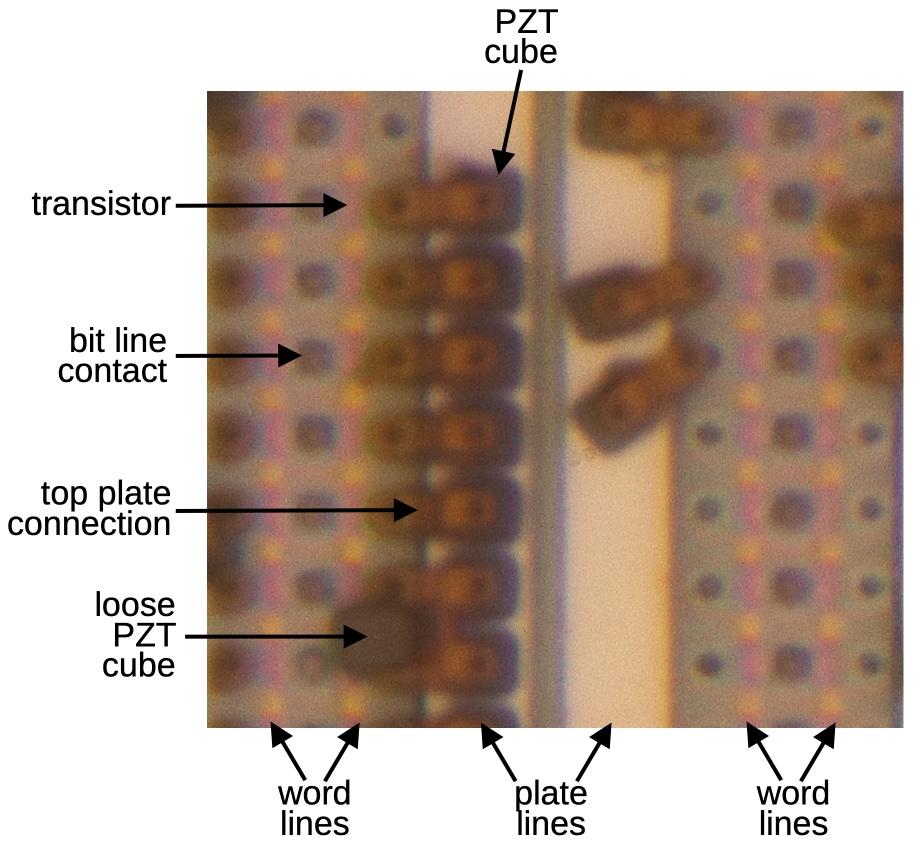
Structure of the Ramtron FeRAM. The image is focus-stacked for clarity. (Credit: Ken Shirriff)

Although not as prevalent as Flash memory storage, ferroelectric RAM (FeRAM) offers a range of benefits over the former, mostly in terms of endurance and durability, which makes it popular for a range of (niche) applications. Recently [Ken Shirriff] had a look inside a Ramtron FM24C64 FeRAM IC from 1999, to get an idea of how it works. The full die photo can be seen above, and it can store a total of 64 kilobit.

One way to think of FeRAM is as a very small version of magnetic core memory, with lead-zirconate-titanate (PZT) ferroelectric elements making up the individual bits. These PZT elements are used as ferroelectric capacitors, i.e. the ferroelectric material is the dielectric between the two plates, with a positive voltage storing a ‘1’, and vice-versa.

In this particular FeRAM chip, there are two capacitors per bit, which makes it easier to distinguish the polarization state and thus the stored value. Since the distinction between a 0 and a 1 is relatively minor, the sense amplifiers are required to boost the signal. After a read action, the stored value will have been destroyed, necessitating a write-after-read action to restore the value, all of which adds to the required logic to manage the FeRAM. Together with the complexity of integrating these PZT elements into the circuitry this makes these chips relatively hard to produce and scale down.

You can purchase FeRAM off-the-shelf and research is ongoing, but it looks to remain a cool niche technology barring any kind of major breakthrough. That said, the Sega Sonic the Hedgehog 3 cartridges which used an FeRAM chip for save data are probably quite indestructible due to this technology.