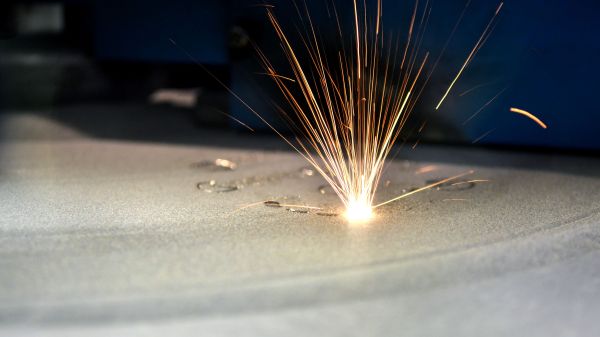
Art of 3D printer in the middle of printing a Hackaday Jolly Wrencher logo

3D Printering: One Bed Level To Rule Them All

In an ideal world, your FDM 3D printer’s bed would be perfectly parallel with the print head’s plane of movement. We usually say that means the bed is “level”, but really it doesn’t matter if it is level in the traditional sense, as long as the head and the bed are the same distance apart at every point. Of course, in practice nothing is perfect.

The second best situation is when the bed is perfectly flat, but tilted relative to the print head. Even though this isn’t ideal, software can move the print head up and down in a linear fashion to compensate for the tilt. Things are significantly worse if the bed isn’t itself flat, and has irregular bumps up and down all over.

To combat that, some printer firmware supports probing the bed to determine its shape, and adjusts the print head up and down as it travels across the map. Of course, you can’t probe the bed at every possible point, so the printer will have to interpolate between the measured reference points. Marlin’s bilinear bed leveling is an example.

But if you have enough flash space and you use Marlin, you may want to try unified bed leveling (UBL). This is like bilinear leveling on steroids. Unfortunately, the documentation for this mode is not as plain as you might like. Everything is out there, but it is hard to get started and information is scattered around a few pages and videos. Let’s fix that.

Continue reading “3D Printering: One Bed Level To Rule Them All”

Does This Lead Make My Car Look Fat?

When looking at the performance of a vehicle, weight is one of the most important factors in the equation. Heavier vehicles take more energy to accelerate and are harder to stop. They’re also more difficult to control through the corners. Overall, anything that makes a vehicle heavier typically comes with a load of drawbacks to both performance and efficiency. You want your racecar as light as possible.

However, now and then, automakers have found reason to intentionally add large weights to vehicles. We’ll look at a couple of key examples, and discuss why this strange design decision can sometimes be just what the engineers ordered.

Continue reading “Does This Lead Make My Car Look Fat?”

What You Should Know Before Buying An Industrial Sewing Machine

I’ve been sewing off and on since I was a kid, and I really started to get into it about ten years ago. Even though I technically outgrew my little 3/4 size domestic machine pretty quickly, I kept using it because it always did whatever I asked it to. I even made my first backpack on it before deciding it was time for something bigger. Don’t ask me how I managed to not kill that machine, because I have no idea.

Left: a 3/4 size Janome 11706. Right: a full-size Singer Heavy Duty 4452.

Last year, I got a so-called heavy duty Singer that claims to have 50% more power than a standard domestic machine. This bad boy will make purses and backpacks with ease, I thought. And it does. Well, most of the time.

I found its limits when I tried to make a bag out of thick upholstery material. And honestly, when it comes down to finishing most bags — sewing the thickest and most difficult seams — the machine often lifts up from the table on the end opposite the needle.

What I really need is an industrial sewing machine. Not to replace the Singer at all, but to complement it. I can totally justify this purchase. Let me tell you why.

Continue reading “What You Should Know Before Buying An Industrial Sewing Machine”

Painted Over But Not Forgotten: Restoring Lost Paintings With Radiation And Mathematics

An intrinsic property of paintings, that makes them both wonderful and very annoying, is the fact that they are physical objects. Sometimes they survive across the ages as amazing artifacts of their era, but they are also susceptible to being lost and even destroyed. Sometimes this destruction is deliberate, such as when a painting is painted over.

Artists reuse canvas all the time — painting over what was already there. Sometimes they might be coerced by a client into altering a painting, or removing entire elements from a scene. Fortunately, nowadays we have many techniques, involving x-rays and infrared radiation, that can analyze paintings to determine not only the composition of what we can see with the naked eye, but also that what lies underneath.

In some cases, we can then reconstruct what was previously hidden, returning to physical reality paintings and sketches which haven’t seen the light of day for sometimes centuries. Continue reading “Painted Over But Not Forgotten: Restoring Lost Paintings With Radiation And Mathematics”

TFT35 Dual Mode 3D Print Control – Hands On

I was rebuilding one of my 3D printers — again — and decided I needed a display upgrade. A color screen is nice, but there are some limitations. I also found there are ways around these limitations, so I wanted to share my thoughts on a dual-mode color touch screen LCD controller for your 3D printer. The screen in question is a TFT35 from BigTree Tech. It is similar to an MKS screen, but it can operate in two different modes, as you will see.

The more-or-less standard display for Marlin.

A few years ago, I picked up an Anet A8 which was very inexpensive, especially on sale. Not the best printer, though, because it has that cheap acrylic frame. No problem. A box full of aluminum extrusion later, the printer was reborn. Over time, I’ve completely reworked the extrusion system and the Y-axis, leaving only the motors, bearings, and the controller/display as the original.

That last part was what bothered me. The Anet board is actually pretty capable for a small cheap board. But it is just what the printer needs and nothing more. If you wanted to hack the printer there was very little memory left and only one spare pin for I/O. So it was time to replace the board and why not the controller, too?

The A8 has an LCD2004. That means it has a 20×4 LCD. Instead of an encoder knob, there are five buttons: basically up, down, left, right, and enter. Most printers now have an LCD12864 which, as you can probably guess, is a 128×64 LCD and they use an encoder knob for direction that you can push for the enter key.

Continue reading “TFT35 Dual Mode 3D Print Control – Hands On”

2021: As The Hardware World Turns

Well, that didn’t go quite as we expected, did it? Wind the clock back 365 days, and the world seemed to be breathing a collective sigh of relief after making it through 2020 in one piece. Folks started getting their COVID-19 vaccines, and in-person events started tentatively putting new dates on the calendar. After a rough year, it seemed like there was finally some light at the end of the tunnel.

Turns out, it was just a another train. New variants of everyone’s favorite acute respiratory syndrome have kept the pandemic rolling, and in many parts of the world, the last month or so has seen more new cases of the virus than at any point during 2020. This is the part of the Twilight Zone episode were we realize that not only have we not escaped the danger, we didn’t even understand the scope of it to begin with.

Case in point, the chip shortages. We can’t blame it entirely on the pandemic, but it certainly hasn’t helped matters. From video game systems to cars, production has crawled to a standstill as manufacturers fight to get their hands on integrated circuits that were once plentiful. It’s not just a problem for industry either, things have gotten so bad that there’s a good chance most of the people reading this have found themselves unable to get their hands on a part or two these last few months. If you were working on a hobby project, it’s a temporary annoyance. But for those who planned on finally bringing their latest big idea to market, we’ve heard tales of heartbreaking delays and costly redesigns.

It would be easy to look at the last twelve months and see nothing but disappointment, but that’s hardly the attitude you want to have at the beginning of the year. So let’s take the high road, and look back on some of the highlights from 2021 as we turn a hopeful eye towards the future.

Continue reading “2021: As The Hardware World Turns”

Hackaday Links Column Banner

Hackaday Links: January 2, 2022

That sound you may have heard in the wee hours of Christmas morning had nothing to do with Santa; rather, it was the sound of a million astronomers collectively letting out their breath around the world as the James Webb Space Telescope survived its fiery ride to space. And not only did it survive, but the ESA launch team did such a good job putting the Ariane rocket on course that NASA predicts the observatory now has enough fuel to more than double its planned ten-year mission. Everything about the deployment process seems to be going well, too, with all the operations — including the critical unfurling of the massive and delicate sunshield — coming off without a hitch. Next up: tensioning of the multiple layers of the sunshield. If you want to play along at home, NASA has a nice site set up to track where JWST is and what its current status is, including temperatures at various points on the telescope.

We got a tip from Mark about some dodgy jumper wires that we thought we should share. Low-quality jumpers aren’t really a new problem, but they can really put a damper on the fun of prototyping. The ones that Mark found could be downright dangerous. He got them with a recent dev board purchase; outwardly, they appear fine, at least at first. Upon closer inspection, though, the conductors have turned to powder inside the insulation. Even the insulation is awful, since it discolors when even slightly flexed. He suspects conductors are actually copper-plated aluminum; check out his pictures below and maybe look through your collection for similarly afflicted jumpers.

Speaking of dodgy hardware, if you love the smell of melting MOSFETs in the morning, then have we got a deal for you. It seems that a non-zero number of Asus Z690 Hero PC motherboards have suffered a fiery demise lately, stirring complaints and discontent. This led some curious types to look for the root cause, which led to the theory that an electrolytic cap had been installed with the wrong polarity on the dead boards. Asus confirmed the diagnosis, and is doing the right thing as they are “working with the relevant government agencies on a replacement program.” So if you’ve got one of these motherboards, you might want to watch the video below and see how the caps were installed.

If you’re in the mood for some engineering eye-candy, check out the latest video from Asianometry. They’ve got a finger on the pulse of the semiconductor industry, with particular attention paid to the engineering involved in making the chips we all have come to depend on. The video below goes into detail on the extreme ultraviolet (EUV) light source that fabrication machine maker ASML is developing for the next generation of chip making. The goal is to produce light with a mind-bending wavelength of only 13.5 nanometers. We won’t spoil the details, but suffice it to say that hitting microscopic droplets of tin with not one but two lasers is a bit of a challenge.

And finally, bad luck for 38 people in Tokyo who were part of a data breach by the city’s Metropolitan Police Department. Or rather, good luck since the data breach was caused by the loss of two floppy disks containing their information. The police say that there haven’t been any reports of misuse of the data yet, which is really not surprising since PCs with floppy drives are a little thin on the ground these days. You’d think that this would mean the floppies were left over from the 90s or early 2000s, but no — the police say they received the disks in December of 2019 and February of 2021. We’d love to know why they’re still using floppies for something like this, although it probably boils down to yet another case of “if it ain’t broke, don’t fix it.”