Who Flew Across The Atlantic First? The Airborne Boats Of 1919

Aviation history is a bit strange. People tend to remember some firsts but not others and — sometimes — not even firsts. For example, everyone knows Amelia Earhart attempted to be the first woman to fly around the globe. She failed, but do you know who succeeded? It was Jerrie Mock. How about the first person to do it? Wiley Post, a name largely forgotten by the public. Charles Lindbergh is another great example. He was the first person to fly across the Atlantic, right? Not exactly. The story of the real first transatlantic flight is one of aviation hacking by the United States Navy.

Continue reading “Who Flew Across The Atlantic First? The Airborne Boats Of 1919”

Avoiding Repetitive Stress Injury: Invest In Yourself Now, Or Pay Later

There I was, thirty years after I first sat down at an Apple IIe , and I suddenly found myself wondering if I would ever use a computer again without pain. How could I work if I couldn’t use a computer anymore? I had to seriously ask myself this question. It took a bit of a winding road to figure out what was going on and two EMGs to confirm it, but after all these years, it was clear to the medical community that I had developed a repetitive stress injury (RSI) called cubital tunnel syndrome in my left arm.

Yeah, it’s about like that. Image via Kinesis

Cubital tunnel syndrome is like carpal tunnel, but in your elbow instead of your wrist. What a misnomer! Sometimes my pain went all the way from my armpit to my fingertips and made me want to gnaw my own arm off. I don’t think you can really understand neuropathy unless you’ve felt this weird, annoying type of pain firsthand. I hope you never do.

Can you stop and seriously imagine not being able to use a computer for the rest of your life? Or at least feeling that way because doing so causes incredibly annoying pain? I feel like we’re all vaguely aware of the standard list of anti-RSI precautions, but let’s review:

  • maintain good posture — sit with feet flat on the floor, wrists straight, elbows at 90°
  • put the screen an arm’s length away at eye level
  • take frequent short breaks

Yes, those are all fine and good. But there are other things you can do to avoid computer-related RSIs, like using ergonomic inputs, and building a custom setup that fits you exactly. This isn’t a study kiosk at the university library we’re talking about — this is your battlestation! The problem is that many people are stubborn, and won’t go out of their way to do anything to proactively prevent these injuries. But you don’t have to cross a bridge when you come to it if you have a map that shows you a way around the body of water.

Continue reading “Avoiding Repetitive Stress Injury: Invest In Yourself Now, Or Pay Later”

Retrotechtacular: Nuvistor, Vacuum’s Last Gasp

In 2021 all our electronics are solid state, in that they exclusively use semiconductor devices as their active components. Some of us may experiment with vacuum tubes, but only for curiosity or aesthetic purposes. Semiconductors have overtaken vacuum devices in all but the rarest of niche applications due to their easier design requirements, greater reliability, lower cost, and increased performance.

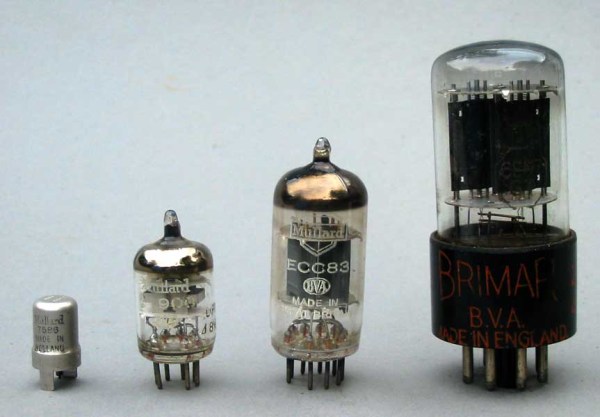
It was not always this way though, and there was a period at the start of the semiconductor era when transistors and vacuum tubes existed together side-by-side and competed directly. Vacuum tube manufacturers continued to create new devices into the 1970s, and in doing so they pushed the boundaries of their art in unprecedented directions. [David W Knight] has a page dedicated to the Nuvistor, something his calls the “final evolution of the thermionic valve”. His comparison photo seen above shows a Nuvistor on the left — a miniature vacuum tube you’ve likely never seen before.

Continue reading “Retrotechtacular: Nuvistor, Vacuum’s Last Gasp”

What Exactly Is A Gaussian Blur?

Blurring is a commonly used visual effect when digitally editing photos and videos. One of the most common blurs used in these fields is the Gaussian blur. You may have used this tool thousands of times without ever giving it greater thought. After all, it does a nice job and does indeed make things blurrier.

Of course, we often like to dig deeper here at Hackaday, so here’s our crash course on what’s going on when you run a Gaussian blur operation. Continue reading “What Exactly Is A Gaussian Blur?”

The Story Behind Ohm’s Law

Do you ever wonder how much of what we do you could figure out from scratch? Tying your shoe might seem simple now, but kids have trouble mastering the skill, and dreaming it up for the first time is even harder. The same holds true for a lot of technology we use every day. Would you think up the computer mouse or even the computer if they didn’t already exist? Surely, though, one of the simplest and most useful math equations that is fundamental to electronics — Ohm’s law — would be easy to figure out, right? It is often the first thing you learn about electronics, but figuring it out that first time turned out to be quite difficult.

The fellow who discovered the relationship was Georg Ohm, a high school math and physics teacher from Köln. What you might not know is that the first time he published it, he got it wrong. But, lucky for us, he figured out his mistake and was able to correct it.

Continue reading “The Story Behind Ohm’s Law”

This Group Of Women Tried To Break Into Astronaut Program In 1960s; One Just Made It

When Mary Wallace “Wally” Funk reached the boundary of space aboard the first crewed flight of Blue Origin’s New Shepard capsule earlier today, it marked the end of a journey she started 60 years ago. In 1961 she became the youngest member of what would later become known as the “Mercury 13”, a group of accomplished female aviators that volunteered to be put through the same physical and mental qualification tests that NASA’s Mercury astronauts went through. But the promising experiment was cut short by the space agency’s rigid requirements for potential astronauts, and what John Glenn referred to in his testimony to the Committee on Science and Astronautics as the “social order” of America at the time.

Continue reading “This Group Of Women Tried To Break Into Astronaut Program In 1960s; One Just Made It”

Reimagine Supportive Tech For The Newest Hackaday Prize Challenge

Beginning right now, the 2021 Hackaday Prize challenges you to Reimagine Supportive Tech. Quite frankly, this is all about shortcuts to success. Can we make it easier for people to learn about science and technology? Can we break down some barriers that keep people from taking up DIY as a hobby (or way of life)? What can we do to build on the experience and skill of one another?
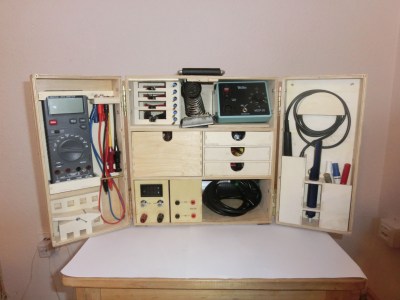
For instance, to get into building your own electronics, you need a huge dedicated electronics lab, right? Of course that’s nonsense, but we only know that because we’ve already been elbow-deep into soldering stations and vacuum tweezers. To the outsider, this looks like an unclimbable mountain. What if I told you that you could build electrics at any desk, and make it easy to store everything away in between hacking sessions? That sounds like a job for [M.Hehr’s] portable workbench & mini lab project. Here’s a blueprint that can take a beginner from zero to solder smoke while having fun along the way.

What about breaking down complex topics into something us newbies can swallow? Radio signals are all around us, but again the barriers to getting into SDR are many and varied. A great bit of supportive tech would be a project that shows simple hardware and shares a virtual machine with the open source software toolchain already set to go. A beginner could pick something like this up and be listening for transponders from airplanes passing by in a matter of hours.

If you’re reading this, chances are you’ve spent countless joyful hours learning how to do some difficult and fascinating stuff. Share the wealth!  Take an existing hardware concept and make it modular and easy to use. Refine an existing design to make it more approachable for users with any range of mobility challenges. Or pull together a beginner-friendly project to move STEM education forward.

Ten finalists from this round will win $500 and be shuttled onto the final round judging in October for a chance at the $25,000 Hackaday Prize and four other top prizes. Start your project page on Hackaday.io and use the dropdown in the left sidebar to enter it into the 2021 Hackaday Prize.