FBI Vs Apple: A Postmortem

By now you’ve doubtless heard that the FBI has broken the encryption on Syed Farook — the suicide terrorist who killed fourteen and then himself in San Bernardino. Consequently, they won’t be requiring Apple’s (compelled) services any more.

A number of people have written in and asked what we knew about the hack, and the frank answer is “not a heck of a lot”. And it’s not just us, because the FBI has classified the technique. What we do know is that they paid Cellebrite, an Israeli security firm, at least $218,004.85 to get the job done for them. Why would we want to know more? Because, broadly, it matters a lot if it was a hardware attack or a software attack.

Continue reading “FBI Vs Apple: A Postmortem”

Rotary Subwoofer Combines A Speaker Coil W/ A Fan

What happens when you combine a fan with a sub-woofer? Apparently, you get a high-efficiency ultra low hertz (3-5hz) rotary subwoofer!

First thing’s first, believe it or not, these things really do exist. [Chris] got the idea to build his own after seeing the TRW-17, a commercial offering of a rotary subwoofer.

The concept is pretty simple. If you use a giant subwoofer, you can get low frequency response, but it uses an immense amount of power to move a giant speaker coil. So what if you put something on a smaller speaker coil to increase airflow? Like, a fan or something?

Continue reading “Rotary Subwoofer Combines A Speaker Coil W/ A Fan”

Remote Sensing Bombs Could Stem Terrorism

If you understand technology, there were a lot of things hard to explain on Star Trek. Transporters, doors that were smart enough to open unless you hit them during a fight, and the universal translator all defy easy explanation. But one of the hardest things to explain were Mr. Spock’s sensors. From the ship or with a tricorder, Spock could sense at a distance just about anything from chemical compositions, to energy, and even the presence of life (which, today, at least, is difficult to determine even what that means).

Remote sensing would have a very distinct use in today’s world: finding terrorist bombs earlier. A recent article published on New Scientist by [Debora MacKenzie] points out that stopping attacks like the recent one in Brussels is difficult without increasing congestion. For example, putting checkpoints at doors instead of inside transit stations is common in Asia, but causes lines and delays.
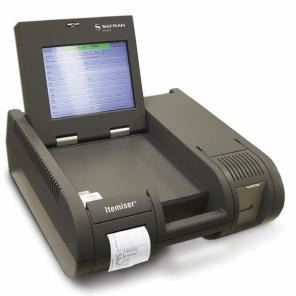
detecThe United States has used ion mobility spectrometry (IMS) to detect explosive traces on swabs (using machines like the one on the left). However in the early 2000’s they experimented with a version of the device that used puffs of air to determine if people had explosives while they passed by the machine. By 2010, officials decided the machines broke down too often and stopped using them.

Remote Sensing in Practice

According to an expert at Rand Corporation, remote sensing is likely to employ imaging or sniffers. However, imaging solutions are easy to fool since a bomb can take the shape of an ordinary object. Sniffers, including biological sniffers (known as dogs), are harder to fool. The problem is that deploying thousands of dogs to cover the world’s airports is difficult.

Continue reading “Remote Sensing Bombs Could Stem Terrorism”

Dirt-Cheap USB Arduino Hack From The Past

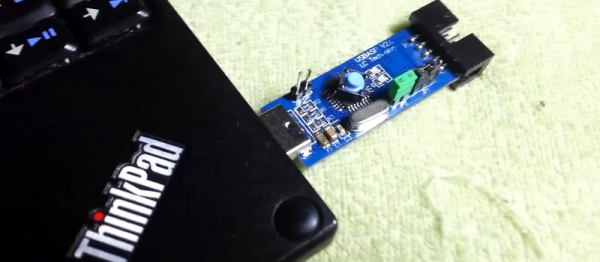
Mass production is a wonderful thing. Prices fall, and hobby hackers get cheap gear. The mind then wanders towards what can be done with it. So it’s little wonder that someone like [Aaron Christophel] would try to repurpose those sub-$3 AVR programmers that are all over eBay (translated poorly out of German here, but demonstrated in the video embedded below).

[Aaron] didn’t have to do much, really. The only trick is that you’ll first need to re-flash the existing ISP firmware with one that lets you upload code to the device itself over USB. If you don’t have an Arduino on hand to re-flash, buy at least two of the cheap programmers — one to program the other ones. Once you’ve done that, you have essentially an Arduino with limited pinout and two onboard LEDs, but in a nice small form-factor and with built-in USB. [Aaron] even provides an Arduino boards.txt file to make it all work smoothly within the IDE.

Continue reading “Dirt-Cheap USB Arduino Hack From The Past”

Improving The RTL-SDR

The RTL-SDR dongle is a real workhorse for radio hacking. However, the 28.8 MHz oscillator onboard isn’t as stable as you might wish. It is fine for a lot of applications and, considering the price, you shouldn’t complain. However, there are some cases where you need a more stable reference frequency.

[Craig] wanted a stable solution and immediately thought of a TCXO (Temperature Compensated “Xtal” Oscillator). The problem is, finding these at 28.8 MHz is difficult and, if you can find them, they are relatively expensive. He decided to make an alternate oscillator using an easier-to-find 19.2 MHz crystal.

Continue reading “Improving The RTL-SDR”

Raspberry Pi Art Frame Using OpenFrame

Digital picture frames were a fad awhile back, and you can still pick them up at the local big box store. [Ishac Bertran] and [Jonathan Wohl] decided to go open source with digital frames and create the openframe project. The open-source project uses a Raspberry Pi with WiFi and either an HDMI monitor or a monitor that the Pi can drive (e.g., a VGA with an HDMI adapter).

You are probably thinking: Why not just let the Pi display images? The benefit of openframe is you can remotely manage your frames at the openframe.io site. You can push images, websites (like Hackaday.com) or shaders out to any of your frames. You can also draw on public streams of artwork posted by other users.

Continue reading “Raspberry Pi Art Frame Using OpenFrame”

The Raspberry Pi 3 does Eddystone!

Turn Your RPi 3 Into A BLE Beacon

With the launch of the Raspberry Pi 3, Bluetooth Low Energy (BLE) is now at our disposal. With BLE, there are a few technologies for implementing one-way beacons that broadcast data. Apple has been pushing iBeacon since 2013, and Google just launched their Eddystone solution last year.

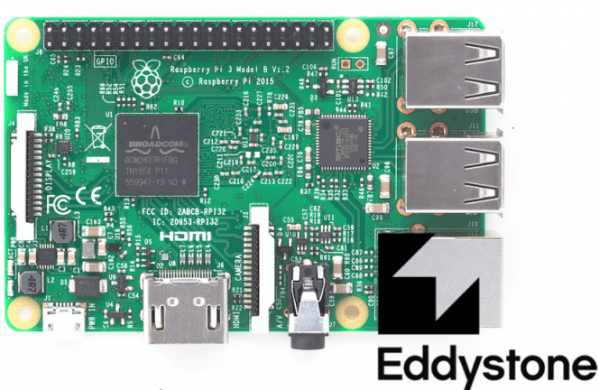
If you’re looking to target Google’s Eddystone on your RPi 3, [Yamir] has you covered. He’s put together a guide on setting up an Eddystone-URL beacon within Raspbian. This type of beacon just broadcasts a URL. Users within range will get a notification that the URL is available, and can navigate through to it. Eddystone-URL works on both iOS and Android.

The process for setting this up is pretty simple. The hciconfig and hcitool commands do all the work. [Yamir] was even nice enough to make a calculator tool that generates the hcitool command for your own URL. While is hack is a simple one, it’s a nice five-minute project. It’s also handy for broadcasting the URL of your Raspberry Pi if it’s running a web server as part of a more intricate hack.