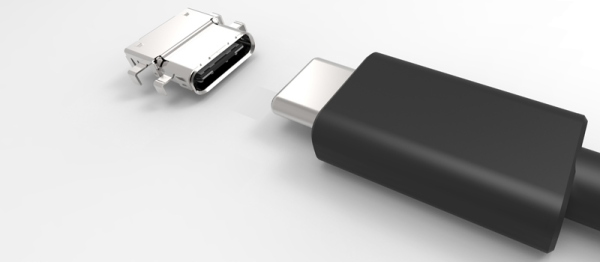
USB cables? What a pain. You can never find the right type of connector when you need one, or you can’t figure out which way is up when you plug the cable in. These problems could be a thing of the past, though, with the latest version of the venerable USB connection: USB Type C. This new standard uses a single style of plug for both ends, so you can use cables either way around. The plugs also work both ways up, so you can plug it in with your eyes closed. Let’s take a look at what the USB type C connector means.
Even before the announcement and introduction of the Raspberry Pi 3, word of a few very powerful single board ARM Linux computers was flowing out of China. The hardware was there – powerful 64-bit ARM chips were available, all that was needed was a few engineers to put these chips on a board, a few marketing people, and a contract manufacturer.
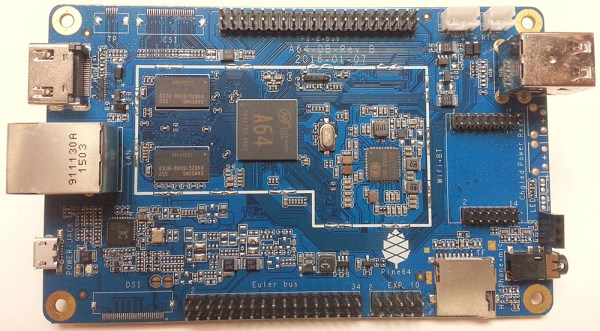
One of the first of these 64-bit boards is the Pine64. Introduced to the world through a Kickstarter that netted $1.7 Million USD from 36,000 backers, the Pine64 is already extremely popular. The boards are beginning to land on the doorsteps and mailboxes of backers, and the initial impressions are showing up in the official forums and Kickstarter campaign comments.
I pledged $15 USD to the Pine64 Kickstarter, and received a board with 512MB of RAM, 4K HDMI, 10/100 Ethernet and a 1.2 GHz ARM Cortex A53 CPU in return. This post is not a review, as I can’t fully document the Pine64 experience. My initial impression? This is bad. This is pretty bad.
Of all the horrors visited upon a warrior, being captured by the enemy might count as the worst. With death in combat, the suffering is over, but with internment in a POW camp, untold agonies may await. Tales of torture, starvation, enslavement and indoctrination attend the history of every nation’s prison camps to some degree, even in the recent past with the supposedly civilizing influence of the Hague and Geneva Conventions.
But even the most humanely treated POWs universally suffer from one thing: lack of information. To not know how the war is progressing in your absence is a form of torture in itself, and POWs do whatever they can to get information. Starting in World War II, imprisoned soldiers and sailors familiar with the new field of electronics began using whatever materials they could scrounge and the abundance of time available to them to hack together solutions to the fundamental question, “How goes the war?” This is the story of the life-saving radios some POWs managed to hack together under seemingly impossible conditions.
In the US, we don’t hear much about computing from beyond the Anglosphere. We’ve seen some home computer clones from behind the iron curtain, but getting any information about them is hard. If you find an old keyboard with a QWERTZ layout, or even a few Cyrillic characters, in the States, it’s a rarity. To date, the only French computer on Hackaday is an old Minitel dumb terminal. To help rectify this, [Jeremie Marsin], [Thierry Mazzoleni], and [Jean Paul Mari] from Quebec brought the best of the French computing revolution of the 1980s along to this year’s Vintage Computer Festival East
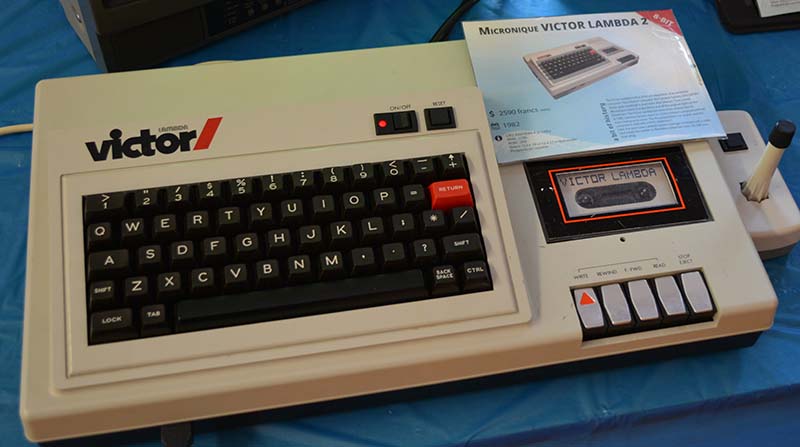
The American-designed French Victor
The evolution of the reigning champion of this exhibit begins with the Micronique Victor Lambda, a licensed copy of a purely American computer, the Interact Home Computer System. This computer featured a 2 MHz 8080A, 8 or 16 kB of RAM, and was quickly discontinued. The French company Micronique quickly bought the original designs and remarketed the computer in France.
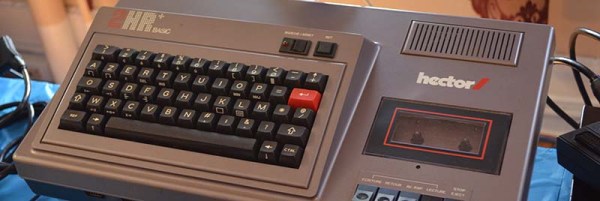
In a few short years, Micronique took this design and turned it into the Hector. This machine featured a 5 MHz Z80, 48 kB of RAM, high resolution graphics (243×231 at four colors) and included BASIC and Forth interpreters.
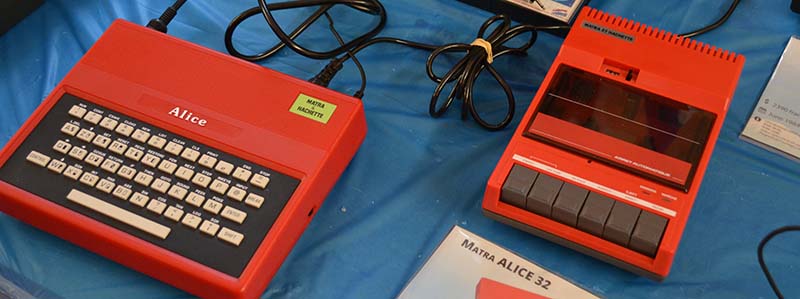
The Victor and Hector were the best home computers at the time, but for every Commodore or Apple, you need a ZX Spectrum. France’s version of this tiny computer with a terrible keyboard was the Matra Alice 32, a computer with a 1 MHz 6803, 16kB of Ram, and a real 80×25 text mode. The Alice is heavily based on the American TRS-80 MC-10, with a SCART connector and an AZERTY keyboard.
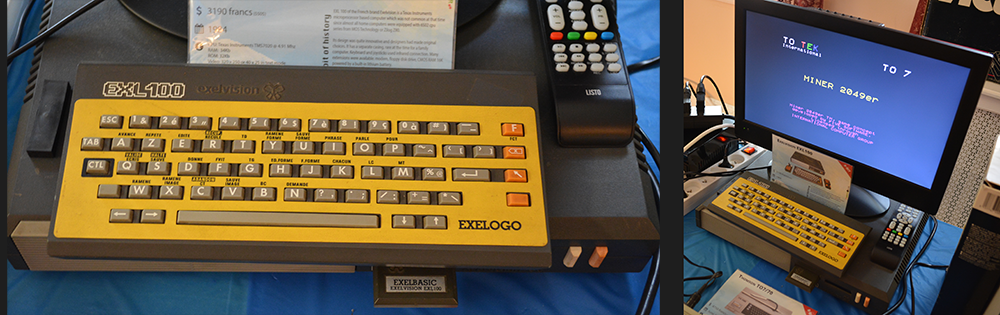
The weirdest computer [Jeremie], [Thierry], and [Jean Paul] brought out? That would be the Excelvision EXL100. The 1980s, for better or worse, were the times of the Z80 and 6502. The EXL100 was running something completely different. This home computer used a TMS7020 CPU from Texas Instruments, a speech synthesizer, and a wireless keyboard. Very strange for the time and relatively inexpensive; in 1984 this computer cost only ₣3190, or about $550 USD.
[Jeremie], [Thierry], and [Jean Paul] had an exhibit that presented the best the Francosphere had to offer to the computing world in the 80s and 90s. We haven’t seen enough early computers from outside the US, so we’re happy to have met these guys at the 11th annual Vintage Computer Festival East.
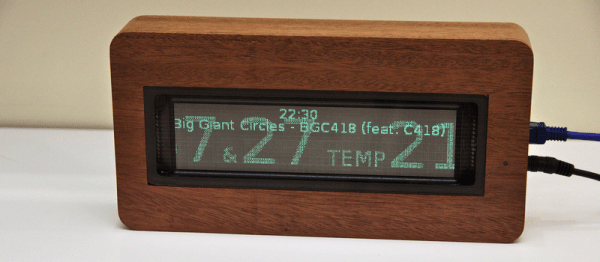
[Sprite_tm] picked up some used VFD displays for cheap, and wanted to make his own custom temperature and air-quality display. He did that, of course, but turned it into a colossal experiment in re-design to boot. What started out as a $6 used VFD becomes priceless with the addition of hours of high-powered hacking mojo.
You see, the phosphor screen had burnt-in spots where the old display was left static for too long. A normal person would either live with it or buy new displays. [Sprite_tm] ripped off the old display driver and drives the row and column shift registers using the DMA module on a Raspberry Pi2, coding up his own fast PWM/BCM hybrid scheme that can do greyscale.
He mapped out the individual pixels using a camera and post processing in The Gimp to establish the degradation of burnt-in pixels. He then re-wrote a previous custom driver project to compensate for the pixels’ inherent brightness in firmware. After all that work, he wrapped the whole thing up in a nice wooden frame.
There’s a lot to read, so just go hit up his website. High points include the shift-register-based driver transplant, the bit-angle modulation that was needed to get the necessary bit-depth for the grayscale, and the PHP script that does the photograph-based brightness correction.
Picking a favorite [Sprite_tm] hack is like picking a favorite ice-cream flavor: they’re all good. But his investigation into hard-drive controller chips still makes our head spin just a little bit. If you missed his talks about the Tamagotchi Singularity from the Hackaday SuperCon make sure you drop what you’re doing and watch it now.
It’s no secret that fossil fuels are quickly becoming extinct. As technology charges ever forward, they are disappearing faster and faster. Many of our current dependencies on fossil fuels are associated with high-energy applications like transportation. Since it’s unlikely that global transportation will ever be in decline for any reason other than fuel shortage itself, it’s imperative that we find something that can replicate the high energy density of fossil fuels. Either that, or go back to the drawing board and change the entire scope of global transportation.
Energy, especially solar and wind, cannot be created all over the world. Traditionally, energy is created in situ and shipped to other places that need it. The proposed solutions for zero-carbon energy carriers—batteries and hydrogen—all have their weaknesses. Batteries are a fairly safe option, but their energy density is pretty poor. Hydrogen’s energy density is higher, but its flammability makes it dangerously volatile to store and transport.
Recently, a group of researchers at McGill University in Canada released a paper exploring the use of metal powders as our zero-carbon fuel of the future. Although metal powders could potentially be used as primary energy sources, the transitory solution they propose is to use them as secondary sources powered by wind and solar primaries.
Look up ‘concrete lathe’ and you’ll quickly find yourself reading the works of [David Gingery]. His series of books on building a machine shop from scrap begin with a charcoal foundry, and quickly move to creating a metal lathe out of concrete. Before [Gingery]’s lathe, around the time of World War I, many factories created gigantic machine tools out of concrete. It’s an old idea, but you’ll be hard pressed to find anyone with a shop featuring concrete machine tools. Cheap lathes are plentiful on Craigslist, after all.
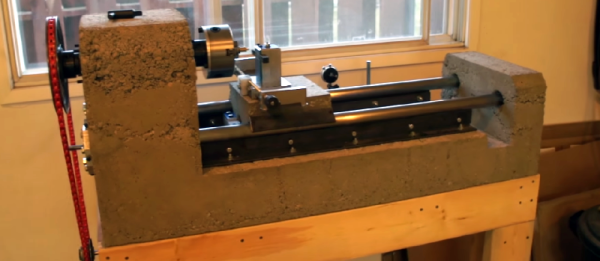
Building a metal lathe from concrete is more of a challenge. This challenge was recently taken up by [Curt Filipowski] in a five part YouTube series that resulted in a real, working lathe made out of concrete, scrap, and a lot of bolts.
The concrete lathe begins with a form, and for this [Curt] cut out all the parts on a CNC router. Creating the form isn’t quite as simple as you would think – the concrete form included several bolts that would alow [Curt] to bolt bearings, ways made out of gas pipe, and angle iron. This form was filled with concrete in [Curt]’s kitchen, and after a nice long cure, the lathe was moved up to the upstairs shop. That’s a five hundred pound block moved up a flight of stairs by a single person.
The rest of the build deals with the cast concrete carriage which rides along the polished gas pipe ways, a tool post holder milled out of a block of aluminum, and finally making some chips. While it’s not the most practical lathe – the carriage moves along the ways by turning a wheel underneath the tailstock – it does demonstrate a concrete lathe is possible.