Bring The Crane Game Home

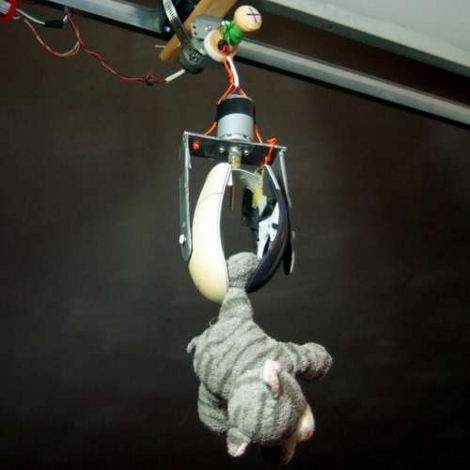
Everyone’s familiar with the quarter gobbling crane games. More often than not there’s a child nearby begging a parent for more quarters so they can try their hand at the toy-snatching claw. [Marc.Cryan] put his quarters to a better use by building a home version of the crane game.

[Marc] installed a gantry in an archway of his house.  The crane trolley rides on this gantry and uses a spool to raise or lower the tether for the claw. Winning copious style-points, he used the case of an old mouse to form the claw. An Arduino controls the different motors in the system and a toy was repurposed to act as the controller. As you can see after the break, it’s more fun than the cinema-lobby version of the game and your kids can play with it for free.
Continue reading “Bring The Crane Game Home”

Sukhoi Su-27 Jet Build Throws Down

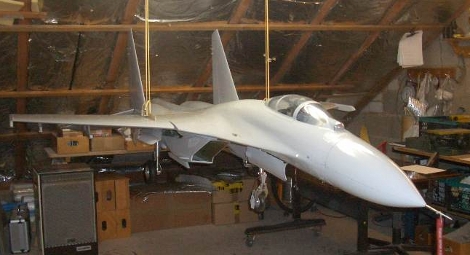
This no model, but a fully functioning RC jet. The Sukhoi Su-27 was the Soviet Union’s counterpart of the F15 and this 1/6.5 scaled version measures eleven feet long and is fully controllable. As if the 80-page build log wasn’t enough, the flight video after the break is nothing short of jaw-dropping. The test flights end in smooth landings but with all the time that went into the project that’s got to be nerve-wracking.

Continue reading “Sukhoi Su-27 Jet Build Throws Down”

The Mini-Markade

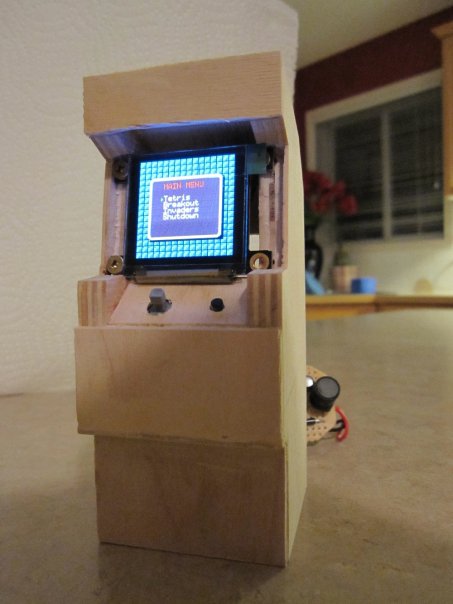
We love arcade games. Who doesn’t? We feel that the “arcade” feeling just can’t be replicated in any other form factor than an arcade cabinet. [Moslevin] must feel the same way too. He has built, what could possibly be the worlds smallest arcade cabinet. Aside from a coin mechanism, it is fully functional. It is an ATMega328p running his own custom software. The games he has available are Tetris, Invader, and Breakout, all coded by himself as well. We’ve seen small arcade cabinets before, but none this small.

Adding Words To Catch Phrase

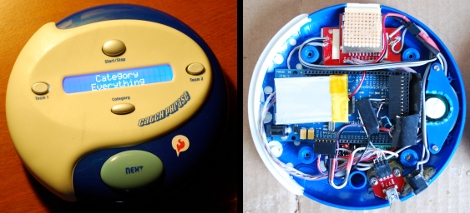
[Brandon Meyer] spared no expense in modding the Catch Phrase game to use custom word lists. The altered version of the game, normal sold for around $25, now comes in at a whopping $230! That’s because the internals were gutted and replaced with an Arduino, 20×2 LCD display, and some other interesting bits. The device now features an SD slot for storing your own lists and a USB port for programming.

At first glance we were hoping some simple EEPROM hacking had unlocked the secrets of the device but that wasn’t he case. We’d love to see some more economical versions of [Brandon’s] prototype. Perhaps reusing the original LCD, replacing the Arduino with the ATmega168 that makes up its core, and using a diy SD cradle for a card reader.

So yes, this version is a bit of overkill but still very nicely done!

[Thanks Zoidberg]

Hexacopter

[vimeo=http://vimeo.com/6194911]
Quad copters have been pretty popular for the last few years, but this one is new to us. Take the same basic layout, but bump it to 6 rotors. Then you’ll have the hexacopter (google translated). With 6 rotors, built in GPS and stabilization and a camera mounted on the bottom, this thing is pretty well equipped. You can see how agile and stable it is in the video above. We know it isn’t necessarily new, but it is new to us. Of course, you don’t have to stop at 6 rotors. You could always just continue on to 8.

HUD For Real Life Capture-the-flag

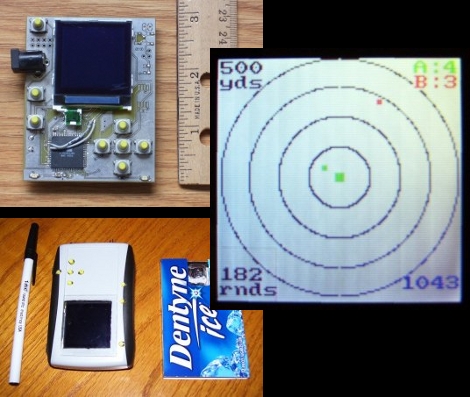
If you’ve played any of the Splinter Cell games you’ll remember the PDA that [Sam Fisher] carried around with him.  What if you could have one of your own when playing capture-the-flag? [Brad] has created the ZephyrEye as an electronic command and communications device for real-life games.

Each player carries around their own unit. The ZephyrEye has a GPS module, Xbee module, LCD screen, and control buttons. This allows a player to setup one of several different games, map out the game field including base locations and flag locations, and monitor a time limit and scoring. Other players can join the game in progress. The best part? The GPS modules report tracking to each handheld and act as radar for your team and the enemy team. We’ve got a couple of demo videos after the break.

Words can’t describe how delighted this would have made us back in the day. We don’t play outside with the other neighborhood kids anymore (insert dirty-old-man joke here) but that might change just because of this device. We may end up joining [Barney Stinson] for some amazingly awesome laser-tag games after all.

[Brad’s] posted hardware information and source code so that you can use to throw together a dozen or so units. We think the next version should incorporate a wearable display.

Continue reading “HUD For Real Life Capture-the-flag”

PicAxe LEGO Tank

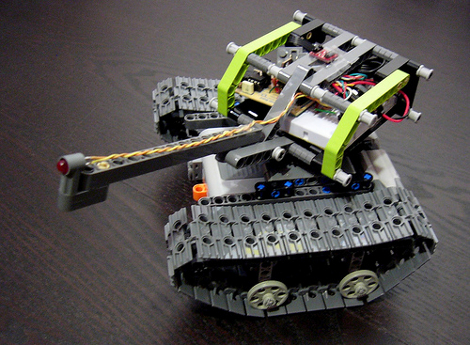
[TomTheGeek] built a LEGO tank with a PicAxe controller. Locomotion is supplied by a Lego Power Function motor controller. He cut an LPF extension wire in half so that he could patch into the PWM signals without altering the motors themselves. You can make out the control circuitry and a small breadboard in the tank’s turret. [Tom] added a laser pointer to the tip of the barrel but we’d like to see an IR LED. The tank is controlled by a infrared remote control and adding TV-b-gone functionality to the toy would create something of a Rube Goldberg feature for turning off the tube. But alas, there’s no programming space left for that as the PicAxe 08M is limited to 256 bytes.

There’s a video after the break of this little demon tracking its way around the room. This is a nice addition to the other LEGO tank we saw a while back.

Continue reading “PicAxe LEGO Tank”