How HP Calculators Communicate Over Infrared

For most people, calculators are cheap and simple devices used for little more than addition and the odd multiplication job. However, when you get into scientific and graphical calculators, the feature sets get a lot more interesting. For example, [Ready? Z80] has this excellent explainer on how HP’s older calculators handle infrared communications.

The video focuses on the HP 27S Scientific Calculator, which [Ready? Z80] found in an op-shop for just $5. Introduced in 1988, the HP-27S had the ability to dump screen data over an infrared link to a thermal printer to produce paper records of mundane high-school calculations or important engineering math. In the video, [Ready? Z80] explains the communication method with the aid of Hewlett-Packard’s own journal publication from October 1987, which lays out of the details of “the REDEYE Protocol.” Edgy stuff.

It’s pretty straightforward to understand, with the calculator sending out bursts of data in six to eight pulses at a time, modulated onto a 32.768 KHz square wave as is the norm. [Ready? Z80] then goes a step further, whipping up custom hardware to receive the signal and display the resulting data on a serial terminal. This is achieved with a TEC-1G single-board computer, based on the Z80 CPU, because that’s how [Ready? Z80] does things.

We’ve seen other great stuff from this channel before, too. For example, if you’ve ever wanted to multitask on the Z80, it’s entirely possible with the right techniques.

Continue reading “How HP Calculators Communicate Over Infrared”
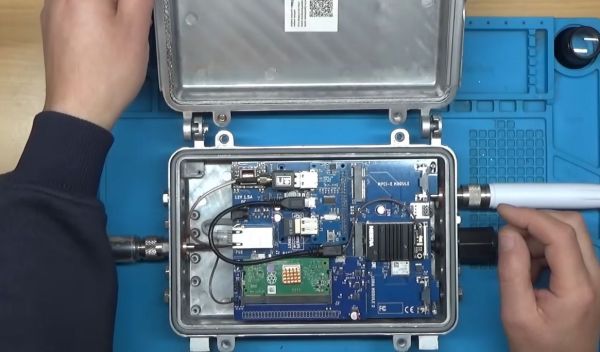
Converting A Nebra Cryptocurrency Miner To A Meshcore Repeater

After the swivel by Helium Inc. towards simply running distributed WiFi hotspots after for years pushing LoRaWAN nodes, much of the associated hardware became effectively obsolete. This led to quite a few of these Nebra LoRa Miners getting sold off, with the [Buy it Fix it] channel being one of those who sought to give these chunks of IP-67-rated computing hardware a new life.

Originally designed to be part of the Helium Network Token (HNT) cryptocurrency mining operation, with users getting rewarded by having these devices operating, they contain fairly off-the-shelf hardware. As can be glanced from e.g. the Sparkfun product page, it’s basically a Raspberry Pi Compute Module 3+ on a breakout board with a RAK 2287 LoRa module. The idea in the video was to convert it into a Meshcore repeater, which ought to be fairly straightforward, one might think.

Unfortunately the unit came with a dead eMMC chip on the compute module, the LoRa module wasn’t compatible with Meshcore, and the Nebra breakout board only covers the first 24 pins of the standard RPi header on its pin header.

Continue reading “Converting A Nebra Cryptocurrency Miner To A Meshcore Repeater”

Demonstrating The Sheer Lack Of Security In First Gen Cellular Networks

Modern cellular networks are built to serve millions upon millions of users, all while maintaining strict encryption across all communications. But earlier cellular networks were by no means so secure, as [Nostalgia for Simplicity] demonstrates in a recent video.

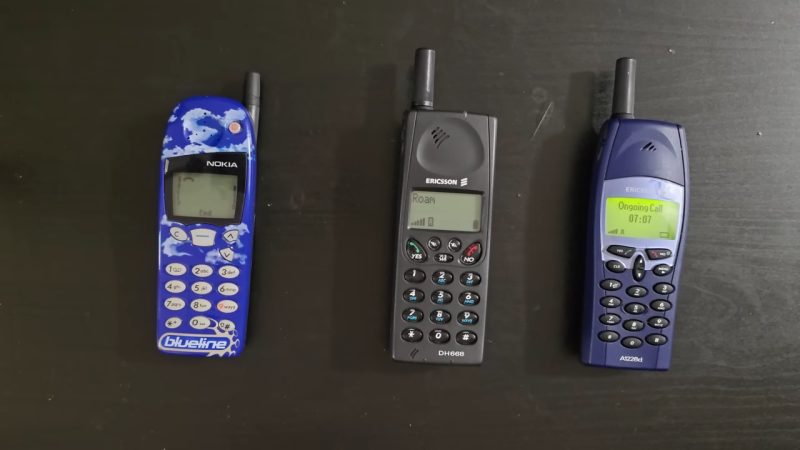
The video begins with an anecdote — our narrator remembers a family member who could listen in on other’s conversations on the analog AMPS phone network. This was easily achieved simply by entering a code that would put an Ericsson handset into a test mode, in which it could be switched to tune in any desired AMPS channel. Since the communications were transmitted in a purely analog manner, with no encryption of any sort, any conversation on such a network was basically entirely open for anyone to hear. The video shows a recreation of this method, using a software-defined radio to spin up a low-power, very local AMPS network. A phone call is carried out between two handsets, with a third handset able to listen in just by using the special test mode.

If you’re particularly keen to build your own first-generation AMPS phone network, just know that it’s not really allowed due to rules around spectrum allocations. Still, it’s entirely possible as we’ve covered before. It doesn’t even take much hardware in our modern SDR era.

Continue reading “Demonstrating The Sheer Lack Of Security In First Gen Cellular Networks”

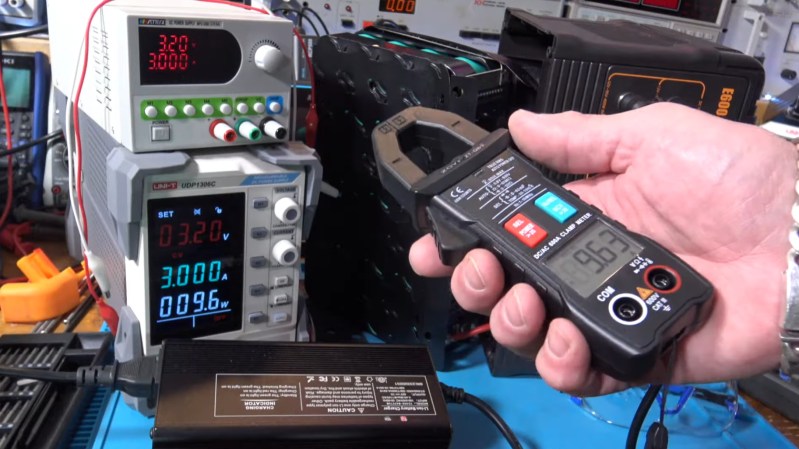
A hand holding the Zoyi ZT-QB9 Smart Clamp meter

Review And Demo Of The Zoyi ZT-QB9 Smart Clamp Meter

Over on YouTube [Kiss Analog] reviews the New Zoyi ZT-QB9 Smart Clamp meter.

If you’re putting together an electronics lab from scratch you absolutely must get a multimeter to start. A typical multimeter will be able to do current measurements but it will require you to break the circuit you’re measuring and interface it to your meter using its mechanical probes.

A good choice for your second, or third, multimeter is a clamp-based one. Many of the clamp meters have the clamp probe available for current measurements while still allowing you to use the standard 4mm banana jack probes for other measurements, particularly voltage and resistance.

If you’re curious to know more about how clamp meters work the answer is that they rely on some physics called the Hall Effect, as explained by the good people at Fluke.

In the video the following clamp meters are seen: Zoyi ZT-QB9, PROVA 11, and Hioki CM4375. If you’re in the market for a clamp meter you might also like to consider the EEVblog BM036 or a clamp meter from Fluke.

We have of course posted about clamp meters before. Check out Frnisi DMC-100: A Clamp Meter Worth Cracking Open or ESP32 Powers DIY Smart Energy Meter if you’d like to know more. Have your own trusty clamp meter? Don’t need no stinkin’ clamp meter? Let us know in the comments!

Continue reading “Review And Demo Of The Zoyi ZT-QB9 Smart Clamp Meter”

39C3: Liberating ESP32 Bluetooth

Bluetooth is everywhere, but it’s hard to inspect. Most of the magic is done inside a Bluetooth controller chip, accessed only through a controller-specific Host-Controller Interface (HCI) protocol, and almost everything your code does with Bluetooth passes through a binary library that speaks the right HCI dialect. Reverse engineering these libraries can get us a lot more control of and information about what’s going on over the radio link.

That’s [Anton]’s motivation and goal in this reversing and documentation project, which he describes for us in this great talk at this year’s Chaos Communication Congress. In the end, [Anton] gets enough transparency about the internal workings of the Bluetooth binaries to transmit and receive data. He stops short of writing his own BT stack, but suggests that it would be possible, but maybe more work than one person should undertake.

So what does this get us? Low-level control of the BT controller in a popular platform like the ESP32 that can do both classic and low-energy Bluetooth should help a lot with security research into Bluetooth in general. He figured out how to send arbitrary packets, for instance, which should allow someone to write a BT fuzzing tool. Unfortunately, there is a sequence ID that prevents his work from turning the controller into a fully promiscuous BT monitor, but still there’s a lot of new ground exposed here.

If any of this sounds interesting to you, you’ll find his write-up, register descriptions, and more in the GitHub repository. This isn’t a plug-and-play Bluetooth tool yet, but this is the kind of groundwork on a popular chip that we expect will enable future hacking, and we salute [Anton] for shining some light into one of the most ubiquitous and yet intransparent corners of everyday tech.

Old FM Radio Upcycled Into Classy Bluetooth Speaker

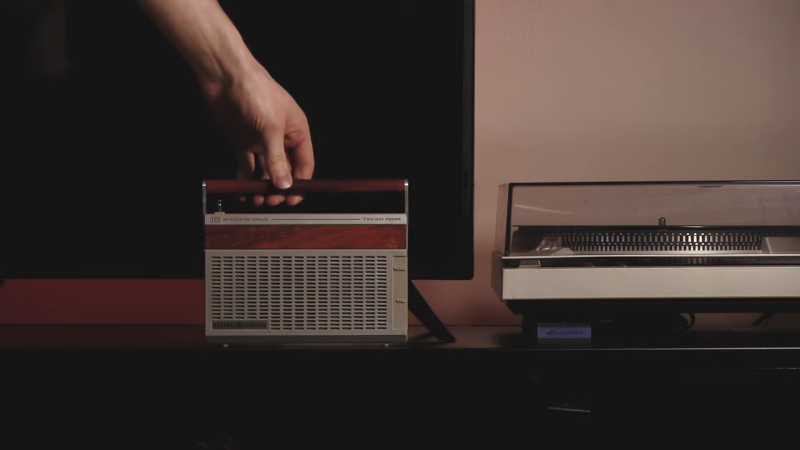
[Distracted by Design] loves gear from the 1980s, though some of it isn’t as useful as it used to be. He happened across a cheap old FM radio with a great look, but wanted to repurpose it into something more modern. Thus, he set about turning this cheap piece of old electronics into a stylish Bluetooth speaker.

All of the original electronics were stripped out, while the original speaker was kept since it neatly fit the case. Electronically, the build relies on a Bluetooth module harvested from an existing speaker. 3D-printed bracketry was used to fasten it neatly into place inside the radio housing, with the buttons neatly presented where the original radio had its tone and volume controls. Power is via an internal lithium-ion battery, charged over USB-C thanks to an off-the-shelf charging module.

Where the build really shines, though, is the detailing. The original cheap plastic handle was replaced with a CNC-machined wooden piece, bolted on with machined aluminium side plates. Similarly, the original clear plastic tuning window was replaced with another tasteful piece of wood that dropped perfectly into place. At the back, the charge port is nicely integrated. Where the radio formerly had a removable door for the power cable storage, it now has a machined aluminium plate hosting the USB-C charge port. Little 3D-printed button actuators were also used to integrate the Bluetooth module’s controls into the case.

It’s a very stylish build, overall. Perhaps the one area it’s a let down is in the sound quality. The ancient speaker simply doesn’t sound great compared to modern Bluetooth speakers and their finely-tuned, bassy audio. However, this isn’t necessarily a bad thing—sometimes it’s nice to have an audio source with a limited frequency response. It can be nice for use in an area where you may want to be able to easily speak over the music.

If you want to build a Bluetooth speaker of your own, you might like to whip up an open-source design from scratch. Video after the break.

Continue reading “Old FM Radio Upcycled Into Classy Bluetooth Speaker”

WiFi Menorah For Eight Nights Of Bandwidth

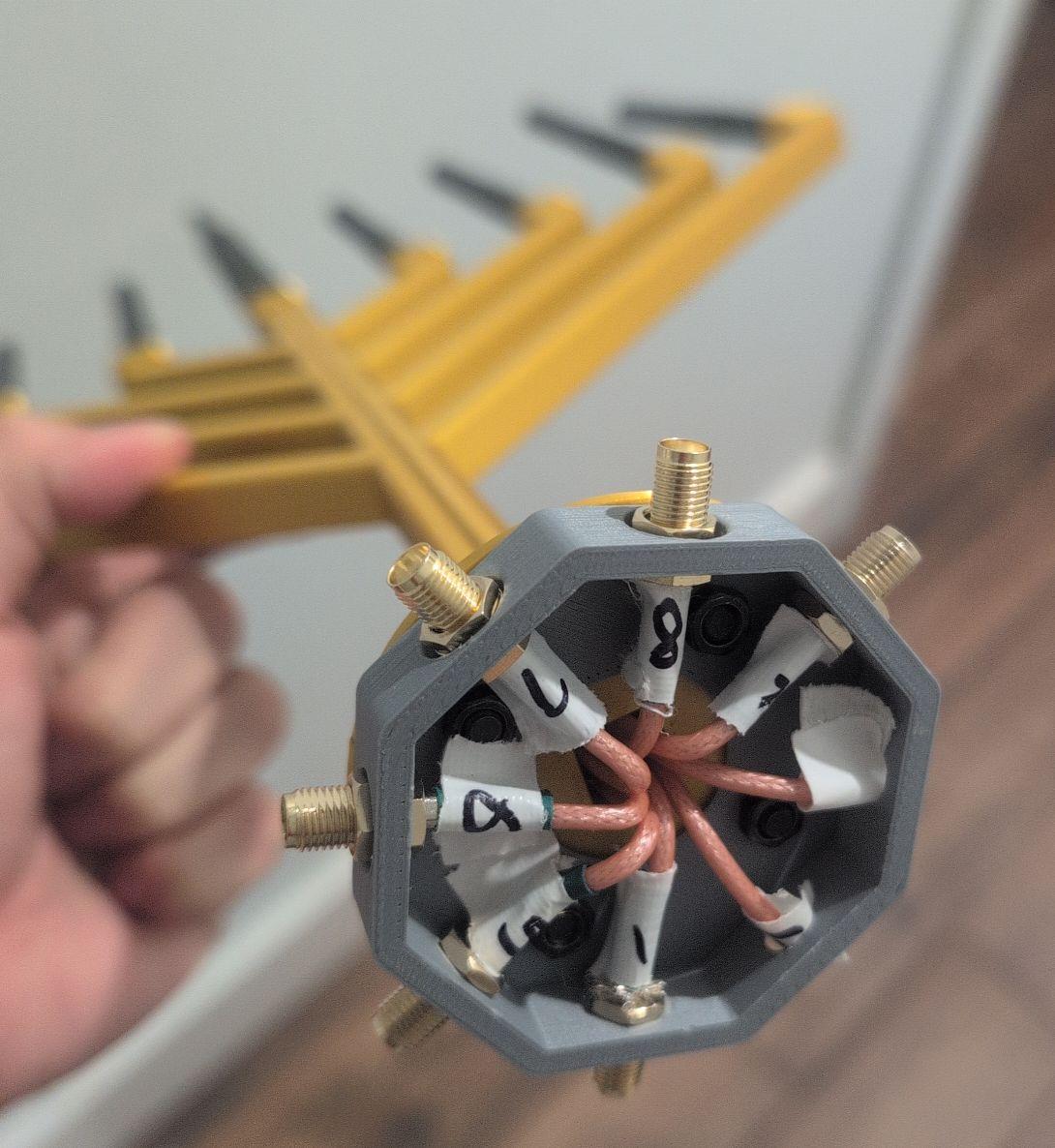
Hanukkah is upon us, and if that’s your jam [Brian] has you covered with this stylish WiFi menorah. While we can’t say if it’ll stretch your last gigabyte of connectivity into eight, it’s certainly going to provide awesome signal with all those antennae.

You could perhaps coax us to make one of these.

[Brian] was inspired by the enterprise version of the Hak5 “WiFi Pineapple”, a high-powered pentesting device. Seeing its plethora of antennae, he was struck with the idea of mounting them all onto a menorah, so he did. The menorah itself is 3D printed (of course) with lots of coax running through it down to the base, where presumably it would be connected to a Pineapple or high-powered router.

The project is presented as more of an art piece than a functional device, as there’s no evidence that [Brian] has actually hooked it up to anything yet. But consider the possibilities — along with the traditional candles, you could “light” one WiFi antenna each night, bringing the holiday glow to 2.4 GHz or 5 GHz. If you prefer more visible wavelengths, perhaps this LED menorah would be more to your tastes.

If you’ve got a hack for your culturally-relevant holiday festival, be it Christmas, Hanukkah, or Festivus, we’d love to see it. The tips line is open all year round.