Watch Bondo Putty Get Sprayed Onto 3D Prints

3D prints destined for presentation need smooth surfaces, and that usually means sanding. [Uncle Jessy] came across an idea he decided to try out for himself: spraying Bondo spot putty onto a 3D print. Bondo spot putty comes from a tube, cures quickly, and sands smoothly. It’s commonly used to hide defects and give 3D prints a great finish. Could spraying liquified Bondo putty onto a 3D print save time, or act as a cheat code for hiding layer lines? [Uncle Jessy] decided to find out.

Gaps and larger flaws still need to be filled by hand, but spray application seems to be a big time saver if nothing else.

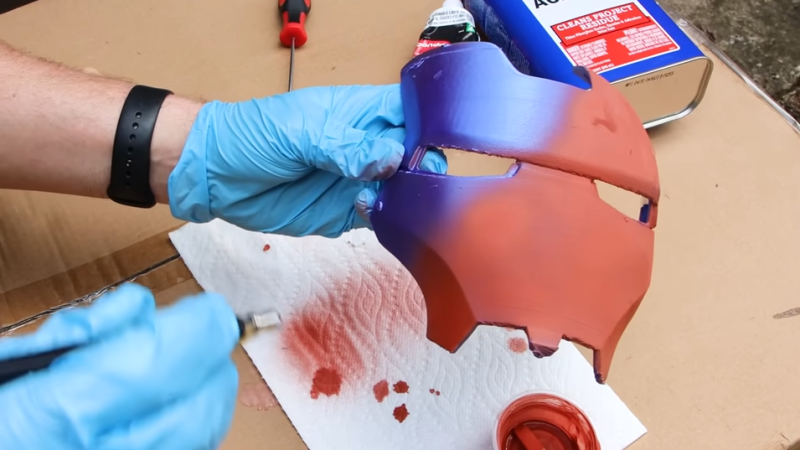
The first step is to turn the distinctive red putty into something that can be sprayed through a cheap, ten dollar airbrush. That part was as easy as squeezing putty into a cup and mixing in acetone in that-looks-about-right proportions. A little test spray showed everything working as expected, so [Uncle Jessy] used an iron man mask (smooth surfaces on the outside, textured inside) for a trial run.

Spraying the liquified Bondo putty looks about as easy as spraying paint. The distinctive red makes it easy to see coverage, and it cures very rapidly. It’s super easy to quickly give an object an even coating — even in textured and uneven spots — which is an advantage all on its own. To get a truly smooth surface one still needs to do some sanding, but the application itself looks super easy.

Is it worth doing? [Uncle Jessy] says it depends. First of all, aerosolizing Bondo requires attention to be paid to safety. There’s also a fair bit of setup involved (and a bit of mess) so it might not be worth the hassle for small pieces, but for larger objects it seems like a huge time saver. It certainly seems to cover layer lines nicely, but one is still left with a Bondo-coated object in the end that might require additional sanding, so it’s not necessarily a cheat code for a finished product.

If you think the procedure might be useful, check out the video (embedded below) for a walkthrough. Just remember to do it in a well-ventilated area and wear appropriate PPE.

An alternative to applying Bondo is brush application of UV resin, but we’ve also seen interesting results from non-planar ironing.

Continue reading “Watch Bondo Putty Get Sprayed Onto 3D Prints”

Run A Lawnmower On Diesel With Hot Bulb Hack

If you’re into automotive hacks and don’t watch [Robot Cantina], you are missing out. This hack has [Jimbo] taking a break from automotive hacking to butcher a poor, innocent Tecumseh lawnmower to run diesel fuel (or anything else) by converting the motor into a hot bulb engine. (Video embedded below.)

The secret is a long stack of anti-fouling adapters, which are essentially extension tubes that move the spark plug out of the combustion chamber to keep it from getting crudded up in an engine that’s burning too much oil. In this case, burning is what’s happening inside the anti-fouling adapters: by stacking seven of them, [Robot Cantina] is able to create a hot-bulb– volume that stays hot enough between strokes to induce spontaneous combustion of the fuel-air mix.

Hot-bulb engines were popular for certain tractors (the Lanz Bulldog being the most famous) and stationary engines from the late 19th century until Rudolf Diesel’s eponymous invention drove them out of their niche completely sometime after WWII.

Continue reading “Run A Lawnmower On Diesel With Hot Bulb Hack”

You Can Make Your Own Ribbon Mic With A Gum Wrapper

There are lots of different types of microphone, with the ribbon microphone being one of the rarer ones. Commercial versions are often prized for their tone and frequency response. You can make your own too, as [Something Physical] demonstrates using a packet of chewing gum.

Yes, the ribbon in this microphone was literally gained from Airwaves Extreme gum. It’s got nothing to do with freshness or the special mintiness quotient of the material, though; just that it’s a conductive foil and it makes the YouTube video more interesting to watch.

The gum wrapper is first soaked in hot water and then acetone, such that the paper backing can be removed. The foil is then corrugated with a tube press with some baking paper used for protection during this delicate process. The “motor” of the ribbon microphone is then produced out of plexiglass, copper tape, and a pair of powerful magnets. The ribbon is then stretched between the magnets and clamped in place, acting as the part of the microphone that will actually vibrate in response to sound. As it vibrates in the magnetic field, a current is generated in response to the sound. From there, it’s just a matter of hooking up a custom-wound transformer to the wires leading to the “motor” and it’s ready to test. It works off the bat, but there is some noise. Adding shielding over the transformer and a proper enclosure helps to make the microphone more fit for purpose.

If you’ve ever wanted to experiment with microphone construction, it’s hard to go past the joy of building a simple ribbon mic. You can experiment at will with different sizes and materials, too; you needn’t just limit yourself to different brands of gum!

We’ve featured some other great mic builds over the years, too. Video after the break.

Continue reading “You Can Make Your Own Ribbon Mic With A Gum Wrapper”

Hands-On: EufyMake E1 UV Printer

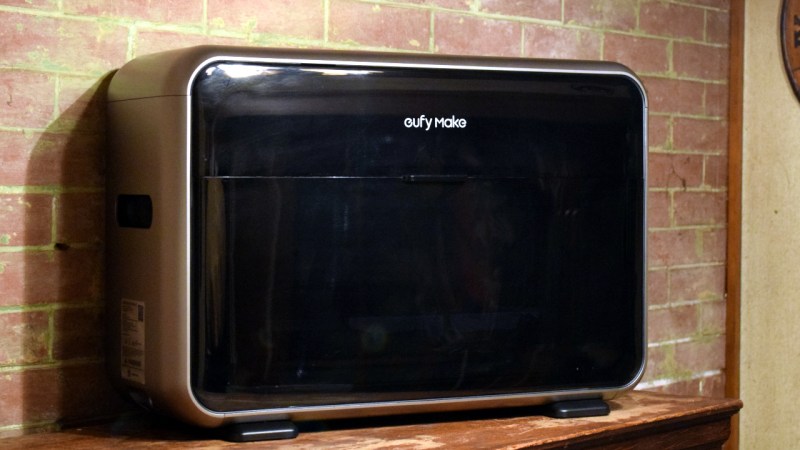
The modern hacker and maker has a truly incredible arsenal of tools at their disposal. High-tech tools like 3D printers, laser cutters, and CNC routers have all become commonplace, and combined with old standbys like the drill press and mini lathe, it sometimes seems like we’ve finally peaked in terms of what the individual is realistically capable of producing in their own home. But occasionally a new tool comes along, and it makes us realize that there are still avenues unexplored for the home gamer.

After spending the last few weeks playing with it, I can confidently say the eufyMake E1 UV printer is one of those tools. The elevator pitch is simple: with a UV printer, you can print anything on anything. As you can imagine, the reality is somewhat more complex, but the fact that you can toss a three dimensional object in the chamber and spray it with a high-resolution color image with a few button presses holds incredible creative potential. Enough that the Kickstarter for the $1,700 printer has already raised a mind-boggling $27 million at the time of this writing, with more than a month yet to go before crossing the finish line.

If you’re on the fence about backing the campaign, or just have doubts about whether or not the machine can do what eufyMake claims, I’ll put those concerns to rest right now — it’s the real deal. Even after using the machine for as long as I have, each time a print job ends, I find myself momentary taken aback by just how good the end result is. The technology inside this machine that not only makes these results possible, but makes them so easily obtainable, is truly revolutionary.

That being said, it’s not a perfect machine by any stretch of the imagination. While I never ran into an outright failure while using the eufyMake E1, there’s a fairly long list of issues which I’d like to see addressed. Some of them are simple tweaks which may well get sorted out before the product starts shipping this summer, while others are fundamental to the way the machine operates and could represent an opportunity for competitors.

Continue reading “Hands-On: EufyMake E1 UV Printer”

Blast Away The Flux — With Brake Cleaner?

Can you use brake cleaner for flux removal on PCBs? According to [Half Burnt Toast], yes you can. But should you? Well, that’s another matter.

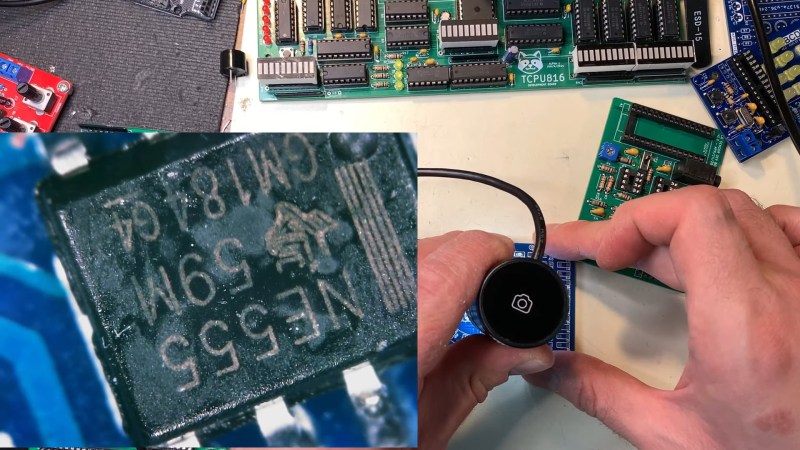
In our experience, flux removal seems to be far more difficult than it should be. We’ve seen plenty of examples of a tiny drop of isopropyl alcohol and a bit of light agitation with a cotton swab being more than enough to loosen up even the nastiest baked-on flux. If we do the same thing, all we get is a gummy mess embedded with cotton fibers smeared all over the board. We might be doing something wrong, or perhaps using the wrong flux, but every time we get those results, we have to admit toying with the idea of more extreme measures.

The LED bar graphs were not a fan of the brake cleaner.

[Toast] went there, busting out a fresh can of brake cleaner and hosing down some of the crustier examples in his collection. The heady dry-cleaner aroma of perchloroethylene was soon in the air, and the powerful solvent along with the high-pressure aerosol blast seemed to work wonders on flux. The board substrate, the resist layer, and the silkscreen all seemed unaffected by the solvent, and the components were left mostly intact; one LED bar graph display did a little melty, though.

So it works, but you might want to think twice about it. The chlorinated formula he used for these tests is pretty strong stuff, and isn’t even available in a lot of places. Ironically, the more environmentally friendly stuff seems like it would be even worse, loaded as it is with acetone and toluene. Whichever formula you choose, proceed with caution and use the appropriate PPE.

What even is flux, and what makes it so hard to clean? Making your own might provide some answers.

Continue reading “Blast Away The Flux — With Brake Cleaner?”

DIY Pipe Inspector Goes Where No Bot Has Gone Before

If you think your job sucks, be grateful you’re not this homebrew sewer inspection robot.

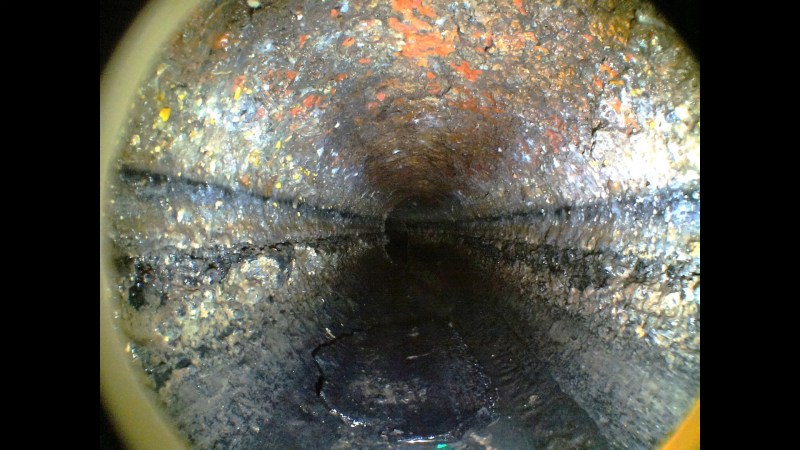
Before anyone gets upset, yes we know what [Stargate System] built here isn’t a robot at all; it’s more of a remotely operated vehicle. That doesn’t take away from the fact that this is a very cool build, especially since it has to work in one of the least hospitable and most unpleasant environments possible. The backstory of this project is that the sewer on a 50-year-old house kept backing up, and efforts to clear it only temporarily solved the problem. The cast iron lateral line was reconfigured at some point in its history to include a 120-degree bend, which left a blind spot for the camera used by a sewer inspection service. What’s worse, the bend was close to a joint where a line that once allowed gutters and foundation drains access to the sewer.

To better visualize the problem, [Stargate] turned to his experience building bots to whip up something for the job. The bot had to be able to fit into the pipe and short enough to make the turn, plus it needed to be — erm, waterproof. It also needed to carry a camera and a light, and to be powered and controlled from the other end of the line. Most of the body of the bot, including the hull and the driving gear, was 3D printed from ABS, which allowed the seams to be sealed with acetone later. The drive tracks were only added after the original wheels didn’t perform well in testing. Controlling the gear motors and camera was up to a Raspberry Pi Zero, chosen mostly due to space constraints. An Ethernet shield provided connectivity to the surface over a Cat5 cable, and a homebrew PoE system provided power.

As interesting as the construction details were, the real treat is the down-hole footage. It’s not too graphic, but the blockage is pretty gnarly. We also greatly appreciated the field-expedient chain flail [Stargate] whipped up to bust up the big chunks of yuck and get the pipe back in shape. He did a little bit of robo-spelunking, too, as you do.

And no, this isn’t the only sewer bot we’ve ever featured.

Continue reading “DIY Pipe Inspector Goes Where No Bot Has Gone Before”

Making A Split-Anode Magnetron

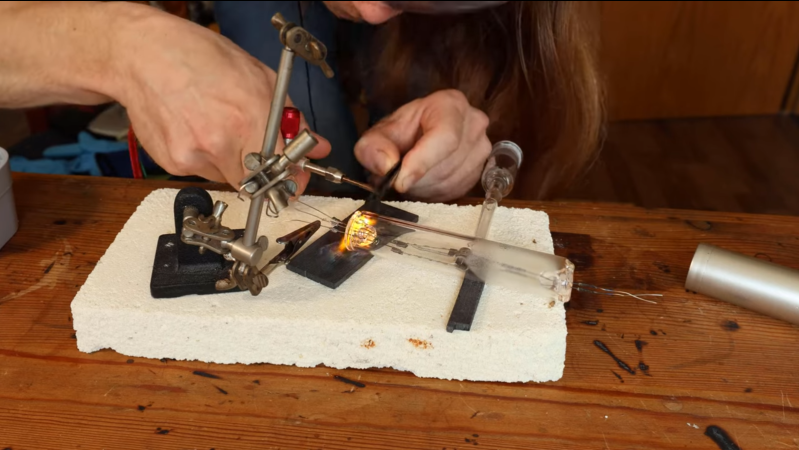
YouTuber The Science Furry has been attempting to make a split-anode magnetron and, after earlier failures, is having another crack at it. This also failed, but they’ve learned where to focus their efforts for the future, and it sure is fun to follow along.

The magnetron theory is simple enough, and we’ve covered this many times, but the split anode arrangement differs slightly from the microwave in your kitchen. The idea is to make a heated filament the cathode, so electrons are ejected from the hot surface by thermionic emission. These are forced into a spiral path using a perpendicular magnetic field. This is a result of the Lorentz force. A simple pair of magnets external to the tube is all that is needed for that. Depending on the diameter of the cavity and the gap width, a standing wave will be emitted. The anodes must be supplied with an alternating potential for this arrangement to work. This causes the electrons to ‘bunch up’ as they cross the gaps, producing the required RF oscillation. The split electrodes also allow an inductor to be added to tune the frequency of this standing wave. That is what makes this special.

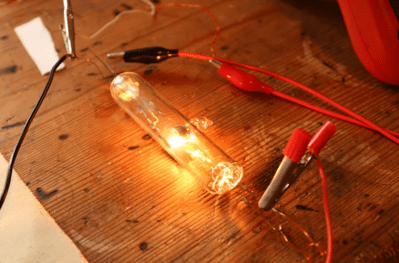
Fizz, pop, ah well.

The construction starts with pre-made end seals with the tungsten wire electrode wire passing through. In the first video, they attempted to coat the cathode with barium nitrate, but this flaked off, ruining the tube. The second attempt replaces the coiled filament with a straight wire and uses a coating paste made from Barium Carbonate mixed with nitrocellulose in a bit of acetone. When heated, the nitrocellulose and the carbonate will decompose, hopefully leaving the barium coating intact. After inserting the electrode assembly into a section of a test tube and welding on the ends, the vacuum could be pulled and sealed off. After preheating the cathode, some gasses will be emitted into the vacuum, which is then adsorbed into a nearby titanium wire getter. At least, that’s the theory.

Upon testing, this second version burned out early on for an unknown reason, so they tried again, this time with an uncoated cathode. Measuring the emission current showed only 50 uA, which is nowhere near enough, and making the filament this hot caused it to boil off and coat the tube! They decide that perhaps this is one step too many and need to experiment with the barium coating by making simpler diode tubes to get the hang of the process!

If this stuff is over your head, you need a quick history lesson about the magnetron. Next check out this teardown. Finally, we have covered DIY magnetrons before, like this excellent DIY magnetron-powered plasma sputtering device. Yes, you read that correctly.

Continue reading “Making A Split-Anode Magnetron”